Search job, employer or placeSearch cards/Check an Offer
SalaryNo.S-63729

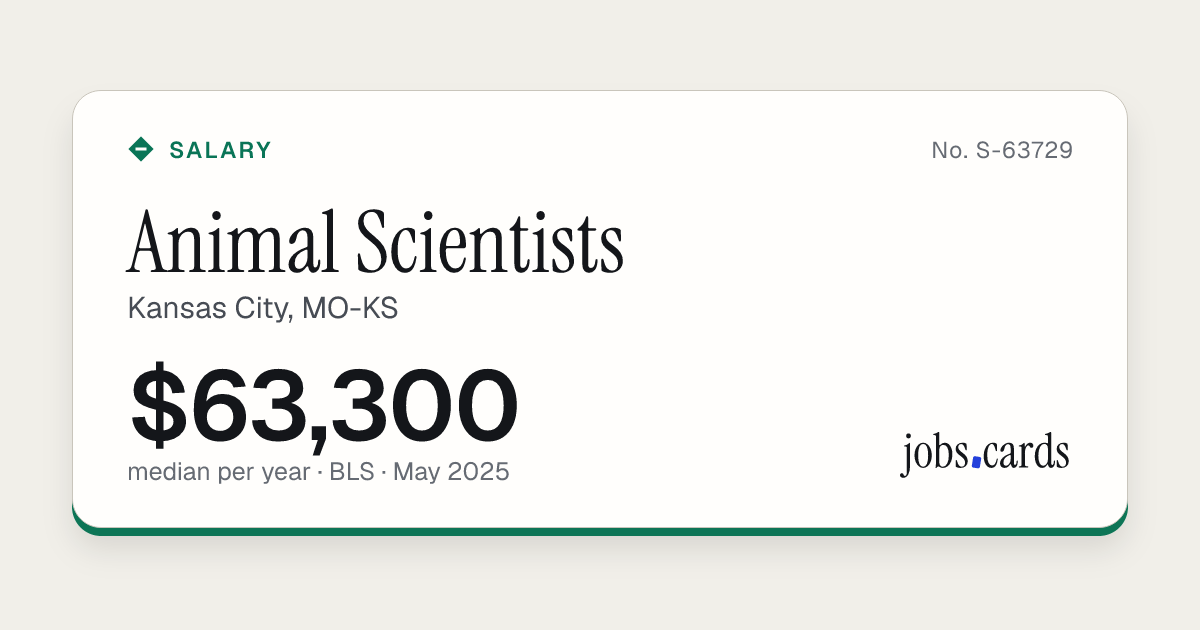
Animal Scientists

Kansas City, MO-KSGovernment job code 19-1011

Market pay · all workers · BLS, May 2025

$63,300median pay per year · $30.43 an hour
10th
$60,600
25th
$60,620
Median
$63,300
75th
$108,850
90th
$124,300

Small sample: BLS marks this estimate as less reliable, so treat the figures with care.

Government wage levels · wage year 2026-27

Level I
$57,138
Level II
$70,366
Level III
$83,574
Level IV
$96,803

The four pay levels the Department of Labor sets for this job in Kansas City, MO-KS. Yearly figures are the hourly level times 2,080 hours.

Filed pay

Fewer than 10 certified full-time filings for this job here, so there is no filed-pay figure.

Against the U.S. median
−8%
Mean pay per year
$83,710
Source: U.S. Bureau of Labor Statistics, May 2025 data · checked Nov 16, 2026
SourcesNo.S-63729

Where This Card Comes From

We show the government's numbers as published. Yearly pay is the hourly figure times 2,080 hours. Nothing is modelled or guessed. The U.S. comparison uses the national median for the same job code.

This page includes information from the O*NET 31.0 Database by the U.S. Department of Labor, Employment and Training Administration (USDOL/ETA). Used under the CC BY 4.0 license. O*NET® is a trademark of USDOL/ETA.

Content hash c953b83b · first dealt Nov 16, 2026 · last changed Nov 16, 2026
Save as Image Compare

jobs.cards/c/S-63729

What Does This Job Pay in Kansas City, MO-KS?

Animal Scientists in Kansas City, MO-KS earn a median of $63,300 a year, according to the U.S. Bureau of Labor Statistics survey for May 2025. Half earn between $60,620 and $108,850. The lowest-paid tenth earn under $60,600 and the highest-paid tenth earn over $124,300. These are government survey figures, not estimates from ads.

Checked Nov 16, 2026Source: U.S. Bureau of Labor Statistics

Reading the Numbers

Worked out from the published figures on this card. Nothing here is an estimate.

  • The median here is 8% below the national median of $68,940 for the same job.
  • The middle half of workers earn between $60,620 and $108,850, a band $48,230 wide.
  • Pay at the 90th percentile ($124,300) is 2.1 times pay at the 10th ($60,600).
  • The average (mean) is $83,710, 32% above the median. An average above the median means a smaller group of high earners pulls it up.
  • By the hour, the published median is $30.43.
  • The market median of $63,300 meets government wage Level I for this job and area (wage year 2026-27).

What Animal Scientists Do

Conduct research in the genetics, nutrition, reproduction, growth, and development of domestic farm animals.

Common job titles: Animal Nutrition Consultant, Animal Nutritionist, Animal Scientist, Beef Cattle Nutritionist, Beef Cattle Specialist, Companion Animal Nutritionist, Dairy Nutrition Consultant, Dairy Research Nutritionist, Research Scientist, Scientist.

What the Work Involves

The five tasks that workers and experts surveyed by O*NET rate most important for this job, most important first.

  • Study nutritional requirements of animals and nutritive values of animal feed materials.
  • Write up or orally communicate research findings to the scientific community, producers, and the public.
  • Develop improved practices in feeding, housing, sanitation, or parasite and disease control of animals.
  • Advise producers about improved products and techniques that could enhance their animal production efforts.
  • Conduct research concerning animal nutrition, breeding, or management to improve products or processes.

Education. 43% of workers surveyed by O*NET said the level required for this job is: Doctoral Degree.

Preparation This Job Usually Needs

Job Zone Five: Extensive Preparation Needed. Most of these occupations require graduate school. For example, they may require a master's degree, and some require a Ph.D., M.D., or J.D. (law degree). Employees may need some on-the-job training, but most of these occupations assume that the person will already have the required skills, knowledge, work-related experience, and/or training. Extensive skill, knowledge, and experience are needed for these occupations. Many require more than five years of experience. For example, surgeons must complete four years of college and an additional five to seven years of specialized medical training to be able to do their job.

This page includes information from the O*NET 31.0 Database by the U.S. Department of Labor, Employment and Training Administration (USDOL/ETA). Used under the CC BY 4.0 license. O*NET® is a trademark of USDOL/ETA.

Embed This Card

Paste this where you want the card to appear. It stays up to date.