Search job, employer or placeSearch cards/Check an Offer
SalaryNo.S-15276

Audiologists

South DakotaGovernment job code 29-1181

Market pay · all workers · BLS, May 2025

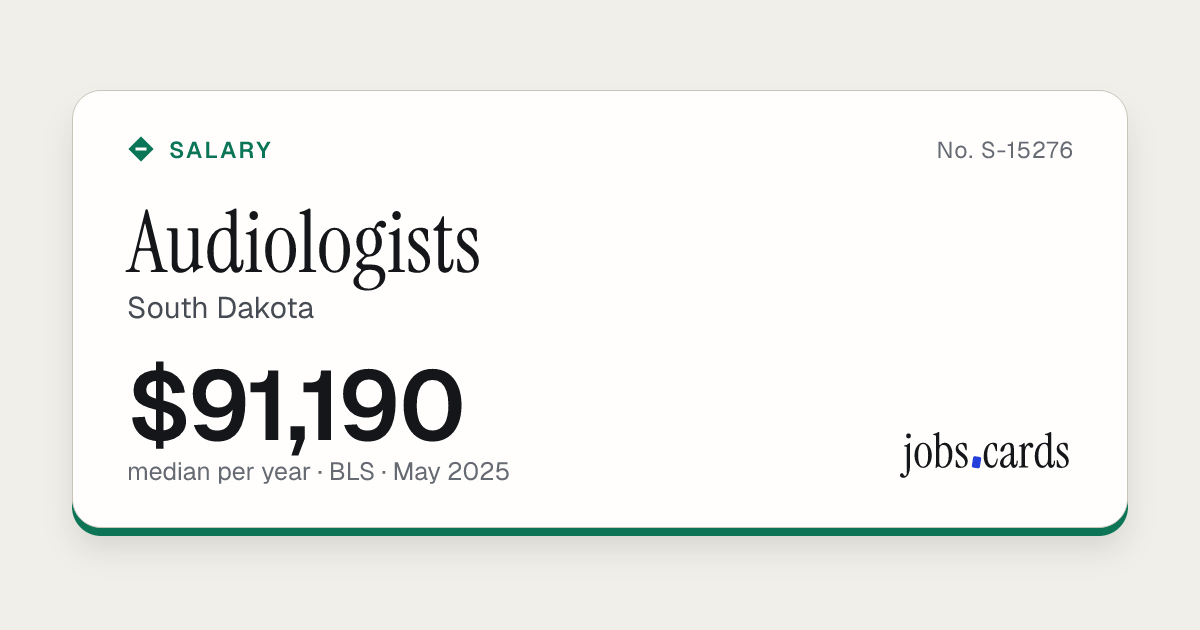
$91,190median pay per year · $43.84 an hour
10th
$77,860
25th
$83,320
Median
$91,190
75th
$106,110
90th
$108,950

Small sample: BLS marks this estimate as less reliable, so treat the figures with care.

Government wage levels

Wage levels are set for each local area. Open a metro card for this job to see them.

Filed pay

Fewer than 10 certified full-time filings for this job here, so there is no filed-pay figure.

People in this job here
40
Against the U.S. median
−5%
Mean pay per year
$92,960
Source: U.S. Bureau of Labor Statistics, May 2025 data · checked Nov 16, 2026
SourcesNo.S-15276

Where This Card Comes From

We show the government's numbers as published. Yearly pay is the hourly figure times 2,080 hours. Nothing is modelled or guessed. The U.S. comparison uses the national median for the same job code.

This page includes information from the O*NET 31.0 Database by the U.S. Department of Labor, Employment and Training Administration (USDOL/ETA). Used under the CC BY 4.0 license. O*NET® is a trademark of USDOL/ETA.

Content hash 93b76a9d · first dealt Nov 16, 2026 · last changed Nov 16, 2026
Save as Image Compare

jobs.cards/c/S-15276

What Does This Job Pay in South Dakota?

Audiologists in South Dakota earn a median of $91,190 a year, according to the U.S. Bureau of Labor Statistics survey for May 2025. Half earn between $83,320 and $106,110. The lowest-paid tenth earn under $77,860 and the highest-paid tenth earn over $108,950. These are government survey figures, not estimates from ads.

Checked Nov 16, 2026Source: U.S. Bureau of Labor Statistics

Reading the Numbers

Worked out from the published figures on this card. Nothing here is an estimate.

  • The median here is 5% below the national median of $95,780 for the same job.
  • 40 people hold this job here, 0.3% of the 13,660 who hold it across the country.
  • Of every 1,000 jobs here, 0.081 are this job, which makes it 7% less common here than in the U.S. as a whole.
  • The middle half of workers earn between $83,320 and $106,110, a band $22,790 wide.
  • Pay at the 90th percentile ($108,950) is 1.4 times pay at the 10th ($77,860).
  • The average (mean) is $92,960, within 3% of the median, so pay is spread fairly evenly around the middle.
  • By the hour, the published median is $43.84.

What Audiologists Do

Assess and treat persons with hearing and related disorders. May fit hearing aids and provide auditory training. May perform research related to hearing problems.

Common job titles: Audiologist, Audiology Doctor (AUD), Certificate of Clinical Competence in Audiology Licensed Audiologist (CCC-A Licensed Audiologist), Clinical Audiologist, Dispensing Audiologist, Educational Audiologist, Forensic Audiologist, Industrial Audiologist, Pediatric Audiologist, Staff Audiologist.

What the Work Involves

The five tasks that workers and experts surveyed by O*NET rate most important for this job, most important first.

  • Maintain patient records at all stages, including initial and subsequent evaluation and treatment activities.
  • Evaluate hearing and balance disorders to determine diagnoses and courses of treatment.
  • Fit, dispense, and repair assistive devices, such as hearing aids.
  • Administer hearing tests and examine patients to collect information on type and degree of impairment, using specialized instruments and electronic equipment.
  • Monitor patients' progress and provide ongoing observation of hearing or balance status.

Education. 95% of workers surveyed by O*NET said the level required for this job is: Doctoral Degree.

Preparation This Job Usually Needs

Job Zone Five: Extensive Preparation Needed. Most of these occupations require graduate school. For example, they may require a master's degree, and some require a Ph.D., M.D., or J.D. (law degree). Employees may need some on-the-job training, but most of these occupations assume that the person will already have the required skills, knowledge, work-related experience, and/or training. Extensive skill, knowledge, and experience are needed for these occupations. Many require more than five years of experience. For example, surgeons must complete four years of college and an additional five to seven years of specialized medical training to be able to do their job.

This page includes information from the O*NET 31.0 Database by the U.S. Department of Labor, Employment and Training Administration (USDOL/ETA). Used under the CC BY 4.0 license. O*NET® is a trademark of USDOL/ETA.

Embed This Card

Paste this where you want the card to appear. It stays up to date.