Search job, employer or placeSearch cards/Check an Offer
SalaryNo.S-149168

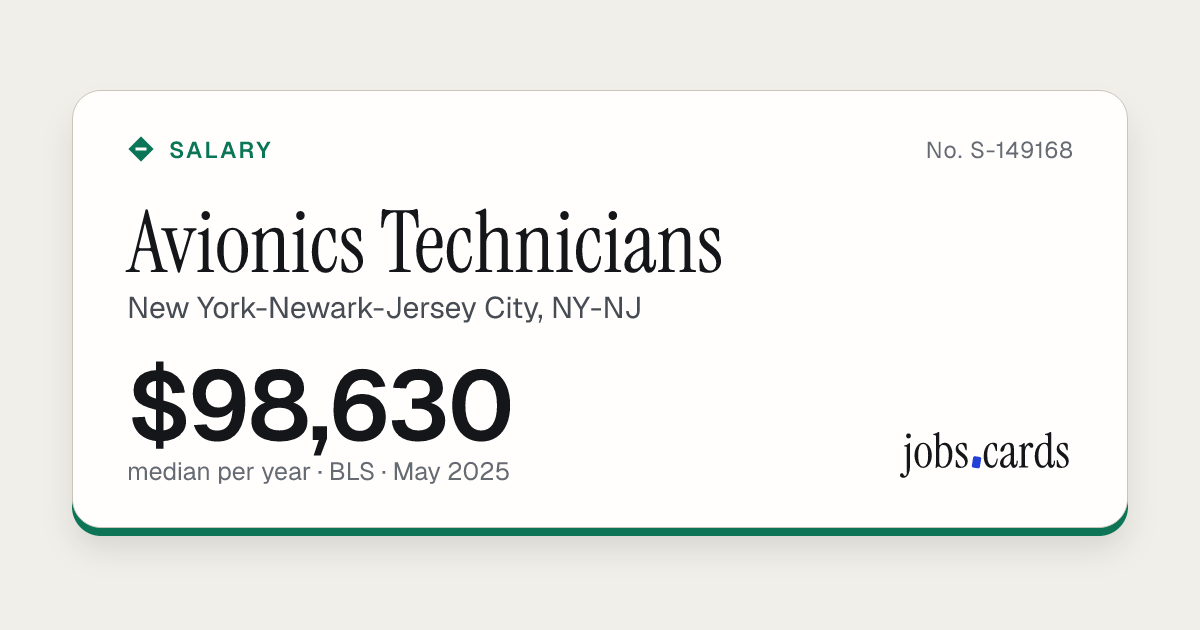
Avionics Technicians

New York-Newark-Jersey City, NY-NJGovernment job code 49-2091

Market pay · all workers · BLS, May 2025

$98,630median pay per year · $47.42 an hour
10th
$43,940
25th
$79,530
Median
$98,630
75th
$107,930
90th
$130,680

Government wage levels · wage year 2026-27

Level I
$57,866
Level II
$74,339
Level III
$90,834
Level IV
$107,307

The four pay levels the Department of Labor sets for this job in New York-Newark-Jersey City, NY-NJ. Yearly figures are the hourly level times 2,080 hours.

Filed pay

Fewer than 10 certified full-time filings for this job here, so there is no filed-pay figure.

People in this job here
300
Against the U.S. median
+20%
Mean pay per year
$90,990
Source: U.S. Bureau of Labor Statistics, May 2025 data · checked Nov 16, 2026
SourcesNo.S-149168

Where This Card Comes From

We show the government's numbers as published. Yearly pay is the hourly figure times 2,080 hours. Nothing is modelled or guessed. The U.S. comparison uses the national median for the same job code.

This page includes information from the O*NET 31.0 Database by the U.S. Department of Labor, Employment and Training Administration (USDOL/ETA). Used under the CC BY 4.0 license. O*NET® is a trademark of USDOL/ETA.

Content hash 2a7c23f9 · first dealt Nov 16, 2026 · last changed Nov 16, 2026
Save as Image Compare

jobs.cards/c/S-149168

What Does This Job Pay in New York-Newark-Jersey City, NY-NJ?

Avionics Technicians in New York-Newark-Jersey City, NY-NJ earn a median of $98,630 a year, according to the U.S. Bureau of Labor Statistics survey for May 2025. Half earn between $79,530 and $107,930. The lowest-paid tenth earn under $43,940 and the highest-paid tenth earn over $130,680. These are government survey figures, not estimates from ads.

Checked Nov 16, 2026Source: U.S. Bureau of Labor Statistics

Reading the Numbers

Worked out from the published figures on this card. Nothing here is an estimate.

  • The median here is 20% above the national median of $82,280 for the same job.
  • It is 19% above the New York median of $83,150.
  • 300 people hold this job here, 1.6% of the 18,830 who hold it across the country.
  • Of every 1,000 jobs here, 0.031 are this job, which makes it 74% less common here than in the U.S. as a whole.
  • The middle half of workers earn between $79,530 and $107,930, a band $28,400 wide.
  • Pay at the 90th percentile ($130,680) is 3.0 times pay at the 10th ($43,940).
  • The average (mean) is $90,990, 8% below the median, so more of the spread lies on the low side.
  • By the hour, the published median is $47.42.
  • The market median of $98,630 meets government wage Level III for this job and area (wage year 2026-27).

New York requires pay or a pay range in job ads from covered employers. What New York’s rule says

What Avionics Technicians Do

Install, inspect, test, adjust, or repair avionics equipment, such as radar, radio, navigation, and missile control systems in aircraft or space vehicles.

Common job titles: Aircraft Electrical Systems Specialist, Aircraft Technician (Aircraft Tech), Aviation Electrical Technician (Aviation Electrical Tech), Aviation Electronics Technician (Aviation Electronics Tech), Avionic Technician (Avionic Tech), Avionics Electrical Technician (AET), Avionics Electronics Technician (Avionics Electronics Tech), Avionics Installer, Avionics Line Technician (Avionics Line Tech), Avionics Repair Technician (Avionics Repair Tech).

What the Work Involves

The five tasks that workers and experts surveyed by O*NET rate most important for this job, most important first.

  • Adjust, repair, or replace malfunctioning components or assemblies, using hand tools or soldering irons.
  • Lay out installation of aircraft assemblies and systems, following documentation such as blueprints, manuals, and wiring diagrams.
  • Test and troubleshoot instruments, components, and assemblies, using circuit testers, oscilloscopes, or voltmeters.
  • Keep records of maintenance and repair work.
  • Connect components to assemblies such as radio systems, instruments, magnetos, inverters, and in-flight refueling systems, using hand tools and soldering irons.

Education. 50% of workers surveyed by O*NET said the level required for this job is: Post-Secondary Certificate.

Preparation This Job Usually Needs

Job Zone Three: Medium Preparation Needed. Most occupations in this zone require training in vocational schools, related on-the-job experience, or an associate's degree. Employees in these occupations usually need one or two years of training involving both on-the-job experience and informal training with experienced workers. A recognized apprenticeship program may be associated with these occupations. Previous work-related skill, knowledge, or experience is required for these occupations. For example, an electrician must have completed three or four years of apprenticeship or several years of vocational training, and often must have passed a licensing exam, in order to perform the job.

This page includes information from the O*NET 31.0 Database by the U.S. Department of Labor, Employment and Training Administration (USDOL/ETA). Used under the CC BY 4.0 license. O*NET® is a trademark of USDOL/ETA.

Embed This Card

Paste this where you want the card to appear. It stays up to date.