Search job, employer or placeSearch cards/Check an Offer
SalaryNo.S-95019

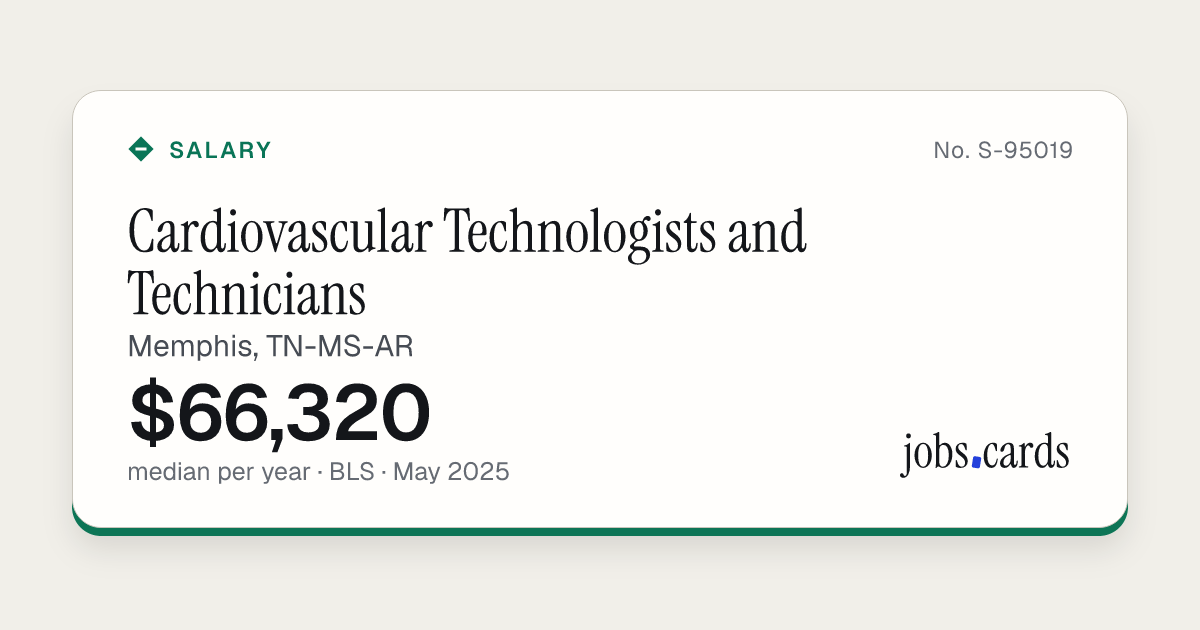
Cardiovascular Technologists and Technicians

Memphis, TN-MS-ARGovernment job code 29-2031

Market pay · all workers · BLS, May 2025

$66,320median pay per year · $31.88 an hour
10th
$39,410
25th
$40,020
Median
$66,320
75th
$81,330
90th
$97,520

Small sample: BLS marks this estimate as less reliable, so treat the figures with care.

Government wage levels · wage year 2026-27

Level I
$39,499
Level II
$52,000
Level III
$64,522
Level IV
$77,022

The four pay levels the Department of Labor sets for this job in Memphis, TN-MS-AR. Yearly figures are the hourly level times 2,080 hours.

Filed pay

Fewer than 10 certified full-time filings for this job here, so there is no filed-pay figure.

People in this job here
220
Against the U.S. median
−11%
Mean pay per year
$64,630
Source: U.S. Bureau of Labor Statistics, May 2025 data · checked Nov 16, 2026
SourcesNo.S-95019

Where This Card Comes From

We show the government's numbers as published. Yearly pay is the hourly figure times 2,080 hours. Nothing is modelled or guessed. The U.S. comparison uses the national median for the same job code.

This page includes information from the O*NET 31.0 Database by the U.S. Department of Labor, Employment and Training Administration (USDOL/ETA). Used under the CC BY 4.0 license. O*NET® is a trademark of USDOL/ETA.

Content hash fb478463 · first dealt Nov 16, 2026 · last changed Nov 16, 2026
Save as Image Compare

jobs.cards/c/S-95019

What Does This Job Pay in Memphis, TN-MS-AR?

Cardiovascular Technologists and Technicians in Memphis, TN-MS-AR earn a median of $66,320 a year, according to the U.S. Bureau of Labor Statistics survey for May 2025. Half earn between $40,020 and $81,330. The lowest-paid tenth earn under $39,410 and the highest-paid tenth earn over $97,520. These are government survey figures, not estimates from ads.

Checked Nov 16, 2026Source: U.S. Bureau of Labor Statistics

Reading the Numbers

Worked out from the published figures on this card. Nothing here is an estimate.

  • The median here is 11% below the national median of $74,310 for the same job.
  • It is 13% below the Tennessee median of $76,650.
  • 220 people hold this job here, 0.3% of the 62,960 who hold it across the country.
  • Of every 1,000 jobs here, 0.35 are this job, which makes it 12% less common here than in the U.S. as a whole.
  • The middle half of workers earn between $40,020 and $81,330, a band $41,310 wide.
  • Pay at the 90th percentile ($97,520) is 2.5 times pay at the 10th ($39,410).
  • The average (mean) is $64,630, 3% below the median, so more of the spread lies on the low side.
  • By the hour, the published median is $31.88.
  • The market median of $66,320 meets government wage Level III for this job and area (wage year 2026-27).

What Cardiovascular Technologists and Technicians Do

Conduct tests on pulmonary or cardiovascular systems of patients for diagnostic, therapeutic, or research purposes. May conduct or assist in electrocardiograms, cardiac catheterizations, pulmonary functions, lung capacity, and similar tests.

Common job titles: Cardiac Cath Lab Technologist (Cardiac Catheterization Laboratory Technologist), Cardiac Catheterization Technician, Cardiac Technician, Cardio Tech (Cardiovascular Technician), Cardiology Technician, Cardiopulmonary Technician, Cardiovascular Technologist (CVT), Electrocardiogram Technician (EKG Tech), Registered Cardiovascular Invasive Specialist (RCIS).

What the Work Involves

The five tasks that workers and experts surveyed by O*NET rate most important for this job, most important first.

  • Conduct electrocardiogram (EKG), phonocardiogram, echocardiogram, stress testing, or other cardiovascular tests to record patients' cardiac activity, using specialized electronic test equipment, recording devices, or laboratory instruments.
  • Compare measurements of heart wall thickness and chamber sizes to standard norms to identify abnormalities.
  • Explain testing procedures to patients to obtain cooperation and reduce anxiety.
  • Maintain a proper sterile field during surgical procedures.
  • Observe ultrasound display screen and listen to signals to record vascular information, such as blood pressure, limb volume changes, oxygen saturation, or cerebral circulation.

Education. 63% of workers surveyed by O*NET said the level required for this job is: Associate's Degree or other 2-year degree.

Preparation This Job Usually Needs

Job Zone Three: Medium Preparation Needed. Most occupations in this zone require training in vocational schools, related on-the-job experience, or an associate's degree. Employees in these occupations usually need one or two years of training involving both on-the-job experience and informal training with experienced workers. A recognized apprenticeship program may be associated with these occupations. Previous work-related skill, knowledge, or experience is required for these occupations. For example, an electrician must have completed three or four years of apprenticeship or several years of vocational training, and often must have passed a licensing exam, in order to perform the job.

This page includes information from the O*NET 31.0 Database by the U.S. Department of Labor, Employment and Training Administration (USDOL/ETA). Used under the CC BY 4.0 license. O*NET® is a trademark of USDOL/ETA.

Embed This Card

Paste this where you want the card to appear. It stays up to date.