Search job, employer or placeSearch cards/Check an Offer
SalaryNo.S-76588

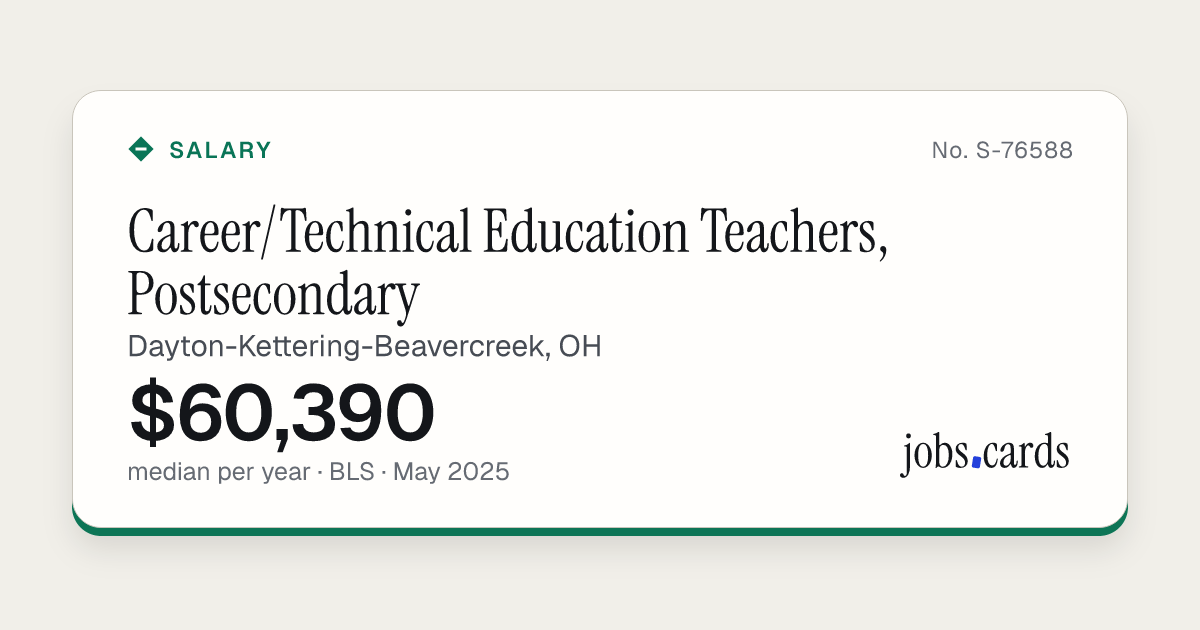
Career/Technical Education Teachers, Postsecondary

Dayton-Kettering-Beavercreek, OHGovernment job code 25-1194

Market pay · all workers · BLS, May 2025

$60,390median pay per year · $29.04 an hour
10th
$45,750
25th
$46,990
Median
$60,390
75th
$76,460
90th
$96,860

Government wage levels · wage year 2026-27

Level I
$44,158
Level II
$55,162
Level III
$66,144
Level IV
$77,147

The four pay levels the Department of Labor sets for this job in Dayton-Kettering-Beavercreek, OH. Yearly figures are the hourly level times 2,080 hours.

Filed pay

Fewer than 10 certified full-time filings for this job here, so there is no filed-pay figure.

People in this job here
350
Against the U.S. median
−5%
Mean pay per year
$66,260
Source: U.S. Bureau of Labor Statistics, May 2025 data · checked Nov 16, 2026
SourcesNo.S-76588

Where This Card Comes From

We show the government's numbers as published. Yearly pay is the hourly figure times 2,080 hours. Nothing is modelled or guessed. The U.S. comparison uses the national median for the same job code.

This page includes information from the O*NET 31.0 Database by the U.S. Department of Labor, Employment and Training Administration (USDOL/ETA). Used under the CC BY 4.0 license. O*NET® is a trademark of USDOL/ETA.

Content hash d3a32bd6 · first dealt Nov 16, 2026 · last changed Nov 16, 2026
Save as Image Compare

jobs.cards/c/S-76588

What Does This Job Pay in Dayton-Kettering-Beavercreek, OH?

Career/Technical Education Teachers, Postsecondary in Dayton-Kettering-Beavercreek, OH earn a median of $60,390 a year, according to the U.S. Bureau of Labor Statistics survey for May 2025. Half earn between $46,990 and $76,460. The lowest-paid tenth earn under $45,750 and the highest-paid tenth earn over $96,860. These are government survey figures, not estimates from ads.

Checked Nov 16, 2026Source: U.S. Bureau of Labor Statistics

Reading the Numbers

Worked out from the published figures on this card. Nothing here is an estimate.

  • The median here is 5% below the national median of $63,820 for the same job.
  • It is about the same as the Ohio median of $60,600.
  • 350 people hold this job here, 0.3% of the 114,110 who hold it across the country.
  • Of every 1,000 jobs here, 0.93 are this job, which makes it 27% more common here than in the U.S. as a whole.
  • The middle half of workers earn between $46,990 and $76,460, a band $29,470 wide.
  • Pay at the 90th percentile ($96,860) is 2.1 times pay at the 10th ($45,750).
  • The average (mean) is $66,260, 10% above the median. An average above the median means a smaller group of high earners pulls it up.
  • By the hour, the published median is $29.04.
  • The market median of $60,390 meets government wage Level II for this job and area (wage year 2026-27).

Ohio has no statewide pay-range law, but Cleveland and Columbus have city rules. What Ohio’s rule says

What Career/Technical Education Teachers, Postsecondary Do

Teach vocational courses intended to provide occupational training below the baccalaureate level in subjects such as construction, mechanics/repair, manufacturing, transportation, or cosmetology, primarily to students who have graduated from or left high school. Teaching takes place in public or private schools whose primary business is academic or vocational education.

Common job titles: Automotive Instructor, Automotive Technology Instructor, Cosmetology Instructor, Flight Instructor, HVAC-R Instructor (Heating, Ventilation, Air Conditioning, And Refrigeration Instructor), Instructor, Professor, Teacher, Welding Instructor.

What the Work Involves

The five tasks that workers and experts surveyed by O*NET rate most important for this job, most important first.

  • Observe and evaluate students' work to determine progress, provide feedback, and make suggestions for improvement.
  • Present lectures and conduct discussions to increase students' knowledge and competence using visual aids, such as graphs, charts, videotapes, and slides.
  • Supervise and monitor students' use of tools and equipment.
  • Administer oral, written, or performance tests to measure progress and to evaluate training effectiveness.
  • Provide individualized instruction and tutorial or remedial instruction.

Education. 42% of workers surveyed by O*NET said the level required for this job is: Associate's Degree or other 2-year degree.

Preparation This Job Usually Needs

Job Zone Three: Medium Preparation Needed. Most occupations in this zone require training in vocational schools, related on-the-job experience, or an associate's degree. Employees in these occupations usually need one or two years of training involving both on-the-job experience and informal training with experienced workers. A recognized apprenticeship program may be associated with these occupations. Previous work-related skill, knowledge, or experience is required for these occupations. For example, an electrician must have completed three or four years of apprenticeship or several years of vocational training, and often must have passed a licensing exam, in order to perform the job.

This page includes information from the O*NET 31.0 Database by the U.S. Department of Labor, Employment and Training Administration (USDOL/ETA). Used under the CC BY 4.0 license. O*NET® is a trademark of USDOL/ETA.

Embed This Card

Paste this where you want the card to appear. It stays up to date.