We show the government's numbers as published. Yearly pay is the hourly figure times 2,080 hours. Nothing is modelled or guessed. The U.S. comparison uses the national median for the same job code.
This page includes information from the O*NET 31.0 Database by the U.S. Department of Labor, Employment and Training Administration (USDOL/ETA). Used under the CC BY 4.0 license. O*NET® is a trademark of USDOL/ETA.
Content hash ffdfe009 · first dealt Nov 16, 2026 · last changed Nov 16, 2026
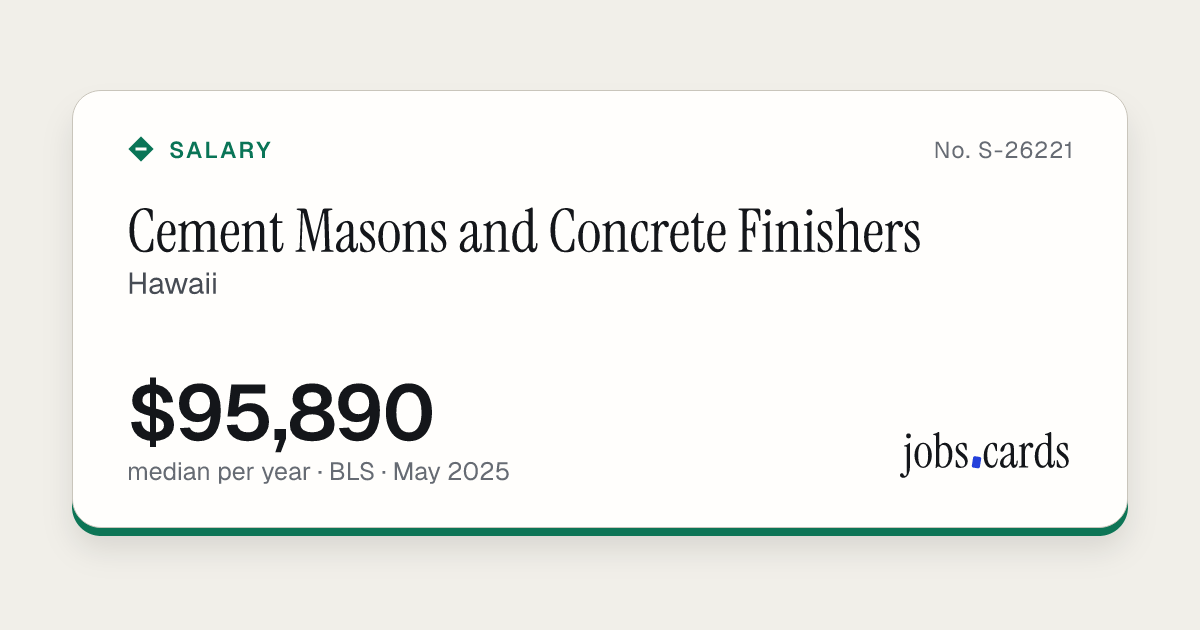
Cement Masons and Concrete Finishers in Hawaii earn a median of $95,890 a year, according to the U.S. Bureau of Labor Statistics survey for May 2025. Half earn between $67,310 and $99,190. The lowest-paid tenth earn under $49,030 and the highest-paid tenth earn over $110,230. These are government survey figures, not estimates from ads.
Checked Nov 16, 2026Source: U.S. Bureau of Labor Statistics
Reading the Numbers
Worked out from the published figures on this card. Nothing here is an estimate.
The median here is 68% above the national median of $57,020 for the same job.
Among the 50 states and territories where the Bureau of Labor Statistics publishes a reliable median for this job, Hawaii ranks 1st by median pay. Hawaii is highest at $95,890 and Puerto Rico lowest at $29,000.
650 people hold this job here, 0.3% of the 206,170 who hold it across the country.
Of every 1,000 jobs here, 1.03 are this job, which makes it 22% less common here than in the U.S. as a whole.
The middle half of workers earn between $67,310 and $99,190, a band $31,880 wide.
Pay at the 90th percentile ($110,230) is 2.2 times pay at the 10th ($49,030).
The average (mean) is $85,470, 11% below the median, so more of the spread lies on the low side.
By the hour, the published median is $46.10.
Hawaii requires pay or a pay range in job ads from covered employers. What Hawaii’s rule says
Where This State Ranks
Its place among 50 states and territories, by median pay for this job.
Smooth and finish surfaces of poured concrete, such as floors, walks, sidewalks, roads, or curbs using a variety of hand and power tools. Align forms for sidewalks, curbs, or gutters; patch voids; and use saws to cut expansion joints.
The five tasks that workers and experts surveyed by O*NET rate most important for this job, most important first.
Check the forms that hold the concrete to see that they are properly constructed.
Set the forms that hold concrete to the desired pitch and depth, and align them.
Spread, level, and smooth concrete, using rake, shovel, hand or power trowel, hand or power screed, and float.
Monitor how the wind, heat, or cold affect the curing of the concrete throughout the entire process.
Mold expansion joints and edges, using edging tools, jointers, and straightedge.
Education. 52% of workers surveyed by O*NET said the level required for this job is: Less than a High School Diploma.
Preparation This Job Usually Needs
Job Zone 1-2: Very Little to Some Preparation Needed. Usually requires a high school diploma or GED, though some occupations may not. Ranges from a few days to one year of on-the-job training. Some occupations may need little or no previous experience; others require several months to a year of experience. For example, landscaping and groundskeeping workers might require very little training or previous experience, while agricultural equipment operators can benefit from on-the job training.
This page includes information from the O*NET 31.0 Database by the U.S. Department of Labor, Employment and Training Administration (USDOL/ETA). Used under the CC BY 4.0 license. O*NET® is a trademark of USDOL/ETA.