Search job, employer or placeSearch cards/Check an Offer
SalaryNo.S-59243

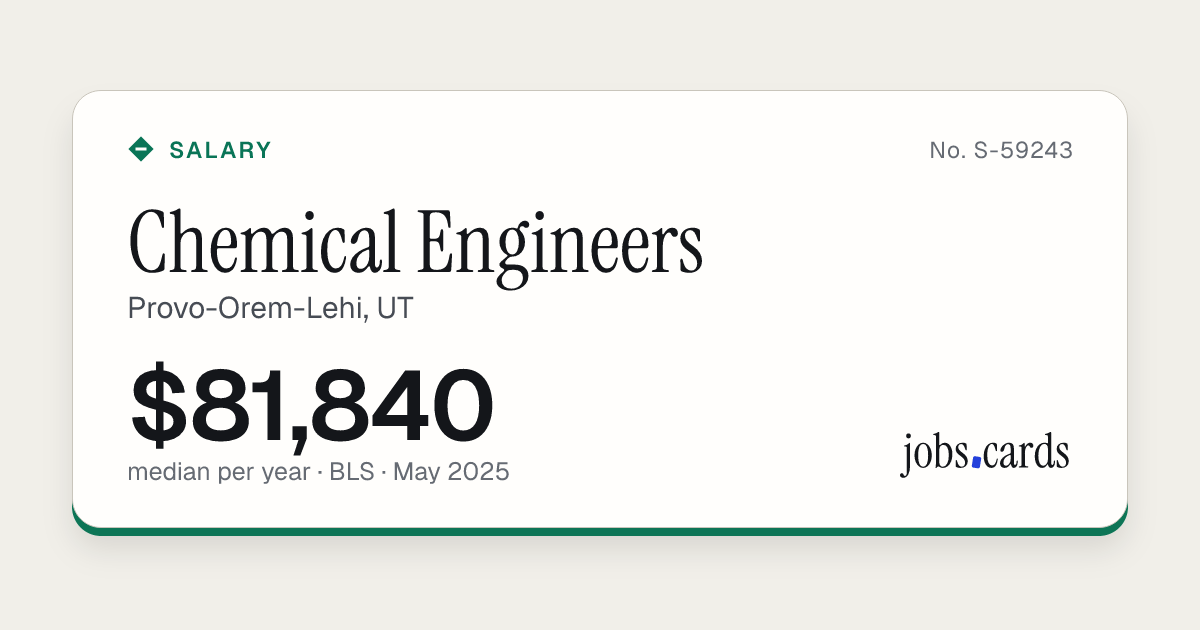
Chemical Engineers

Provo-Orem-Lehi, UTGovernment job code 17-2041

Market pay · all workers · BLS, May 2025

$81,840median pay per year · $39.34 an hour
10th
$59,990
25th
$81,840
Median
$81,840
75th
$81,840
90th
$86,080

Small sample: BLS marks this estimate as less reliable, so treat the figures with care.

Government wage levels · wage year 2026-27

Level I
$72,675
Level II
$78,728
Level III
$84,781
Level IV
$90,834

The four pay levels the Department of Labor sets for this job in Provo-Orem-Lehi, UT. Yearly figures are the hourly level times 2,080 hours.

Filed pay

Fewer than 10 certified full-time filings for this job here, so there is no filed-pay figure.

People in this job here
90
Against the U.S. median
−35%
Mean pay per year
$84,840
Source: U.S. Bureau of Labor Statistics, May 2025 data · checked Nov 16, 2026
SourcesNo.S-59243

Where This Card Comes From

We show the government's numbers as published. Yearly pay is the hourly figure times 2,080 hours. Nothing is modelled or guessed. The U.S. comparison uses the national median for the same job code.

This page includes information from the O*NET 31.0 Database by the U.S. Department of Labor, Employment and Training Administration (USDOL/ETA). Used under the CC BY 4.0 license. O*NET® is a trademark of USDOL/ETA.

Content hash 604396ca · first dealt Nov 16, 2026 · last changed Nov 16, 2026
Save as Image Compare

jobs.cards/c/S-59243

What Does This Job Pay in Provo-Orem-Lehi, UT?

Chemical Engineers in Provo-Orem-Lehi, UT earn a median of $81,840 a year, according to the U.S. Bureau of Labor Statistics survey for May 2025. Half earn between $81,840 and $81,840. The lowest-paid tenth earn under $59,990 and the highest-paid tenth earn over $86,080. These are government survey figures, not estimates from ads.

Checked Nov 16, 2026Source: U.S. Bureau of Labor Statistics

Reading the Numbers

Worked out from the published figures on this card. Nothing here is an estimate.

  • The median here is 35% below the national median of $125,040 for the same job.
  • It is 4% below the Utah median of $85,520.
  • 90 people hold this job here, 0.4% of the 21,070 who hold it across the country.
  • Of every 1,000 jobs here, 0.28 are this job, which makes it 2.1 times as common here as in the U.S. as a whole.
  • The middle half of workers earn between $81,840 and $81,840, a band $0 wide.
  • Pay at the 90th percentile ($86,080) is 1.4 times pay at the 10th ($59,990).
  • The average (mean) is $84,840, 4% above the median. An average above the median means a smaller group of high earners pulls it up.
  • By the hour, the published median is $39.34.
  • The market median of $81,840 meets government wage Level II for this job and area (wage year 2026-27).

What Chemical Engineers Do

Design chemical plant equipment and devise processes for manufacturing chemicals and products, such as gasoline, synthetic rubber, plastics, detergents, cement, paper, and pulp, by applying principles and technology of chemistry, physics, and engineering.

Common job titles: Chemical Engineer, Development Engineer, Engineer, Engineering Scientist, Process Control Engineer, Process Engineer, Project Engineer, Refinery Process Engineer, Research Chemical Engineer, Scientist.

What the Work Involves

The five tasks that workers and experts surveyed by O*NET rate most important for this job, most important first.

  • Develop safety procedures to be employed by workers operating equipment or working in close proximity to ongoing chemical reactions.
  • Troubleshoot problems with chemical manufacturing processes.
  • Monitor and analyze data from processes and experiments.
  • Evaluate chemical equipment and processes to identify ways to optimize performance or to ensure compliance with safety and environmental regulations.
  • Design and plan layout of equipment.

Education. 91% of workers surveyed by O*NET said the level required for this job is: Bachelor's Degree.

Preparation This Job Usually Needs

Job Zone Four: Considerable Preparation Needed. Most of these occupations require a four-year bachelor's degree, but some do not. Employees in these occupations usually need several years of work-related experience, on-the-job training, and/or vocational training. A considerable amount of work-related skill, knowledge, or experience is needed for these occupations. For example, an accountant must complete four years of college and work for several years in accounting to be considered qualified.

This page includes information from the O*NET 31.0 Database by the U.S. Department of Labor, Employment and Training Administration (USDOL/ETA). Used under the CC BY 4.0 license. O*NET® is a trademark of USDOL/ETA.

Embed This Card

Paste this where you want the card to appear. It stays up to date.