Search job, employer or placeSearch cards/Check an Offer
SalaryNo.S-165566

Cutting and Slicing Machine Setters, Operators, and Tenders

El Paso, TXGovernment job code 51-9032

Market pay · all workers · BLS, May 2025

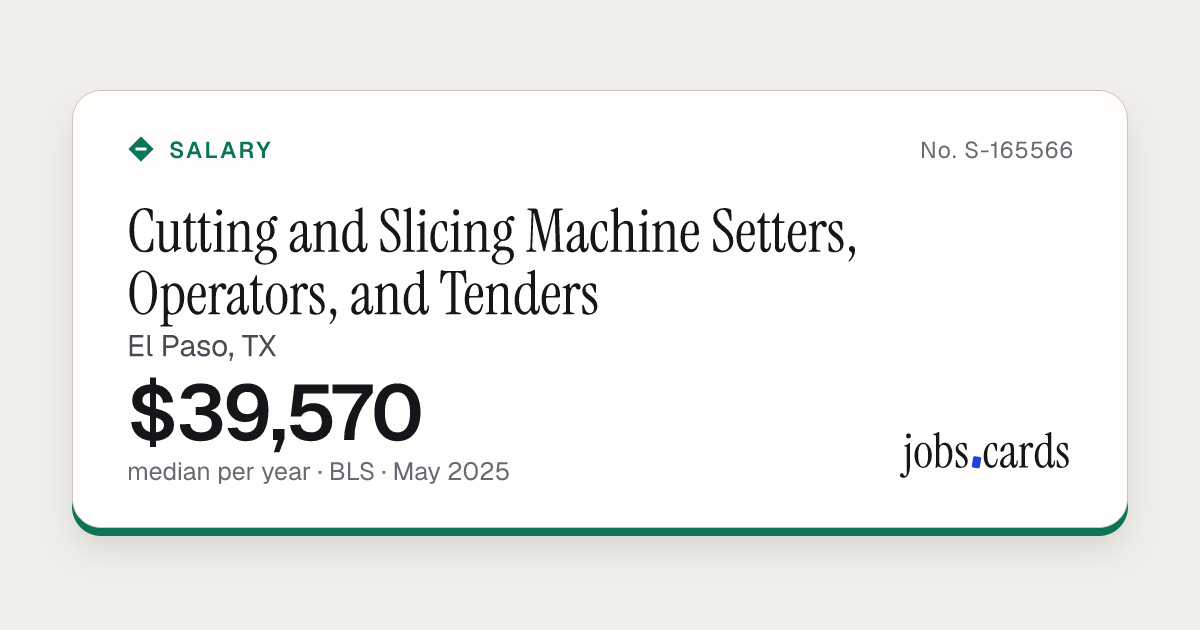
$39,570median pay per year · $19.02 an hour
10th
$30,490
25th
$36,710
Median
$39,570
75th
$45,750
90th
$46,610

Small sample: BLS marks this estimate as less reliable, so treat the figures with care.

Government wage levels · wage year 2026-27

Level I
$33,342
Level II
$36,670
Level III
$39,978
Level IV
$43,306

The four pay levels the Department of Labor sets for this job in El Paso, TX. Yearly figures are the hourly level times 2,080 hours.

Filed pay

Fewer than 10 certified full-time filings for this job here, so there is no filed-pay figure.

People in this job here
100
Against the U.S. median
−15%
Mean pay per year
$40,020
Source: U.S. Bureau of Labor Statistics, May 2025 data · checked Nov 16, 2026
SourcesNo.S-165566

Where This Card Comes From

We show the government's numbers as published. Yearly pay is the hourly figure times 2,080 hours. Nothing is modelled or guessed. The U.S. comparison uses the national median for the same job code.

This page includes information from the O*NET 31.0 Database by the U.S. Department of Labor, Employment and Training Administration (USDOL/ETA). Used under the CC BY 4.0 license. O*NET® is a trademark of USDOL/ETA.

Content hash 65feed6f · first dealt Nov 16, 2026 · last changed Nov 16, 2026
Save as Image Compare

jobs.cards/c/S-165566

What Does This Job Pay in El Paso, TX?

Cutting and Slicing Machine Setters, Operators, and Tenders in El Paso, TX earn a median of $39,570 a year, according to the U.S. Bureau of Labor Statistics survey for May 2025. Half earn between $36,710 and $45,750. The lowest-paid tenth earn under $30,490 and the highest-paid tenth earn over $46,610. These are government survey figures, not estimates from ads.

Checked Nov 16, 2026Source: U.S. Bureau of Labor Statistics

Reading the Numbers

Worked out from the published figures on this card. Nothing here is an estimate.

  • The median here is 15% below the national median of $46,570 for the same job.
  • It is 6% below the Texas median of $42,210.
  • 100 people hold this job here, 0.2% of the 44,980 who hold it across the country.
  • Of every 1,000 jobs here, 0.28 are this job, about as common here as in the U.S. as a whole.
  • The middle half of workers earn between $36,710 and $45,750, a band $9,040 wide.
  • Pay at the 90th percentile ($46,610) is 1.5 times pay at the 10th ($30,490).
  • The average (mean) is $40,020, within 3% of the median, so pay is spread fairly evenly around the middle.
  • By the hour, the published median is $19.02.
  • The market median of $39,570 meets government wage Level II for this job and area (wage year 2026-27).

What Cutting and Slicing Machine Setters, Operators, and Tenders Do

Set up, operate, or tend machines that cut or slice materials, such as glass, stone, cork, rubber, tobacco, food, paper, or insulating material.

Common job titles: Cutter, Cutter Operator, Cutting Machine Operator, Die Cutter Operator, Flat Cutter, Machine Operator, Paper Cutter, Sheeter, Skiver Operator, Slitter.

What the Work Involves

The five tasks that workers and experts surveyed by O*NET rate most important for this job, most important first.

  • Remove defective or substandard materials from machines, and readjust machine components so that products meet standards.
  • Maintain production records, such as quantities, types, and dimensions of materials produced.
  • Start machines to verify setups, and make any necessary adjustments.
  • Press buttons, pull levers, or depress pedals to start and operate cutting and slicing machines.
  • Start pumps to circulate water and abrasives onto blades or cables during cutting.

Education. 92% of workers surveyed by O*NET said the level required for this job is: High School Diploma or the equivalent.

Preparation This Job Usually Needs

Job Zone 1-2: Very Little to Some Preparation Needed. Usually requires a high school diploma or GED, though some occupations may not. Ranges from a few days to one year of on-the-job training. Some occupations may need little or no previous experience; others require several months to a year of experience. For example, landscaping and groundskeeping workers might require very little training or previous experience, while agricultural equipment operators can benefit from on-the job training.

This page includes information from the O*NET 31.0 Database by the U.S. Department of Labor, Employment and Training Administration (USDOL/ETA). Used under the CC BY 4.0 license. O*NET® is a trademark of USDOL/ETA.

Embed This Card

Paste this where you want the card to appear. It stays up to date.