Search job, employer or placeSearch cards/Check an Offer
SalaryNo.S-106424

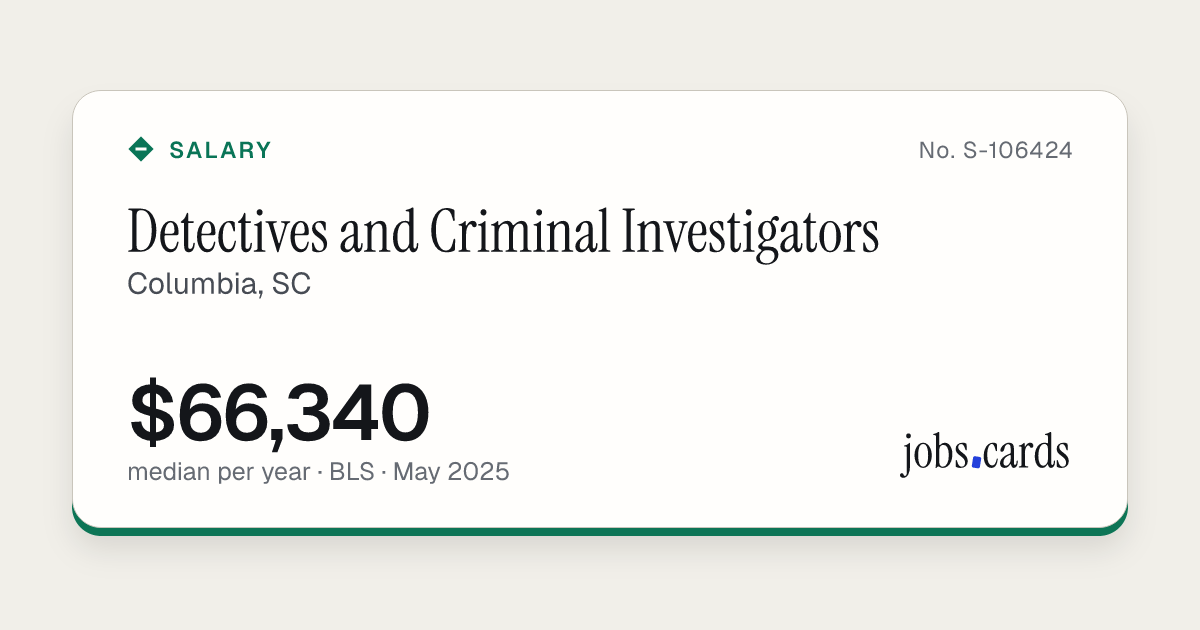
Detectives and Criminal Investigators

Columbia, SCGovernment job code 33-3021

Market pay · all workers · BLS, May 2025

$66,340median pay per year · $31.89 an hour
10th
$50,730
25th
$55,480
Median
$66,340
75th
$78,990
90th
$136,120

Government wage levels · wage year 2026-27

Level I
$52,437
Level II
$63,939
Level III
$75,442
Level IV
$86,944

The four pay levels the Department of Labor sets for this job in Columbia, SC. Yearly figures are the hourly level times 2,080 hours.

Filed pay

Fewer than 10 certified full-time filings for this job here, so there is no filed-pay figure.

People in this job here
580
Against the U.S. median
−29%
Mean pay per year
$75,550
Source: U.S. Bureau of Labor Statistics, May 2025 data · checked Nov 16, 2026
SourcesNo.S-106424

Where This Card Comes From

We show the government's numbers as published. Yearly pay is the hourly figure times 2,080 hours. Nothing is modelled or guessed. The U.S. comparison uses the national median for the same job code.

This page includes information from the O*NET 31.0 Database by the U.S. Department of Labor, Employment and Training Administration (USDOL/ETA). Used under the CC BY 4.0 license. O*NET® is a trademark of USDOL/ETA.

Content hash 1aa2ee6d · first dealt Nov 16, 2026 · last changed Nov 16, 2026
Save as Image Compare

jobs.cards/c/S-106424

What Does This Job Pay in Columbia, SC?

Detectives and Criminal Investigators in Columbia, SC earn a median of $66,340 a year, according to the U.S. Bureau of Labor Statistics survey for May 2025. Half earn between $55,480 and $78,990. The lowest-paid tenth earn under $50,730 and the highest-paid tenth earn over $136,120. These are government survey figures, not estimates from ads.

Checked Nov 16, 2026Source: U.S. Bureau of Labor Statistics

Reading the Numbers

Worked out from the published figures on this card. Nothing here is an estimate.

  • The median here is 29% below the national median of $93,790 for the same job.
  • It is 6% above the South Carolina median of $62,760.
  • 580 people hold this job here, 0.5% of the 114,430 who hold it across the country.
  • Of every 1,000 jobs here, 1.47 are this job, which makes it 2.0 times as common here as in the U.S. as a whole.
  • The middle half of workers earn between $55,480 and $78,990, a band $23,510 wide.
  • Pay at the 90th percentile ($136,120) is 2.7 times pay at the 10th ($50,730).
  • The average (mean) is $75,550, 14% above the median. An average above the median means a smaller group of high earners pulls it up.
  • By the hour, the published median is $31.89.
  • The market median of $66,340 meets government wage Level II for this job and area (wage year 2026-27).

What Detectives and Criminal Investigators Do

Conduct investigations related to suspected violations of federal, state, or local laws to prevent or solve crimes.

Common job titles: Criminal Investigator, CSI (Crime Scene Investigator), Detective, Fugitive Detective, Fugitive Investigator, Investigator, Narcotics Detective, Narcotics Investigator, Police Detective, Special Agent.

What the Work Involves

The five tasks that workers and experts surveyed by O*NET rate most important for this job, most important first.

  • Prepare reports that detail investigation findings.
  • Obtain and verify evidence by interviewing and observing suspects and witnesses or by analyzing records.
  • Obtain facts or statements from complainants, witnesses, and accused persons and record interviews, using recording device.
  • Preserve, process, and analyze items of evidence obtained from crime scenes and suspects, placing them in proper containers and destroying evidence no longer needed.
  • Record progress of investigation, maintain informational files on suspects, and submit reports to commanding officer or magistrate to authorize warrants.

Education. 26% of workers surveyed by O*NET said the level required for this job is: Post-Secondary Certificate.

Preparation This Job Usually Needs

Job Zone Three: Medium Preparation Needed. Most occupations in this zone require training in vocational schools, related on-the-job experience, or an associate's degree. Employees in these occupations usually need one or two years of training involving both on-the-job experience and informal training with experienced workers. A recognized apprenticeship program may be associated with these occupations. Previous work-related skill, knowledge, or experience is required for these occupations. For example, an electrician must have completed three or four years of apprenticeship or several years of vocational training, and often must have passed a licensing exam, in order to perform the job.

This page includes information from the O*NET 31.0 Database by the U.S. Department of Labor, Employment and Training Administration (USDOL/ETA). Used under the CC BY 4.0 license. O*NET® is a trademark of USDOL/ETA.

Embed This Card

Paste this where you want the card to appear. It stays up to date.