Search job, employer or placeSearch cards/Check an Offer
SalaryNo.S-92830

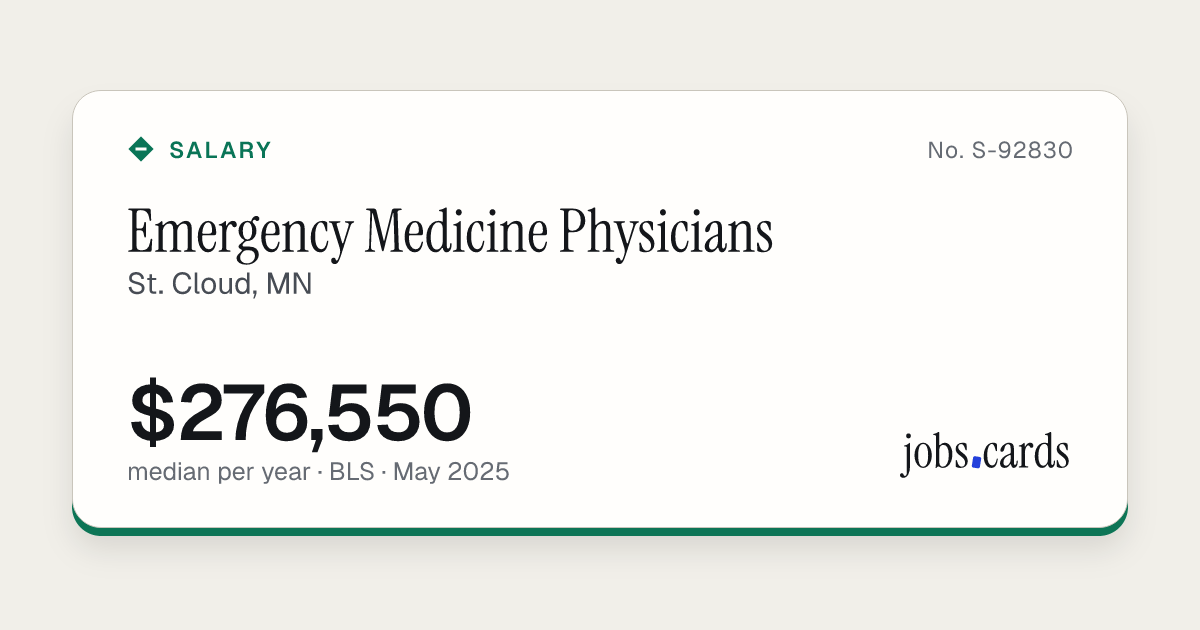
Emergency Medicine Physicians

St. Cloud, MNGovernment job code 29-1214

Market pay · all workers · BLS, May 2025

$276,550median pay per year · $132.96 an hour
10th
$134,230
25th
$178,480
Median
$276,550
75th
$567,460
90th
$567,460

Small sample: BLS marks this estimate as less reliable, so treat the figures with care.

Government wage levels · wage year 2026-27

Level I
$156,416
Level II
$257,962
Level III
$359,528
Level IV
$461,074

The four pay levels the Department of Labor sets for this job in St. Cloud, MN. Yearly figures are the hourly level times 2,080 hours.

Filed pay

Fewer than 10 certified full-time filings for this job here, so there is no filed-pay figure.

Against the U.S. median
−18%
Mean pay per year
$360,530
Source: U.S. Bureau of Labor Statistics, May 2025 data · checked Nov 16, 2026
SourcesNo.S-92830

Where This Card Comes From

We show the government's numbers as published. Yearly pay is the hourly figure times 2,080 hours. Nothing is modelled or guessed. The U.S. comparison uses the national median for the same job code.

This page includes information from the O*NET 31.0 Database by the U.S. Department of Labor, Employment and Training Administration (USDOL/ETA). Used under the CC BY 4.0 license. O*NET® is a trademark of USDOL/ETA.

Content hash 0e1124ba · first dealt Nov 16, 2026 · last changed Nov 16, 2026
Save as Image Compare

jobs.cards/c/S-92830

What Does This Job Pay in St. Cloud, MN?

Emergency Medicine Physicians in St. Cloud, MN earn a median of $276,550 a year, according to the U.S. Bureau of Labor Statistics survey for May 2025. Half earn between $178,480 and $567,460. The lowest-paid tenth earn under $134,230 and the highest-paid tenth earn over $567,460. These are government survey figures, not estimates from ads.

Checked Nov 16, 2026Source: U.S. Bureau of Labor Statistics

Reading the Numbers

Worked out from the published figures on this card. Nothing here is an estimate.

  • The median here is 18% below the national median of $335,550 for the same job.
  • It is 29% below the Minnesota median of $390,940.
  • The middle half of workers earn between $178,480 and $567,460, a band $388,980 wide.
  • Pay at the 90th percentile ($567,460) is 4.2 times pay at the 10th ($134,230).
  • The average (mean) is $360,530, 30% above the median. An average above the median means a smaller group of high earners pulls it up.
  • By the hour, the published median is $132.96.
  • The market median of $276,550 meets government wage Level II for this job and area (wage year 2026-27).

What Emergency Medicine Physicians Do

Make immediate medical decisions and act to prevent death or further disability. Provide immediate recognition, evaluation, care, stabilization, and disposition of patients. May direct emergency medical staff in an emergency department.

Common job titles: Attending Emergency Physician, Attending Physician, Emergency MD (Emergency Medicine Doctor), Emergency Medicine Physician (EM Physician), Emergency Physician, MD (Medical Doctor), Physician.

What the Work Involves

The five tasks that workers and experts surveyed by O*NET rate most important for this job, most important first.

  • Evaluate patients' vital signs or laboratory data to determine emergency intervention needs and priority of treatment.
  • Perform emergency resuscitations on patients.
  • Perform such medical procedures as emergent cricothyrotomy, endotracheal intubation, and emergency thoracotomy.
  • Select, request, perform, or interpret diagnostic procedures, such as laboratory tests, electrocardiograms, emergency ultrasounds, and radiographs.
  • Stabilize patients in critical condition.

Education. 62% of workers surveyed by O*NET said the level required for this job is: Post-Doctoral Training.

Preparation This Job Usually Needs

Job Zone Five: Extensive Preparation Needed. Most of these occupations require graduate school. For example, they may require a master's degree, and some require a Ph.D., M.D., or J.D. (law degree). Employees may need some on-the-job training, but most of these occupations assume that the person will already have the required skills, knowledge, work-related experience, and/or training. Extensive skill, knowledge, and experience are needed for these occupations. Many require more than five years of experience. For example, surgeons must complete four years of college and an additional five to seven years of specialized medical training to be able to do their job.

This page includes information from the O*NET 31.0 Database by the U.S. Department of Labor, Employment and Training Administration (USDOL/ETA). Used under the CC BY 4.0 license. O*NET® is a trademark of USDOL/ETA.

Embed This Card

Paste this where you want the card to appear. It stays up to date.