Search job, employer or placeSearch cards/Check an Offer
SalaryNo.S-07406

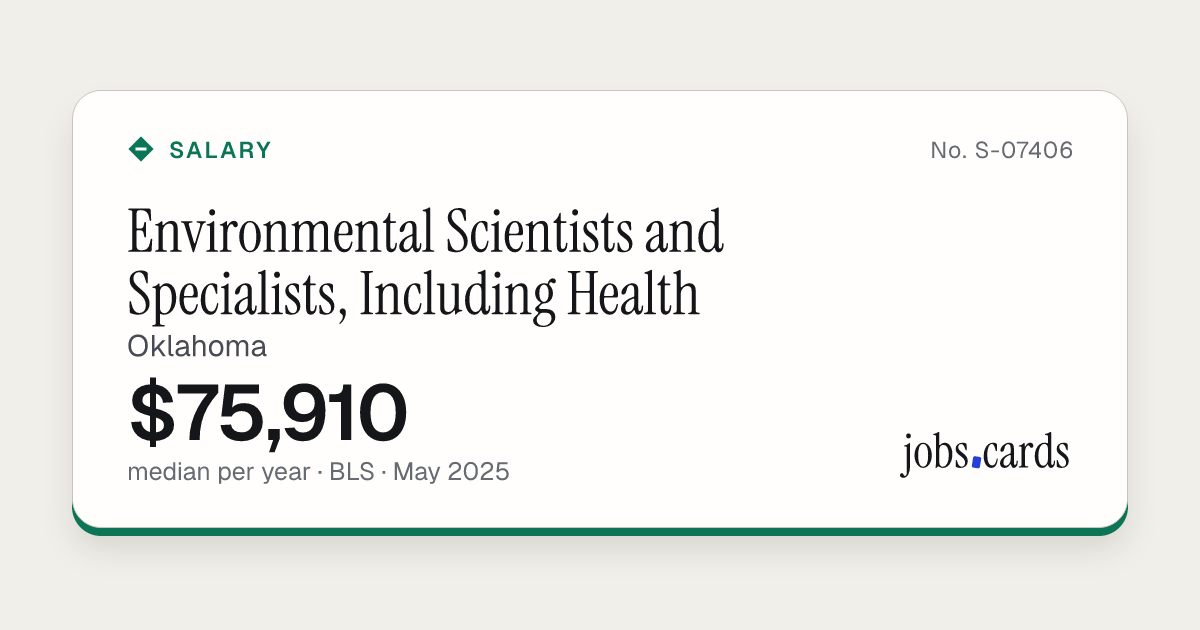
Environmental Scientists and Specialists, Including Health

OklahomaGovernment job code 19-2041

Market pay · all workers · BLS, May 2025

$75,910median pay per year · $36.49 an hour
10th
$43,590
25th
$59,840
Median
$75,910
75th
$89,670
90th
$119,150

Government wage levels

Wage levels are set for each local area. Open a metro card for this job to see them.

Filed pay

Fewer than 10 certified full-time filings for this job here, so there is no filed-pay figure.

People in this job here
520
Against the U.S. median
−8%
Mean pay per year
$78,430
Source: U.S. Bureau of Labor Statistics, May 2025 data · checked Nov 16, 2026
SourcesNo.S-07406

Where This Card Comes From

We show the government's numbers as published. Yearly pay is the hourly figure times 2,080 hours. Nothing is modelled or guessed. The U.S. comparison uses the national median for the same job code.

This page includes information from the O*NET 31.0 Database by the U.S. Department of Labor, Employment and Training Administration (USDOL/ETA). Used under the CC BY 4.0 license. O*NET® is a trademark of USDOL/ETA.
Content hash 56825e1c · first dealt Nov 16, 2026 · last changed Nov 16, 2026

Save as Image Compare

jobs.cards/c/S-07406

What Does This Job Pay in Oklahoma?

Environmental Scientists and Specialists, Including Health in Oklahoma earn a median of $75,910 a year, according to the U.S. Bureau of Labor Statistics survey for May 2025. Half earn between $59,840 and $89,670. The lowest-paid tenth earn under $43,590 and the highest-paid tenth earn over $119,150. These are government survey figures, not estimates from ads.

Checked Nov 16, 2026Source: U.S. Bureau of Labor Statistics

Reading the Numbers

Worked out from the published figures on this card. Nothing here is an estimate.

  • The median here is 8% below the national median of $82,220 for the same job.
  • Among the 47 states and territories where the Bureau of Labor Statistics publishes a reliable median for this job, Oklahoma ranks 32nd by median pay. District of Columbia is highest at $132,620 and Puerto Rico lowest at $53,030.
  • 520 people hold this job here, 0.6% of the 89,250 who hold it across the country.
  • Of every 1,000 jobs here, 0.3 are this job, which makes it 47% less common here than in the U.S. as a whole.
  • The middle half of workers earn between $59,840 and $89,670, a band $29,830 wide.
  • Pay at the 90th percentile ($119,150) is 2.7 times pay at the 10th ($43,590).
  • The average (mean) is $78,430, 3% above the median. An average above the median means a smaller group of high earners pulls it up.
  • By the hour, the published median is $36.49.

Where This State Ranks

Its place among 47 states and territories, by median pay for this job.

All States
RankStateMedian PayPeople in the JobAgainst U.S.
30Pennsylvania$76,1103,020−7%
31Michigan$76,0803,100−7%
32Oklahoma$75,910520−8%
33South Carolina$74,910490−9%
34North Carolina$74,1304,150−10%

What Environmental Scientists and Specialists, Including Health Do

Conduct research or perform investigation for the purpose of identifying, abating, or eliminating sources of pollutants or hazards that affect either the environment or public health. Using knowledge of various scientific disciplines, may collect, synthesize, study, report, and recommend action based on data derived from measurements or observations of air, food, soil, water, and other sources.

Common job titles: Environmental Analyst, Environmental Health and Safety Specialist (EHS Specialist), Environmental Health Specialist, Environmental Programs Specialist, Environmental Protection Specialist, Environmental Scientist, Environmental Specialist, Hazardous Substances Scientist, Natural Resources Specialist, Registered Environmental Health Specialist (REHS).

What the Work Involves

The five tasks that workers and experts surveyed by O*NET rate most important for this job, most important first.

  • Communicate scientific or technical information to the public, organizations, or internal audiences through oral briefings, written documents, workshops, conferences, training sessions, or public hearings.
  • Monitor effects of pollution or land degradation and recommend means of prevention or control.
  • Collect, synthesize, analyze, manage, and report environmental data, such as pollution emission measurements, atmospheric monitoring measurements, meteorological or mineralogical information, or soil or water samples.
  • Review and implement environmental technical standards, guidelines, policies, and formal regulations that meet all appropriate requirements.
  • Provide scientific or technical guidance, support, coordination, or oversight to governmental agencies, environmental programs, industry, or the public.

Education. 47% of workers surveyed by O*NET said the level required for this job is: Bachelor's Degree.

Preparation This Job Usually Needs

Job Zone Four: Considerable Preparation Needed. Most of these occupations require a four-year bachelor's degree, but some do not. Employees in these occupations usually need several years of work-related experience, on-the-job training, and/or vocational training. A considerable amount of work-related skill, knowledge, or experience is needed for these occupations. For example, an accountant must complete four years of college and work for several years in accounting to be considered qualified.

This page includes information from the O*NET 31.0 Database by the U.S. Department of Labor, Employment and Training Administration (USDOL/ETA). Used under the CC BY 4.0 license. O*NET® is a trademark of USDOL/ETA.

The Same Job in Other Places

All Places for This Job

Embed This Card

Paste this where you want the card to appear. It stays up to date.