We show the government's numbers as published. Yearly pay is the hourly figure times 2,080 hours. Nothing is modelled or guessed. The U.S. comparison uses the national median for the same job code.
This page includes information from the O*NET 31.0 Database by the U.S. Department of Labor, Employment and Training Administration (USDOL/ETA). Used under the CC BY 4.0 license. O*NET® is a trademark of USDOL/ETA.
Content hash 336aeea5 · first dealt Nov 16, 2026 · last changed Nov 16, 2026
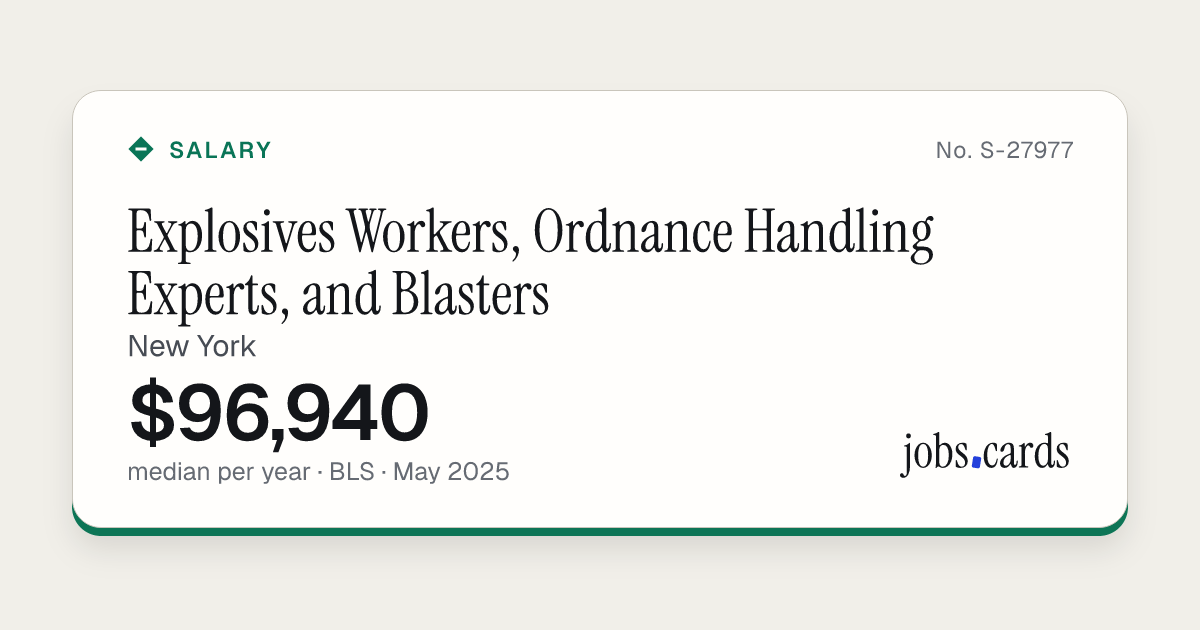
Explosives Workers, Ordnance Handling Experts, and Blasters in New York earn a median of $96,940 a year, according to the U.S. Bureau of Labor Statistics survey for May 2025. Half earn between $81,930 and $121,350. The lowest-paid tenth earn under $72,650 and the highest-paid tenth earn over $123,160. These are government survey figures, not estimates from ads.
Checked Nov 16, 2026Source: U.S. Bureau of Labor Statistics
Reading the Numbers
Worked out from the published figures on this card. Nothing here is an estimate.
The median here is 58% above the national median of $61,390 for the same job.
The middle half of workers earn between $81,930 and $121,350, a band $39,420 wide.
Pay at the 90th percentile ($123,160) is 1.7 times pay at the 10th ($72,650).
The average (mean) is $99,420, 3% above the median. An average above the median means a smaller group of high earners pulls it up.
What Explosives Workers, Ordnance Handling Experts, and Blasters Do
Place and detonate explosives to demolish structures or to loosen, remove, or displace earth, rock, or other materials. May perform specialized handling, storage, and accounting procedures.
Common job titles: Blast Hole Driller, Blaster, Explosive Technician, Powderman, Unexploded Ordnance Quality Control Officer.
What the Work Involves
The five tasks that workers and experts surveyed by O*NET rate most important for this job, most important first.
Examine blast areas to determine amounts and kinds of explosive charges needed and to ensure that safety laws are observed.
Tie specified lengths of delaying fuses into patterns in order to time sequences of explosions.
Place safety cones around blast areas to alert other workers of danger zones, and signal workers as necessary to ensure that they clear blast sites prior to explosions.
Place explosive charges in holes or other spots; then detonate explosives to demolish structures or to loosen, remove, or displace earth, rock, or other materials.
Insert, pack, and pour explosives, such as dynamite, ammonium nitrate, black powder, or slurries into blast holes; then shovel drill cuttings, admit water into boreholes, and tamp material to compact charges.
Education. 63% of workers surveyed by O*NET said the level required for this job is: High School Diploma or the equivalent.
Preparation This Job Usually Needs
Job Zone 1-2: Very Little to Some Preparation Needed. Usually requires a high school diploma or GED, though some occupations may not. Ranges from a few days to one year of on-the-job training. Some occupations may need little or no previous experience; others require several months to a year of experience. For example, landscaping and groundskeeping workers might require very little training or previous experience, while agricultural equipment operators can benefit from on-the job training.
This page includes information from the O*NET 31.0 Database by the U.S. Department of Labor, Employment and Training Administration (USDOL/ETA). Used under the CC BY 4.0 license. O*NET® is a trademark of USDOL/ETA.