Search job, employer or placeSearch cards/Check an Offer
SalaryNo.S-140616

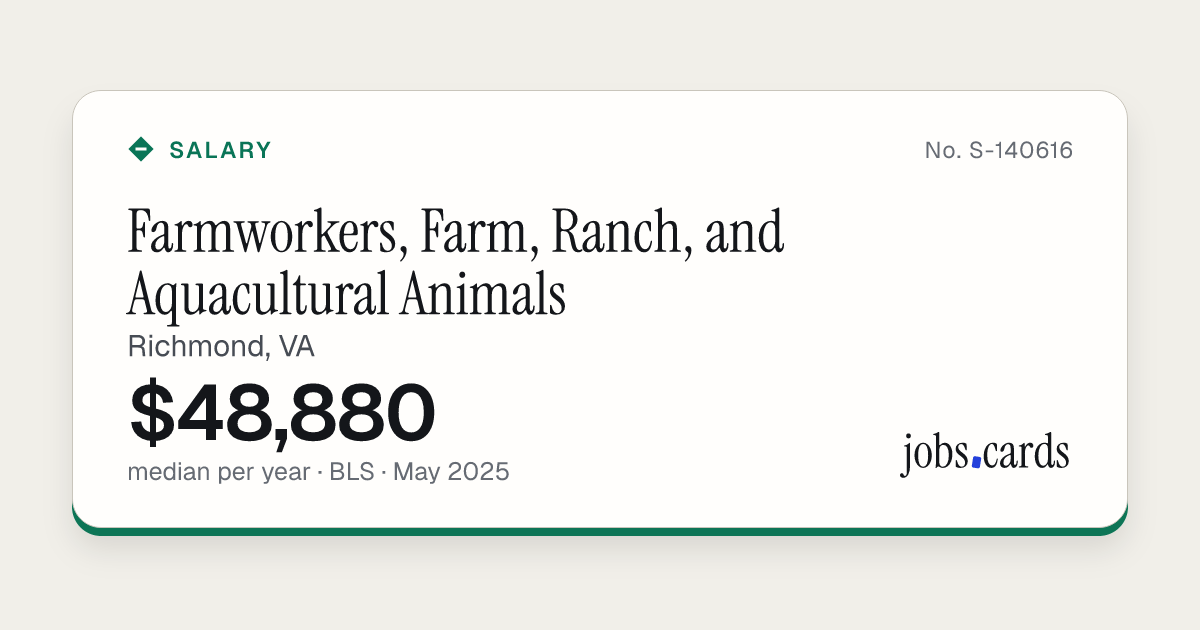
Farmworkers, Farm, Ranch, and Aquacultural Animals

Richmond, VAGovernment job code 45-2093

Market pay · all workers · BLS, May 2025

$48,880median pay per year · $23.50 an hour
10th
$33,740
25th
$36,580
Median
$48,880
75th
$59,730
90th
$61,500

Small sample: BLS marks this estimate as less reliable, so treat the figures with care.

Government wage levels · wage year 2026-27

Level I
$35,006
Level II
$43,098
Level III
$51,210
Level IV
$59,301

The four pay levels the Department of Labor sets for this job in Richmond, VA. Yearly figures are the hourly level times 2,080 hours.

Filed pay

Fewer than 10 certified full-time filings for this job here, so there is no filed-pay figure.

People in this job here
40
Against the U.S. median
+33%
Mean pay per year
$51,280
Source: U.S. Bureau of Labor Statistics, May 2025 data · checked Nov 16, 2026
SourcesNo.S-140616

Where This Card Comes From

We show the government's numbers as published. Yearly pay is the hourly figure times 2,080 hours. Nothing is modelled or guessed. The U.S. comparison uses the national median for the same job code.

This page includes information from the O*NET 31.0 Database by the U.S. Department of Labor, Employment and Training Administration (USDOL/ETA). Used under the CC BY 4.0 license. O*NET® is a trademark of USDOL/ETA.

Content hash 1c8d6c0f · first dealt Nov 16, 2026 · last changed Nov 16, 2026
Save as Image Compare

jobs.cards/c/S-140616

What Does This Job Pay in Richmond, VA?

Farmworkers, Farm, Ranch, and Aquacultural Animals in Richmond, VA earn a median of $48,880 a year, according to the U.S. Bureau of Labor Statistics survey for May 2025. Half earn between $36,580 and $59,730. The lowest-paid tenth earn under $33,740 and the highest-paid tenth earn over $61,500. These are government survey figures, not estimates from ads.

Checked Nov 16, 2026Source: U.S. Bureau of Labor Statistics

Reading the Numbers

Worked out from the published figures on this card. Nothing here is an estimate.

  • The median here is 33% above the national median of $36,670 for the same job.
  • It is 26% above the Virginia median of $38,670.
  • 40 people hold this job here, 0.1% of the 32,810 who hold it across the country.
  • Of every 1,000 jobs here, 0.067 are this job, which makes it 68% less common here than in the U.S. as a whole.
  • The middle half of workers earn between $36,580 and $59,730, a band $23,150 wide.
  • Pay at the 90th percentile ($61,500) is 1.8 times pay at the 10th ($33,740).
  • The average (mean) is $51,280, 5% above the median. An average above the median means a smaller group of high earners pulls it up.
  • By the hour, the published median is $23.50.
  • The market median of $48,880 meets government wage Level II for this job and area (wage year 2026-27).

Virginia requires pay or a pay range in job ads from covered employers. What Virginia’s rule says

What Farmworkers, Farm, Ranch, and Aquacultural Animals Do

Attend to live farm, ranch, open range or aquacultural animals that may include cattle, sheep, swine, goats, horses and other equines, poultry, rabbits, finfish, shellfish, and bees. Attend to animals produced for animal products, such as meat, fur, skins, feathers, eggs, milk, and honey. Duties may include feeding, watering, herding, grazing, milking, castrating, branding, de-beaking, weighing, catching, and loading animals. May maintain records on animals; examine animals to detect diseases and injuries; assist in birth deliveries; and administer medications, vaccinations, or insecticides as appropriate. May clean and maintain animal housing areas. Includes workers who shear wool from sheep and collect eggs in hatcheries.

Common job titles: Cowboy, Farm Hand, Farrowing Worker, Herdsman, Livestock Handler, Milking Worker, Ranch Hand, Rancher, Vaccinator, Wrangler.

What the Work Involves

The five tasks that workers and experts surveyed by O*NET rate most important for this job, most important first.

  • Feed and water livestock and monitor food and water supplies.
  • Herd livestock to pastures for grazing or to scales, trucks, or other enclosures.
  • Examine animals to detect illness, injury, or disease, and to check physical characteristics, such as rate of weight gain.
  • Provide medical treatment, such as administering medications and vaccinations, or arrange for veterinarians to provide more extensive treatment.
  • Mix feed, additives, and medicines in prescribed portions.

Education. 39% of workers surveyed by O*NET said the level required for this job is: Some College Courses.

Preparation This Job Usually Needs

Job Zone 1-2: Very Little to Some Preparation Needed. Usually requires a high school diploma or GED, though some occupations may not. Ranges from a few days to one year of on-the-job training. Some occupations may need little or no previous experience; others require several months to a year of experience. For example, landscaping and groundskeeping workers might require very little training or previous experience, while agricultural equipment operators can benefit from on-the job training.

This page includes information from the O*NET 31.0 Database by the U.S. Department of Labor, Employment and Training Administration (USDOL/ETA). Used under the CC BY 4.0 license. O*NET® is a trademark of USDOL/ETA.

Embed This Card

Paste this where you want the card to appear. It stays up to date.