We show the government's numbers as published. Yearly pay is the hourly figure times 2,080 hours. Nothing is modelled or guessed. The U.S. comparison uses the national median for the same job code.
This page includes information from the O*NET 31.0 Database by the U.S. Department of Labor, Employment and Training Administration (USDOL/ETA). Used under the CC BY 4.0 license. O*NET® is a trademark of USDOL/ETA.
Content hash 73efdffa · first dealt Nov 16, 2026 · last changed Nov 16, 2026
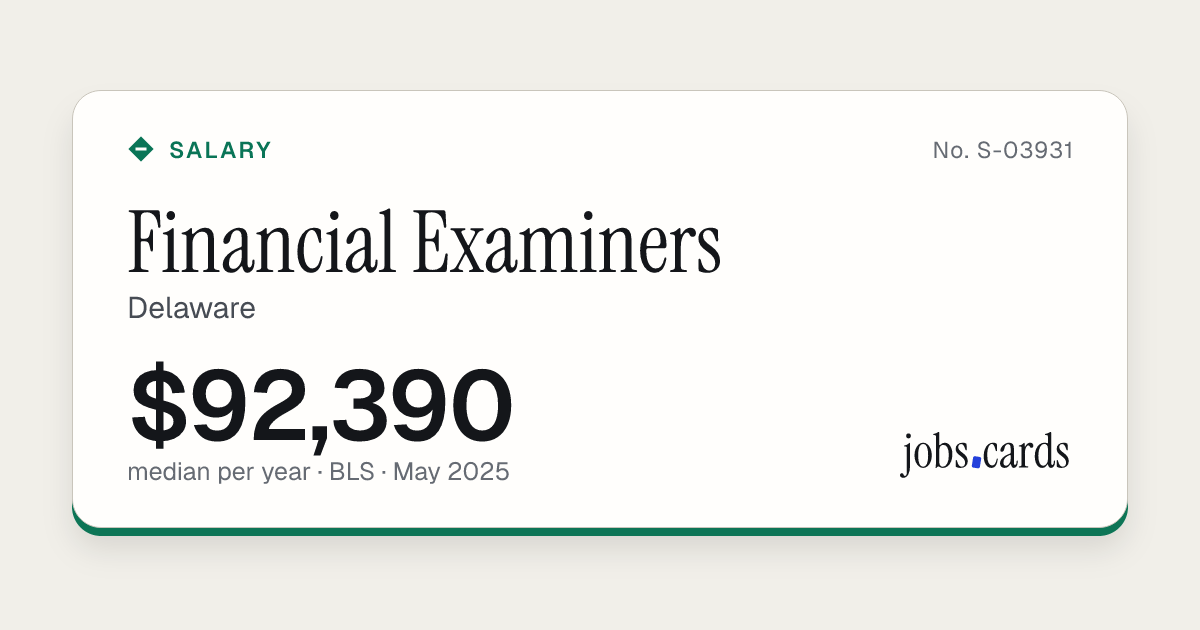
Financial Examiners in Delaware earn a median of $92,390 a year, according to the U.S. Bureau of Labor Statistics survey for May 2025. Half earn between $58,140 and $120,030. The lowest-paid tenth earn under $57,790 and the highest-paid tenth earn over $162,760. These are government survey figures, not estimates from ads.
Checked Nov 16, 2026Source: U.S. Bureau of Labor Statistics
Reading the Numbers
Worked out from the published figures on this card. Nothing here is an estimate.
The median here is 2% below the national median of $94,160 for the same job.
Among the 36 states and territories where the Bureau of Labor Statistics publishes a reliable median for this job, Delaware ranks 15th by median pay. District of Columbia is highest at $198,720 and Puerto Rico lowest at $37,470.
430 people hold this job here, 0.6% of the 67,830 who hold it across the country.
Of every 1,000 jobs here, 0.88 are this job, which makes it 2.0 times as common here as in the U.S. as a whole.
The middle half of workers earn between $58,140 and $120,030, a band $61,890 wide.
Pay at the 90th percentile ($162,760) is 2.8 times pay at the 10th ($57,790).
The average (mean) is $98,290, 6% above the median. An average above the median means a smaller group of high earners pulls it up.
By the hour, the published median is $44.42.
Delaware has enacted a law that will require pay in job ads from Sep 26, 2027. What Delaware’s rule says
Where This State Ranks
Its place among 36 states and territories, by median pay for this job.
Enforce or ensure compliance with laws and regulations governing financial and securities institutions and financial and real estate transactions. May examine, verify, or authenticate records.
Common job titles: Bank Examiner, Bank Secrecy Act Anti-Money Laundering Officer (BSA/AML Officer), Community Reinvestment Act Officer (CRA Officer), Compliance Analyst, Compliance Specialist, Credit Union Examiner, Credit Union Field Examiner, Examining Officer, Internal Auditor.
What the Work Involves
The five tasks that workers and experts surveyed by O*NET rate most important for this job, most important first.
Direct and participate in formal and informal meetings with bank directors, trustees, senior management, counsels, outside accountants, and consultants to gather information and discuss findings.
Recommend actions to ensure compliance with laws and regulations, or to protect solvency of institutions.
Prepare reports, exhibits, and other supporting schedules that detail an institution's safety and soundness, compliance with laws and regulations, and recommended solutions to questionable financial conditions.
Resolve problems concerning the overall financial integrity of banking institutions including loan investment portfolios, capital, earnings, and specific or large troubled accounts.
Investigate activities of institutions to enforce laws and regulations and to ensure legality of transactions and operations or financial solvency.
Education. 87% of workers surveyed by O*NET said the level required for this job is: Bachelor's Degree.
Preparation This Job Usually Needs
Job Zone Four: Considerable Preparation Needed. Most of these occupations require a four-year bachelor's degree, but some do not. Employees in these occupations usually need several years of work-related experience, on-the-job training, and/or vocational training. A considerable amount of work-related skill, knowledge, or experience is needed for these occupations. For example, an accountant must complete four years of college and work for several years in accounting to be considered qualified.
This page includes information from the O*NET 31.0 Database by the U.S. Department of Labor, Employment and Training Administration (USDOL/ETA). Used under the CC BY 4.0 license. O*NET® is a trademark of USDOL/ETA.