We show the government's numbers as published. Yearly pay is the hourly figure times 2,080 hours. Nothing is modelled or guessed. The U.S. comparison uses the national median for the same job code.
This page includes information from the O*NET 31.0 Database by the U.S. Department of Labor, Employment and Training Administration (USDOL/ETA). Used under the CC BY 4.0 license. O*NET® is a trademark of USDOL/ETA.
Content hash 2b90e760 · first dealt Nov 16, 2026 · last changed Nov 16, 2026
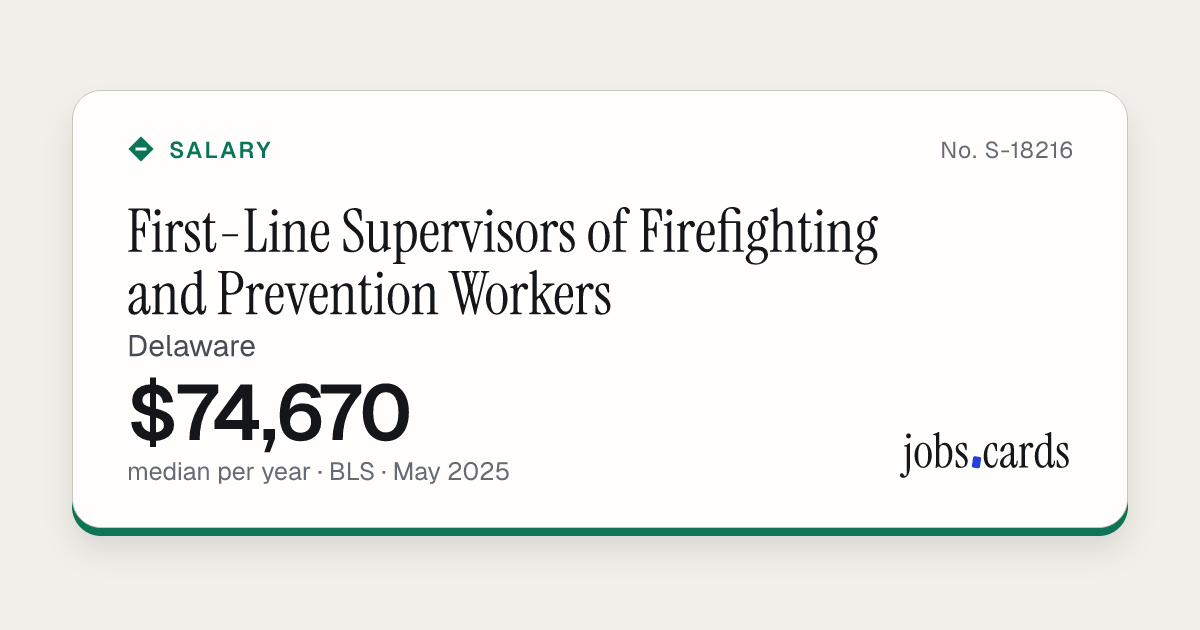
First-Line Supervisors of Firefighting and Prevention Workers in Delaware earn a median of $74,670 a year, according to the U.S. Bureau of Labor Statistics survey for May 2025. Half earn between $63,660 and $100,100. The lowest-paid tenth earn under $50,130 and the highest-paid tenth earn over $100,100. These are government survey figures, not estimates from ads.
Checked Nov 16, 2026Source: U.S. Bureau of Labor Statistics
Reading the Numbers
Worked out from the published figures on this card. Nothing here is an estimate.
The median here is 20% below the national median of $93,530 for the same job.
The middle half of workers earn between $63,660 and $100,100, a band $36,440 wide.
Pay at the 90th percentile ($100,100) is 2.0 times pay at the 10th ($50,130).
The average (mean) is $79,810, 7% above the median. An average above the median means a smaller group of high earners pulls it up.
By the hour, the published median is $35.90.
Delaware has enacted a law that will require pay in job ads from Sep 26, 2027. What Delaware’s rule says
What First-Line Supervisors of Firefighting and Prevention Workers Do
Directly supervise and coordinate activities of workers engaged in firefighting and fire prevention and control.
Common job titles: Battalion Chief, Engine Boss, Fire Battalion Chief, Fire Captain, Fire Chief, Fire Lieutenant, Fire Marshal, Fire Suppression Captain, Forest Fire Specialist Supervisor, Section Forest Fire Warden.
What the Work Involves
The five tasks that workers and experts surveyed by O*NET rate most important for this job, most important first.
Provide emergency medical services as required, and perform light to heavy rescue functions at emergencies.
Maintain fire suppression equipment in good condition, checking equipment periodically to ensure that it is ready for use.
Assign firefighters to jobs at strategic locations to facilitate rescue of persons and maximize application of extinguishing agents.
Communicate fire details to superiors, subordinates, or interagency dispatch centers, using two-way radios.
Serve as a working leader of an engine, hand, helicopter, or prescribed fire crew of three or more firefighters.
Education. 38% of workers surveyed by O*NET said the level required for this job is: High School Diploma or the equivalent.
Preparation This Job Usually Needs
Job Zone Three: Medium Preparation Needed. Most occupations in this zone require training in vocational schools, related on-the-job experience, or an associate's degree. Employees in these occupations usually need one or two years of training involving both on-the-job experience and informal training with experienced workers. A recognized apprenticeship program may be associated with these occupations. Previous work-related skill, knowledge, or experience is required for these occupations. For example, an electrician must have completed three or four years of apprenticeship or several years of vocational training, and often must have passed a licensing exam, in order to perform the job.
This page includes information from the O*NET 31.0 Database by the U.S. Department of Labor, Employment and Training Administration (USDOL/ETA). Used under the CC BY 4.0 license. O*NET® is a trademark of USDOL/ETA.