We show the government's numbers as published. Yearly pay is the hourly figure times 2,080 hours. Nothing is modelled or guessed. The U.S. comparison uses the national median for the same job code.
This page includes information from the O*NET 31.0 Database by the U.S. Department of Labor, Employment and Training Administration (USDOL/ETA). Used under the CC BY 4.0 license. O*NET® is a trademark of USDOL/ETA.
Content hash d7401f48 · first dealt Nov 16, 2026 · last changed Nov 16, 2026
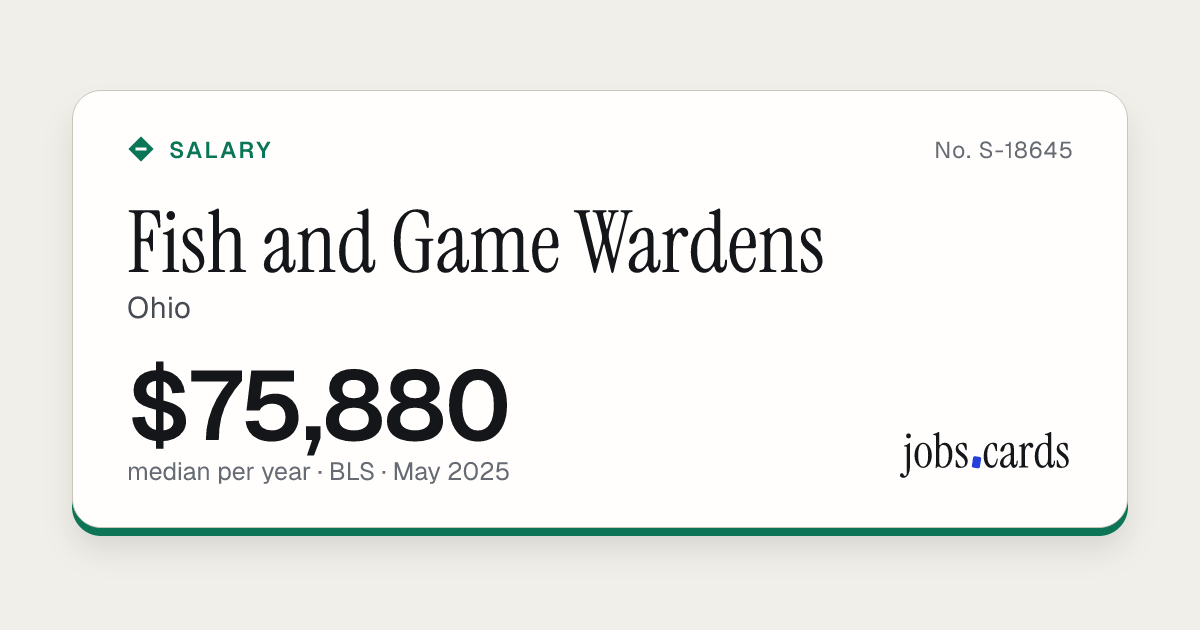
Fish and Game Wardens in Ohio earn a median of $75,880 a year, according to the U.S. Bureau of Labor Statistics survey for May 2025. Half earn between $62,380 and $87,170. The lowest-paid tenth earn under $56,620 and the highest-paid tenth earn over $100,710. These are government survey figures, not estimates from ads.
Checked Nov 16, 2026Source: U.S. Bureau of Labor Statistics
Reading the Numbers
Worked out from the published figures on this card. Nothing here is an estimate.
The median here is 2% above the national median of $74,060 for the same job.
160 people hold this job here, 2.8% of the 5,770 who hold it across the country.
Of every 1,000 jobs here, 0.029 are this job, which makes it 22% less common here than in the U.S. as a whole.
The middle half of workers earn between $62,380 and $87,170, a band $24,790 wide.
Pay at the 90th percentile ($100,710) is 1.8 times pay at the 10th ($56,620).
The average (mean) is $76,100, within 3% of the median, so pay is spread fairly evenly around the middle.
By the hour, the published median is $36.48.
Ohio has no statewide pay-range law, but Cleveland and Columbus have city rules. What Ohio’s rule says
What Fish and Game Wardens Do
Patrol assigned area to prevent fish and game law violations. Investigate reports of damage to crops or property by wildlife. Compile biological data.
Common job titles: Conservation Enforcement Officer, Conservation Officer, Conservation Warden, Fish and Game Constable, Game Warden, Refuge Officer, State Game Warden, State Wildlife Officer, Wildlife Conservation Officer, Wildlife Officer.
What the Work Involves
The five tasks that workers and experts surveyed by O*NET rate most important for this job, most important first.
Participate in search-and-rescue operations.
Compile and present evidence for court actions.
Protect and preserve native wildlife, plants, or ecosystems.
Patrol assigned areas by car, boat, airplane, horse, or on foot to enforce game, fish, or boating laws or to manage wildlife programs, lakes, or land.
Investigate hunting accidents or reports of fish or game law violations.
Preparation This Job Usually Needs
Job Zone Three: Medium Preparation Needed. Most occupations in this zone require training in vocational schools, related on-the-job experience, or an associate's degree. Employees in these occupations usually need one or two years of training involving both on-the-job experience and informal training with experienced workers. A recognized apprenticeship program may be associated with these occupations. Previous work-related skill, knowledge, or experience is required for these occupations. For example, an electrician must have completed three or four years of apprenticeship or several years of vocational training, and often must have passed a licensing exam, in order to perform the job.
This page includes information from the O*NET 31.0 Database by the U.S. Department of Labor, Employment and Training Administration (USDOL/ETA). Used under the CC BY 4.0 license. O*NET® is a trademark of USDOL/ETA.