We show the government's numbers as published. Yearly pay is the hourly figure times 2,080 hours. Nothing is modelled or guessed. The U.S. comparison uses the national median for the same job code.
This page includes information from the O*NET 31.0 Database by the U.S. Department of Labor, Employment and Training Administration (USDOL/ETA). Used under the CC BY 4.0 license. O*NET® is a trademark of USDOL/ETA.
Content hash 53824991 · first dealt Nov 16, 2026 · last changed Nov 16, 2026
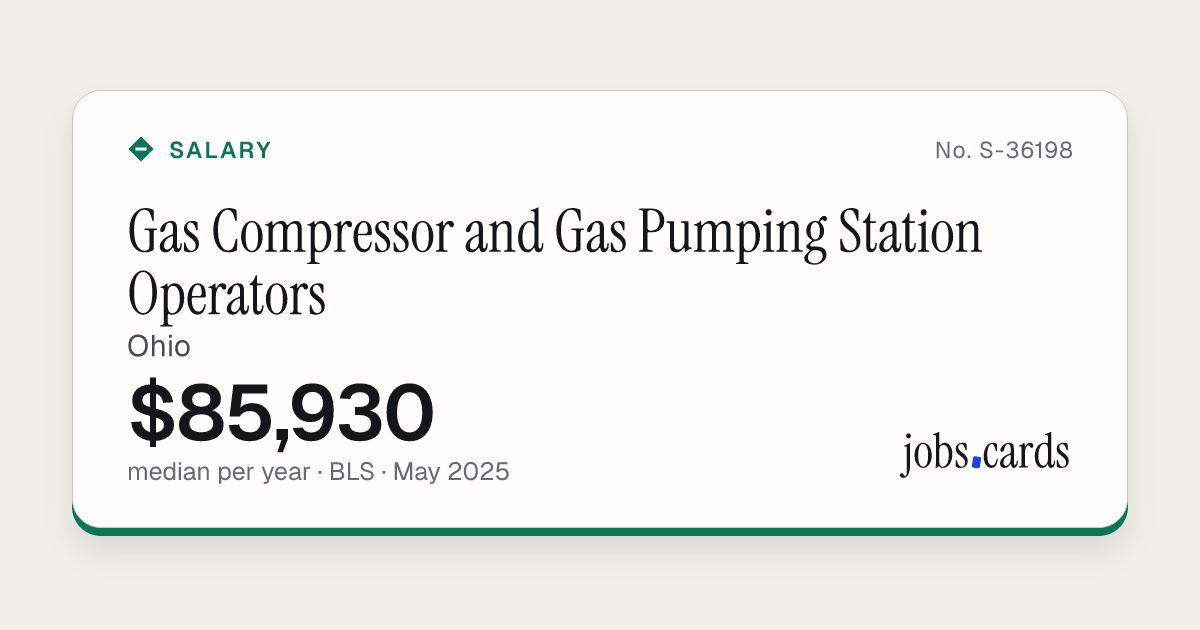
Gas Compressor and Gas Pumping Station Operators in Ohio earn a median of $85,930 a year, according to the U.S. Bureau of Labor Statistics survey for May 2025. Half earn between $82,310 and $96,220. The lowest-paid tenth earn under $78,890 and the highest-paid tenth earn over $103,190. These are government survey figures, not estimates from ads.
Checked Nov 16, 2026Source: U.S. Bureau of Labor Statistics
Reading the Numbers
Worked out from the published figures on this card. Nothing here is an estimate.
The median here is 11% above the national median of $77,320 for the same job.
120 people hold this job here, 3.4% of the 3,510 who hold it across the country.
Of every 1,000 jobs here, 0.021 are this job, which makes it 6% less common here than in the U.S. as a whole.
The middle half of workers earn between $82,310 and $96,220, a band $13,910 wide.
Pay at the 90th percentile ($103,190) is 1.3 times pay at the 10th ($78,890).
The average (mean) is $89,090, 4% above the median. An average above the median means a smaller group of high earners pulls it up.
By the hour, the published median is $41.31.
Ohio has no statewide pay-range law, but Cleveland and Columbus have city rules. What Ohio’s rule says
What Gas Compressor and Gas Pumping Station Operators Do
Operate steam-, gas-, electric motor-, or internal combustion-engine driven compressors. Transmit, compress, or recover gases, such as butane, nitrogen, hydrogen, and natural gas.
Common job titles: Compressor Operator, Compressor Station Operator, Compressor Technician, Fill Plant Operator, Filler, Liquefied Natural Gas Plant Operator (LNG Plant Operator), Pipeline Technician, Plant Operator, Terminal Operator.
What the Work Involves
The five tasks that workers and experts surveyed by O*NET rate most important for this job, most important first.
Monitor meters and pressure gauges to determine consumption rate variations, temperatures, and pressures.
Respond to problems by adjusting control room equipment or instructing other personnel to adjust equipment at problem locations or in other control areas.
Adjust valves and equipment to obtain specified performance.
Record instrument readings and operational changes in operating logs.
Move controls and turn valves to start compressor engines, pumps, and auxiliary equipment.
Preparation This Job Usually Needs
Job Zone 1-2: Very Little to Some Preparation Needed. Usually requires a high school diploma or GED, though some occupations may not. Ranges from a few days to one year of on-the-job training. Some occupations may need little or no previous experience; others require several months to a year of experience. For example, landscaping and groundskeeping workers might require very little training or previous experience, while agricultural equipment operators can benefit from on-the job training.
This page includes information from the O*NET 31.0 Database by the U.S. Department of Labor, Employment and Training Administration (USDOL/ETA). Used under the CC BY 4.0 license. O*NET® is a trademark of USDOL/ETA.