Search job, employer or placeSearch cards/Check an Offer
SalaryNo.S-07877

Geographers

MissouriGovernment job code 19-3092

Market pay · all workers · BLS, May 2025

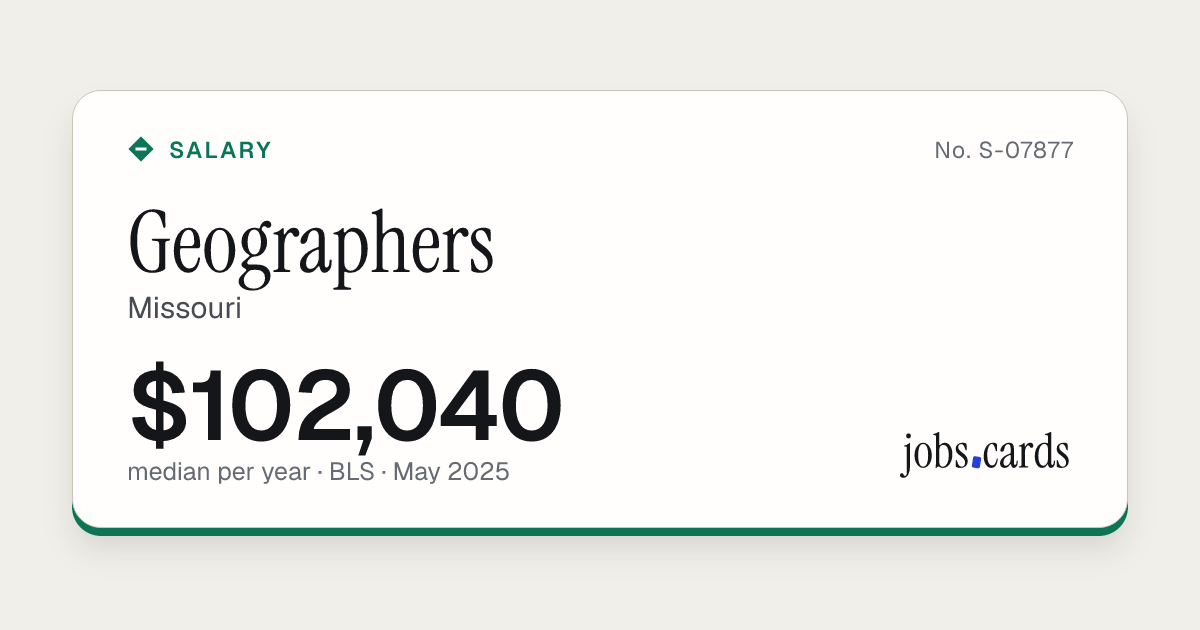
$102,040median pay per year · $49.06 an hour
10th
$75,800
25th
$83,390
Median
$102,040
75th
$115,920
90th
$126,440

Small sample: BLS marks this estimate as less reliable, so treat the figures with care.

Government wage levels

Wage levels are set for each local area. Open a metro card for this job to see them.

Filed pay

Fewer than 10 certified full-time filings for this job here, so there is no filed-pay figure.

People in this job here
40
Against the U.S. median
0%
Mean pay per year
$100,980
Source: U.S. Bureau of Labor Statistics, May 2025 data · checked Nov 16, 2026
SourcesNo.S-07877

Where This Card Comes From

We show the government's numbers as published. Yearly pay is the hourly figure times 2,080 hours. Nothing is modelled or guessed. The U.S. comparison uses the national median for the same job code.

This page includes information from the O*NET 31.0 Database by the U.S. Department of Labor, Employment and Training Administration (USDOL/ETA). Used under the CC BY 4.0 license. O*NET® is a trademark of USDOL/ETA.

Content hash aa9c0831 · first dealt Nov 16, 2026 · last changed Nov 16, 2026
Save as Image Compare

jobs.cards/c/S-07877

What Does This Job Pay in Missouri?

Geographers in Missouri earn a median of $102,040 a year, according to the U.S. Bureau of Labor Statistics survey for May 2025. Half earn between $83,390 and $115,920. The lowest-paid tenth earn under $75,800 and the highest-paid tenth earn over $126,440. These are government survey figures, not estimates from ads.

Checked Nov 16, 2026Source: U.S. Bureau of Labor Statistics

Reading the Numbers

Worked out from the published figures on this card. Nothing here is an estimate.

  • The median here is about the same as the national median of $102,040 for the same job.
  • 40 people hold this job here, 2.9% of the 1,400 who hold it across the country.
  • Of every 1,000 jobs here, 0.013 are this job, which makes it 40% more common here than in the U.S. as a whole.
  • The middle half of workers earn between $83,390 and $115,920, a band $32,530 wide.
  • Pay at the 90th percentile ($126,440) is 1.7 times pay at the 10th ($75,800).
  • The average (mean) is $100,980, within 3% of the median, so pay is spread fairly evenly around the middle.
  • By the hour, the published median is $49.06.

What Geographers Do

Study the nature and use of areas of the Earth's surface, relating and interpreting interactions of physical and cultural phenomena. Conduct research on physical aspects of a region, including land forms, climates, soils, plants, and animals, and conduct research on the spatial implications of human activities within a given area, including social characteristics, economic activities, and political organization, as well as researching interdependence between regions at scales ranging from local to global.

Common job titles: Earth Observations Scientist, Geographer, GIS Coordinator (Geographic Information Systems Coordinator), GIS Geographer (Geographic Information Systems Geographer), GIS Physical Scientist (Geographic Information Systems Physical Scientist), Scientist.

What the Work Involves

The five tasks that workers and experts surveyed by O*NET rate most important for this job, most important first.

  • Create and modify maps, graphs, or diagrams, using geographical information software and related equipment, and principles of cartography, such as coordinate systems, longitude, latitude, elevation, topography, and map scales.
  • Gather and compile geographic data from sources such as censuses, field observations, satellite imagery, aerial photographs, and existing maps.
  • Teach geography.
  • Write and present reports of research findings.
  • Provide geographical information systems support to the private and public sectors.

Education. 45% of workers surveyed by O*NET said the level required for this job is: Bachelor's Degree.

Preparation This Job Usually Needs

Job Zone Four: Considerable Preparation Needed. Most of these occupations require a four-year bachelor's degree, but some do not. Employees in these occupations usually need several years of work-related experience, on-the-job training, and/or vocational training. A considerable amount of work-related skill, knowledge, or experience is needed for these occupations. For example, an accountant must complete four years of college and work for several years in accounting to be considered qualified.

This page includes information from the O*NET 31.0 Database by the U.S. Department of Labor, Employment and Training Administration (USDOL/ETA). Used under the CC BY 4.0 license. O*NET® is a trademark of USDOL/ETA.

Embed This Card

Paste this where you want the card to appear. It stays up to date.