Search job, employer or placeSearch cards/Check an Offer
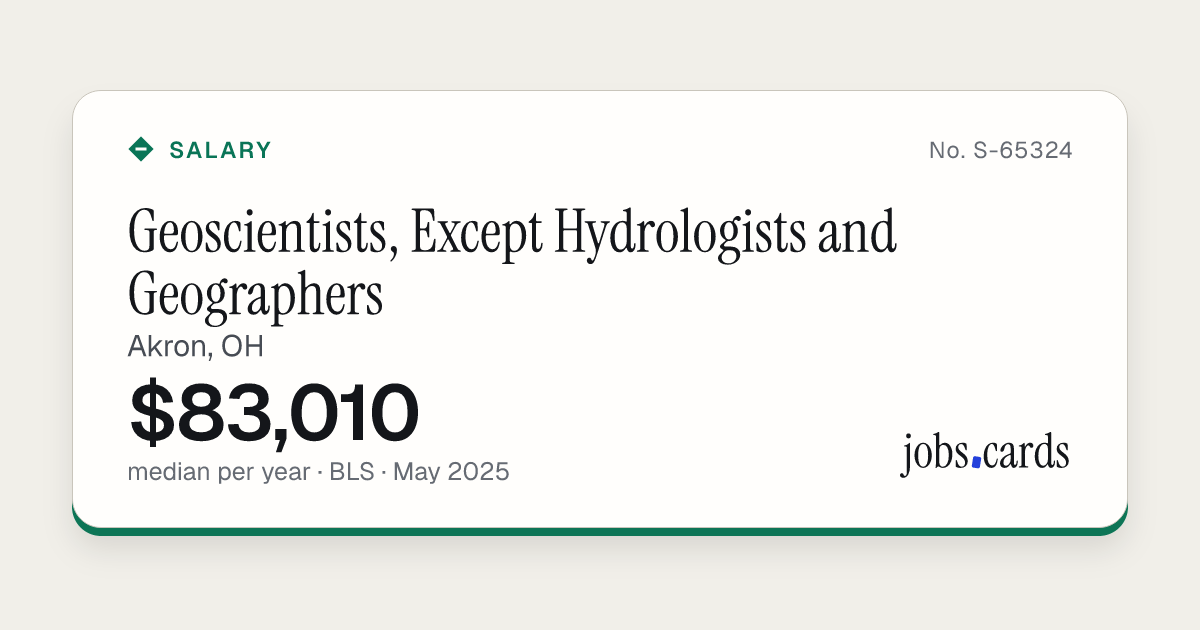
SalaryNo.S-65324

Geoscientists, Except Hydrologists and Geographers

Akron, OHGovernment job code 19-2042

Market pay · all workers · BLS, May 2025

$83,010median pay per year · $39.91 an hour
10th
$53,110
25th
$63,460
Median
$83,010
75th
$94,370
90th
$123,020

Small sample: BLS marks this estimate as less reliable, so treat the figures with care.

Government wage levels · wage year 2026-27

Level I
$57,970
Level II
$70,554
Level III
$83,158
Level IV
$95,742

The four pay levels the Department of Labor sets for this job in Akron, OH. Yearly figures are the hourly level times 2,080 hours.

Filed pay

Fewer than 10 certified full-time filings for this job here, so there is no filed-pay figure.

People in this job here
40
Against the U.S. median
−19%
Mean pay per year
$83,270
Source: U.S. Bureau of Labor Statistics, May 2025 data · checked Nov 16, 2026
SourcesNo.S-65324

Where This Card Comes From

We show the government's numbers as published. Yearly pay is the hourly figure times 2,080 hours. Nothing is modelled or guessed. The U.S. comparison uses the national median for the same job code.

This page includes information from the O*NET 31.0 Database by the U.S. Department of Labor, Employment and Training Administration (USDOL/ETA). Used under the CC BY 4.0 license. O*NET® is a trademark of USDOL/ETA.

Content hash adb34d1c · first dealt Nov 16, 2026 · last changed Nov 16, 2026
Save as Image Compare

jobs.cards/c/S-65324

What Does This Job Pay in Akron, OH?

Geoscientists, Except Hydrologists and Geographers in Akron, OH earn a median of $83,010 a year, according to the U.S. Bureau of Labor Statistics survey for May 2025. Half earn between $63,460 and $94,370. The lowest-paid tenth earn under $53,110 and the highest-paid tenth earn over $123,020. These are government survey figures, not estimates from ads.

Checked Nov 16, 2026Source: U.S. Bureau of Labor Statistics

Reading the Numbers

Worked out from the published figures on this card. Nothing here is an estimate.

  • The median here is 19% below the national median of $101,920 for the same job.
  • It is 2% above the Ohio median of $81,220.
  • 40 people hold this job here, 0.2% of the 23,470 who hold it across the country.
  • Of every 1,000 jobs here, 0.12 are this job, which makes it 19% less common here than in the U.S. as a whole.
  • The middle half of workers earn between $63,460 and $94,370, a band $30,910 wide.
  • Pay at the 90th percentile ($123,020) is 2.3 times pay at the 10th ($53,110).
  • The average (mean) is $83,270, within 3% of the median, so pay is spread fairly evenly around the middle.
  • By the hour, the published median is $39.91.
  • The market median of $83,010 meets government wage Level II for this job and area (wage year 2026-27).

Ohio has no statewide pay-range law, but Cleveland and Columbus have city rules. What Ohio’s rule says

What Geoscientists, Except Hydrologists and Geographers Do

Study the composition, structure, and other physical aspects of the Earth. May use geological, physics, and mathematics knowledge in exploration for oil, gas, minerals, or underground water; or in waste disposal, land reclamation, or other environmental problems. May study the Earth's internal composition, atmospheres, and oceans, and its magnetic, electrical, and gravitational forces. Includes mineralogists, paleontologists, stratigraphers, geodesists, and seismologists.

Common job titles: Engineering Geologist, Environmental Protection Geologist, Exploration Geologist, Geologist, Geoscientist, Mine Geologist, Petroleum Geologist, Project Geologist, Project Geophysicist, Research Geologist.

What the Work Involves

The five tasks that workers and experts surveyed by O*NET rate most important for this job, most important first.

  • Locate and review research articles or environmental, historical, or technical reports.
  • Communicate geological findings by writing research papers, participating in conferences, or teaching geological science at universities.
  • Plan or conduct geological, geochemical, or geophysical field studies or surveys, sample collection, or drilling and testing programs used to collect data for research or application.
  • Prepare geological maps, cross-sectional diagrams, charts, or reports concerning mineral extraction, land use, or resource management, using results of fieldwork or laboratory research.
  • Investigate the composition, structure, or history of the Earth's crust through the collection, examination, measurement, or classification of soils, minerals, rocks, or fossil remains.

Education. 48% of workers surveyed by O*NET said the level required for this job is: Bachelor's Degree.

Preparation This Job Usually Needs

Job Zone Four: Considerable Preparation Needed. Most of these occupations require a four-year bachelor's degree, but some do not. Employees in these occupations usually need several years of work-related experience, on-the-job training, and/or vocational training. A considerable amount of work-related skill, knowledge, or experience is needed for these occupations. For example, an accountant must complete four years of college and work for several years in accounting to be considered qualified.

This page includes information from the O*NET 31.0 Database by the U.S. Department of Labor, Employment and Training Administration (USDOL/ETA). Used under the CC BY 4.0 license. O*NET® is a trademark of USDOL/ETA.

Embed This Card

Paste this where you want the card to appear. It stays up to date.