Search job, employer or placeSearch cards/Check an Offer
SalaryNo.S-75152

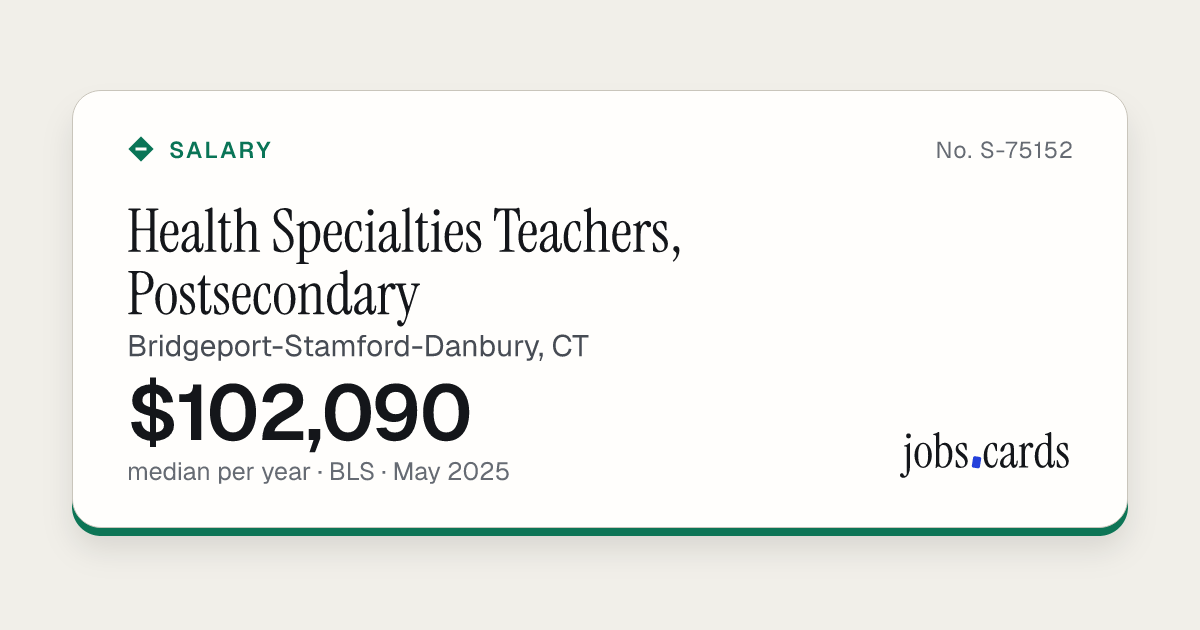
Health Specialties Teachers, Postsecondary

Bridgeport-Stamford-Danbury, CTGovernment job code 25-1071

Market pay · all workers · BLS, May 2025

$102,090median pay per year
10th
$61,990
25th
$75,020
Median
$102,090
75th
$161,990
90th
$213,700

Small sample: BLS marks this estimate as less reliable, so treat the figures with care.

BLS publishes yearly figures only for this job.

Government wage levels · wage year 2026-27

Level I
$133,265,600
Level II
$200,755,360
Level III
$268,243,040
Level IV
$335,732,800

The four pay levels the Department of Labor sets for this job in Bridgeport-Stamford-Danbury, CT. Yearly figures are the hourly level times 2,080 hours.

Filed pay

Fewer than 10 certified full-time filings for this job here, so there is no filed-pay figure.

Against the U.S. median
−5%
Mean pay per year
$129,290
Source: U.S. Bureau of Labor Statistics, May 2025 data · checked Nov 16, 2026
SourcesNo.S-75152

Where This Card Comes From

We show the government's numbers as published. Yearly pay is the hourly figure times 2,080 hours. Nothing is modelled or guessed. The U.S. comparison uses the national median for the same job code.

This page includes information from the O*NET 31.0 Database by the U.S. Department of Labor, Employment and Training Administration (USDOL/ETA). Used under the CC BY 4.0 license. O*NET® is a trademark of USDOL/ETA.

Content hash a496b8ac · first dealt Nov 16, 2026 · last changed Nov 16, 2026
Save as Image Compare

jobs.cards/c/S-75152

What Does This Job Pay in Bridgeport-Stamford-Danbury, CT?

Health Specialties Teachers, Postsecondary in Bridgeport-Stamford-Danbury, CT earn a median of $102,090 a year, according to the U.S. Bureau of Labor Statistics survey for May 2025. Half earn between $75,020 and $161,990. The lowest-paid tenth earn under $61,990 and the highest-paid tenth earn over $213,700. These are government survey figures, not estimates from ads.

Checked Nov 16, 2026Source: U.S. Bureau of Labor Statistics

Reading the Numbers

Worked out from the published figures on this card. Nothing here is an estimate.

  • The median here is 5% below the national median of $107,310 for the same job.
  • The middle half of workers earn between $75,020 and $161,990, a band $86,970 wide.
  • Pay at the 90th percentile ($213,700) is 3.4 times pay at the 10th ($61,990).
  • The average (mean) is $129,290, 27% above the median. An average above the median means a smaller group of high earners pulls it up.
  • The market median of $102,090 is below government wage Level I for this job and area (wage year 2026-27).

Connecticut requires pay or a pay range in job ads from covered employers. What Connecticut’s rule says

What Health Specialties Teachers, Postsecondary Do

Teach courses in health specialties, in fields such as dentistry, laboratory technology, medicine, pharmacy, public health, therapy, and veterinary medicine.

Common job titles: Assistant Professor, Associate Professor, Clinical Professor, Instructor, Lecturer, Occupational Therapy Professor, Pharmacology Professor, Physical Therapy Professor, Professor, Public Health Professor.

What the Work Involves

The five tasks that workers and experts surveyed by O*NET rate most important for this job, most important first.

  • Prepare course materials, such as syllabi, homework assignments, and handouts.
  • Keep abreast of developments in the field by reading current literature, talking with colleagues, and participating in professional conferences.
  • Evaluate and grade students' class work, assignments, and papers.
  • Supervise laboratory sessions.
  • Compile, administer, and grade examinations, or assign this work to others.

Education. 36% of workers surveyed by O*NET said the level required for this job is: Master's Degree.

Preparation This Job Usually Needs

Job Zone Five: Extensive Preparation Needed. Most of these occupations require graduate school. For example, they may require a master's degree, and some require a Ph.D., M.D., or J.D. (law degree). Employees may need some on-the-job training, but most of these occupations assume that the person will already have the required skills, knowledge, work-related experience, and/or training. Extensive skill, knowledge, and experience are needed for these occupations. Many require more than five years of experience. For example, surgeons must complete four years of college and an additional five to seven years of specialized medical training to be able to do their job.

This page includes information from the O*NET 31.0 Database by the U.S. Department of Labor, Employment and Training Administration (USDOL/ETA). Used under the CC BY 4.0 license. O*NET® is a trademark of USDOL/ETA.

Embed This Card

Paste this where you want the card to appear. It stays up to date.