We show the government's numbers as published. Yearly pay is the hourly figure times 2,080 hours. Nothing is modelled or guessed. The U.S. comparison uses the national median for the same job code.
This page includes information from the O*NET 31.0 Database by the U.S. Department of Labor, Employment and Training Administration (USDOL/ETA). Used under the CC BY 4.0 license. O*NET® is a trademark of USDOL/ETA.
Content hash d1de96c7 · first dealt Nov 16, 2026 · last changed Nov 16, 2026
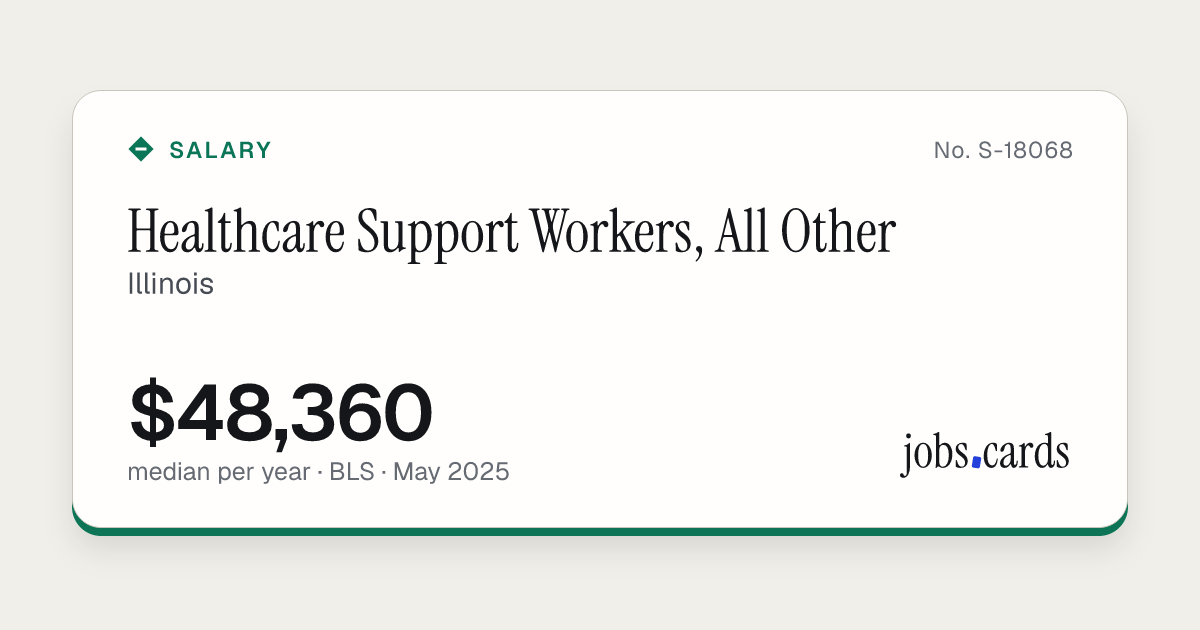
Healthcare Support Workers, All Other in Illinois earn a median of $48,360 a year, according to the U.S. Bureau of Labor Statistics survey for May 2025. Half earn between $39,570 and $60,300. The lowest-paid tenth earn under $37,290 and the highest-paid tenth earn over $68,040. These are government survey figures, not estimates from ads.
Checked Nov 16, 2026Source: U.S. Bureau of Labor Statistics
Reading the Numbers
Worked out from the published figures on this card. Nothing here is an estimate.
The median here is about the same as the national median of $48,430 for the same job.
Among the 43 states and territories where the Bureau of Labor Statistics publishes a reliable median for this job, Illinois ranks 14th by median pay. Washington is highest at $62,040 and Puerto Rico lowest at $26,660.
1,330 people hold this job here, 1.2% of the 109,740 who hold it across the country.
Of every 1,000 jobs here, 0.22 are this job, which makes it 69% less common here than in the U.S. as a whole.
The middle half of workers earn between $39,570 and $60,300, a band $20,730 wide.
Pay at the 90th percentile ($68,040) is 1.8 times pay at the 10th ($37,290).
The average (mean) is $51,210, 6% above the median. An average above the median means a smaller group of high earners pulls it up.
All healthcare support workers not listed separately.
Preparation This Job Usually Needs
Job Zone Three: Medium Preparation Needed. Most occupations in this zone require training in vocational schools, related on-the-job experience, or an associate's degree. Employees in these occupations usually need one or two years of training involving both on-the-job experience and informal training with experienced workers. A recognized apprenticeship program may be associated with these occupations. Previous work-related skill, knowledge, or experience is required for these occupations. For example, an electrician must have completed three or four years of apprenticeship or several years of vocational training, and often must have passed a licensing exam, in order to perform the job.
This page includes information from the O*NET 31.0 Database by the U.S. Department of Labor, Employment and Training Administration (USDOL/ETA). Used under the CC BY 4.0 license. O*NET® is a trademark of USDOL/ETA.