We show the government's numbers as published. Yearly pay is the hourly figure times 2,080 hours. Nothing is modelled or guessed. The U.S. comparison uses the national median for the same job code.
This page includes information from the O*NET 31.0 Database by the U.S. Department of Labor, Employment and Training Administration (USDOL/ETA). Used under the CC BY 4.0 license. O*NET® is a trademark of USDOL/ETA.
Content hash be828743 · first dealt Nov 16, 2026 · last changed Nov 16, 2026
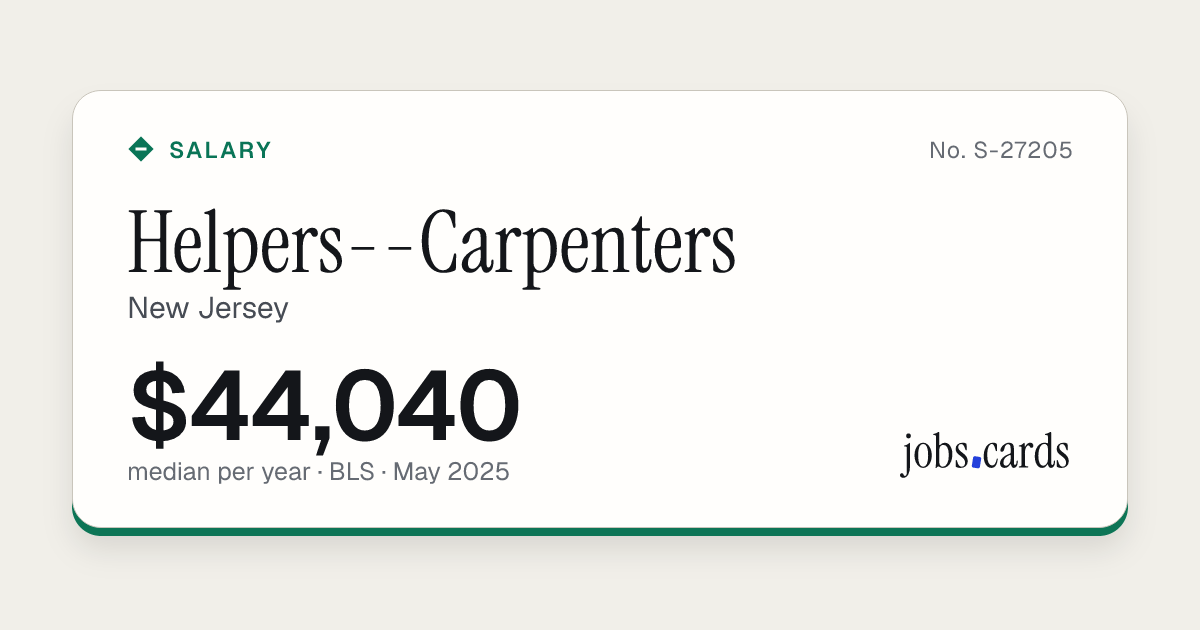
Helpers--Carpenters in New Jersey earn a median of $44,040 a year, according to the U.S. Bureau of Labor Statistics survey for May 2025. Half earn between $33,870 and $50,300. The lowest-paid tenth earn under $32,220 and the highest-paid tenth earn over $58,240. These are government survey figures, not estimates from ads.
Checked Nov 16, 2026Source: U.S. Bureau of Labor Statistics
Reading the Numbers
Worked out from the published figures on this card. Nothing here is an estimate.
The median here is 1% above the national median of $43,780 for the same job.
Among the 17 states and territories where the Bureau of Labor Statistics publishes a reliable median for this job, New Jersey ranks 3rd by median pay. California is highest at $49,890 and Puerto Rico lowest at $24,530.
840 people hold this job here, 3.9% of the 21,680 who hold it across the country.
Of every 1,000 jobs here, 0.2 are this job, which makes it 41% more common here than in the U.S. as a whole.
The middle half of workers earn between $33,870 and $50,300, a band $16,430 wide.
Pay at the 90th percentile ($58,240) is 1.8 times pay at the 10th ($32,220).
The average (mean) is $44,100, within 3% of the median, so pay is spread fairly evenly around the middle.
Help carpenters by performing duties requiring less skill. Duties include using, supplying, or holding materials or tools, and cleaning work area and equipment.
Common job titles: Carpenter Apprentice, Carpenter Assistant, Carpenter Helper.
What the Work Involves
The five tasks that workers and experts surveyed by O*NET rate most important for this job, most important first.
Erect scaffolding, shoring, or braces.
Clean work areas, machines, or equipment, to maintain a clean and safe job site.
Align, straighten, plumb, or square forms for installation.
Select tools, equipment, or materials from storage and transport items to work site.
Construct forms and assist in raising them to the required elevation.
Preparation This Job Usually Needs
Job Zone 1-2: Very Little to Some Preparation Needed. Usually requires a high school diploma or GED, though some occupations may not. Ranges from a few days to one year of on-the-job training. Some occupations may need little or no previous experience; others require several months to a year of experience. For example, landscaping and groundskeeping workers might require very little training or previous experience, while agricultural equipment operators can benefit from on-the job training.
This page includes information from the O*NET 31.0 Database by the U.S. Department of Labor, Employment and Training Administration (USDOL/ETA). Used under the CC BY 4.0 license. O*NET® is a trademark of USDOL/ETA.