Search job, employer or placeSearch cards/Check an Offer
SalaryNo.S-146149

Helpers--Electricians

Greensboro-High Point, NCGovernment job code 47-3013

Market pay · all workers · BLS, May 2025

$42,670median pay per year · $20.51 an hour
10th
$35,390
25th
$38,150
Median
$42,670
75th
$47,620
90th
$49,080

Government wage levels · wage year 2026-27

Level I
$35,443
Level II
$38,792
Level III
$42,162
Level IV
$45,510

The four pay levels the Department of Labor sets for this job in Greensboro-High Point, NC. Yearly figures are the hourly level times 2,080 hours.

Filed pay

Fewer than 10 certified full-time filings for this job here, so there is no filed-pay figure.

People in this job here
560
Against the U.S. median
0%
Mean pay per year
$42,190
Source: U.S. Bureau of Labor Statistics, May 2025 data · checked Nov 16, 2026
SourcesNo.S-146149

Where This Card Comes From

We show the government's numbers as published. Yearly pay is the hourly figure times 2,080 hours. Nothing is modelled or guessed. The U.S. comparison uses the national median for the same job code.

This page includes information from the O*NET 31.0 Database by the U.S. Department of Labor, Employment and Training Administration (USDOL/ETA). Used under the CC BY 4.0 license. O*NET® is a trademark of USDOL/ETA.

Content hash 534e9350 · first dealt Nov 16, 2026 · last changed Nov 16, 2026
Save as Image Compare

jobs.cards/c/S-146149

What Does This Job Pay in Greensboro-High Point, NC?

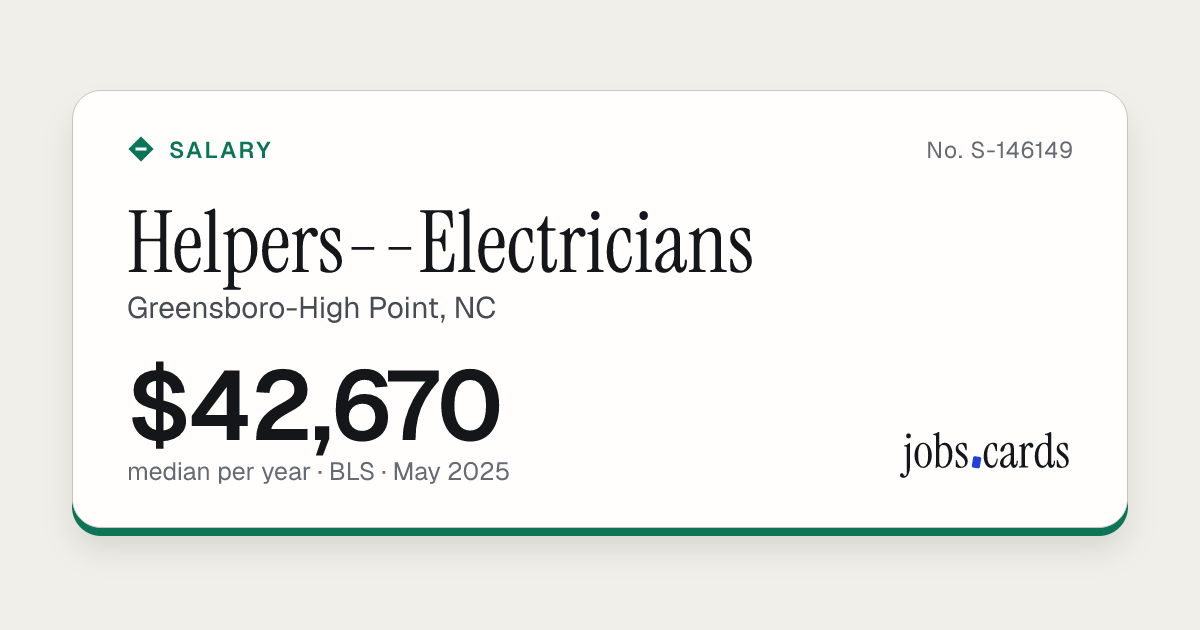
Helpers--Electricians in Greensboro-High Point, NC earn a median of $42,670 a year, according to the U.S. Bureau of Labor Statistics survey for May 2025. Half earn between $38,150 and $47,620. The lowest-paid tenth earn under $35,390 and the highest-paid tenth earn over $49,080. These are government survey figures, not estimates from ads.

Checked Nov 16, 2026Source: U.S. Bureau of Labor Statistics

Reading the Numbers

Worked out from the published figures on this card. Nothing here is an estimate.

  • The median here is about the same as the national median of $42,670 for the same job.
  • It is 7% above the North Carolina median of $39,880.
  • 560 people hold this job here, 0.9% of the 63,630 who hold it across the country.
  • Of every 1,000 jobs here, 1.54 are this job, which makes it 3.8 times as common here as in the U.S. as a whole.
  • The middle half of workers earn between $38,150 and $47,620, a band $9,470 wide.
  • Pay at the 90th percentile ($49,080) is 1.4 times pay at the 10th ($35,390).
  • The average (mean) is $42,190, within 3% of the median, so pay is spread fairly evenly around the middle.
  • By the hour, the published median is $20.51.
  • The market median of $42,670 meets government wage Level III for this job and area (wage year 2026-27).

What Helpers--Electricians Do

Help electricians by performing duties requiring less skill. Duties include using, supplying, or holding materials or tools, and cleaning work area and equipment.

Common job titles: Apprentice, E and I Apprentice (Electrical and Instrumentation Apprentice), E and I Apprentice (Electrician and Instrumentation Apprentice), Electrical Apprentice, Electrical Helper, Electrician Apprentice, Electrician Helper, Electrician's Helper, Inside Wireman Apprentice, Wireman Apprentice.

What the Work Involves

The five tasks that workers and experts surveyed by O*NET rate most important for this job, most important first.

  • Strip insulation from wire ends, using wire stripping pliers, and attach wires to terminals for subsequent soldering.
  • Trace out short circuits in wiring, using test meter.
  • Measure, cut, and bend wire and conduit, using measuring instruments and hand tools.
  • Examine electrical units for loose connections and broken insulation and tighten connections, using hand tools.
  • Maintain tools, vehicles, and equipment and keep parts and supplies in order.

Education. 71% of workers surveyed by O*NET said the level required for this job is: High School Diploma or the equivalent.

Preparation This Job Usually Needs

Job Zone 1-2: Very Little to Some Preparation Needed. Usually requires a high school diploma or GED, though some occupations may not. Ranges from a few days to one year of on-the-job training. Some occupations may need little or no previous experience; others require several months to a year of experience. For example, landscaping and groundskeeping workers might require very little training or previous experience, while agricultural equipment operators can benefit from on-the job training.

This page includes information from the O*NET 31.0 Database by the U.S. Department of Labor, Employment and Training Administration (USDOL/ETA). Used under the CC BY 4.0 license. O*NET® is a trademark of USDOL/ETA.

Embed This Card

Paste this where you want the card to appear. It stays up to date.