We show the government's numbers as published. Yearly pay is the hourly figure times 2,080 hours. Nothing is modelled or guessed. The U.S. comparison uses the national median for the same job code.
This page includes information from the O*NET 31.0 Database by the U.S. Department of Labor, Employment and Training Administration (USDOL/ETA). Used under the CC BY 4.0 license. O*NET® is a trademark of USDOL/ETA.
Content hash 16d88ace · first dealt Nov 16, 2026 · last changed Nov 16, 2026
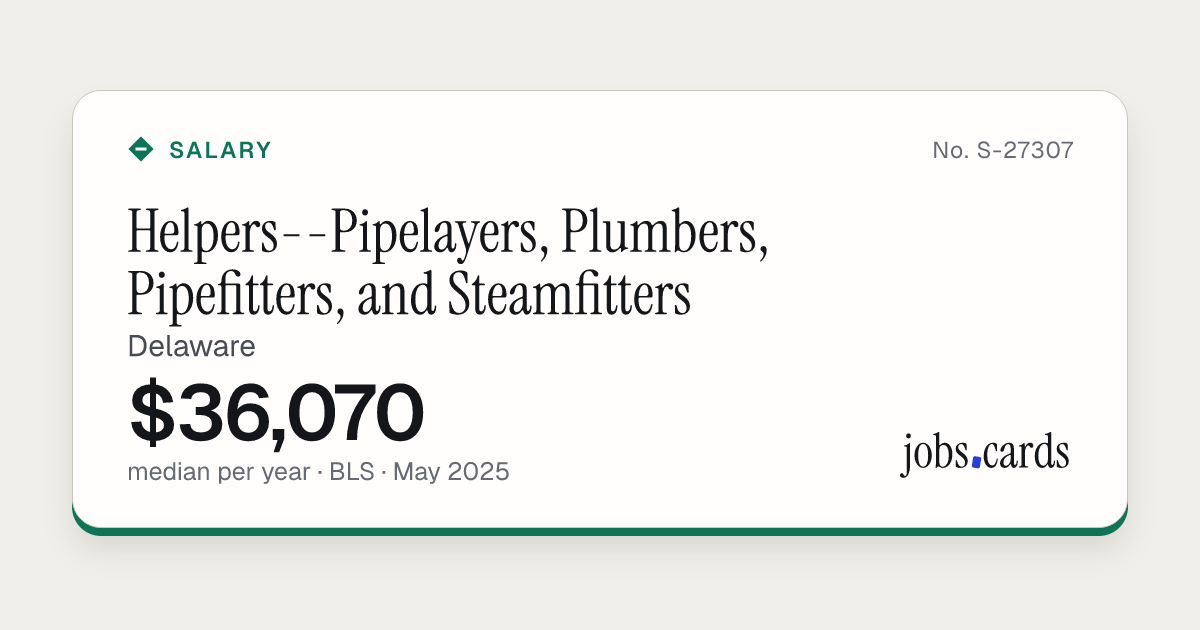
Helpers--Pipelayers, Plumbers, Pipefitters, and Steamfitters in Delaware earn a median of $36,070 a year, according to the U.S. Bureau of Labor Statistics survey for May 2025. Half earn between $34,370 and $41,580. The lowest-paid tenth earn under $32,300 and the highest-paid tenth earn over $43,800. These are government survey figures, not estimates from ads.
Checked Nov 16, 2026Source: U.S. Bureau of Labor Statistics
Reading the Numbers
Worked out from the published figures on this card. Nothing here is an estimate.
The median here is 15% below the national median of $42,360 for the same job.
140 people hold this job here, 0.3% of the 44,330 who hold it across the country.
Of every 1,000 jobs here, 0.29 are this job, about as common here as in the U.S. as a whole.
The middle half of workers earn between $34,370 and $41,580, a band $7,210 wide.
Pay at the 90th percentile ($43,800) is 1.4 times pay at the 10th ($32,300).
The average (mean) is $38,260, 6% above the median. An average above the median means a smaller group of high earners pulls it up.
By the hour, the published median is $17.34.
Delaware has enacted a law that will require pay in job ads from Sep 26, 2027. What Delaware’s rule says
What Helpers--Pipelayers, Plumbers, Pipefitters, and Steamfitters Do
Help plumbers, pipefitters, steamfitters, or pipelayers by performing duties requiring less skill. Duties include using, supplying, or holding materials or tools, and cleaning work area and equipment.
The five tasks that workers and experts surveyed by O*NET rate most important for this job, most important first.
Fit or assist in fitting valves, couplings, or assemblies to tanks, pumps, or systems, using hand tools.
Mount brackets and hangers on walls and ceilings to hold pipes, and set sleeves or inserts to provide support for pipes.
Perform rough-ins, repair and replace fixtures and water heaters, and locate, repair, or remove leaking or broken pipes.
Cut pipe and lift up to fitters.
Measure, cut, thread and assemble new pipe, placing the assembled pipe in hangers or other supports.
Preparation This Job Usually Needs
Job Zone 1-2: Very Little to Some Preparation Needed. Usually requires a high school diploma or GED, though some occupations may not. Ranges from a few days to one year of on-the-job training. Some occupations may need little or no previous experience; others require several months to a year of experience. For example, landscaping and groundskeeping workers might require very little training or previous experience, while agricultural equipment operators can benefit from on-the job training.
This page includes information from the O*NET 31.0 Database by the U.S. Department of Labor, Employment and Training Administration (USDOL/ETA). Used under the CC BY 4.0 license. O*NET® is a trademark of USDOL/ETA.