We show the government's numbers as published. Yearly pay is the hourly figure times 2,080 hours. Nothing is modelled or guessed. The U.S. comparison uses the national median for the same job code.
This page includes information from the O*NET 31.0 Database by the U.S. Department of Labor, Employment and Training Administration (USDOL/ETA). Used under the CC BY 4.0 license. O*NET® is a trademark of USDOL/ETA.
Content hash 959bd94a · first dealt Nov 16, 2026 · last changed Nov 16, 2026
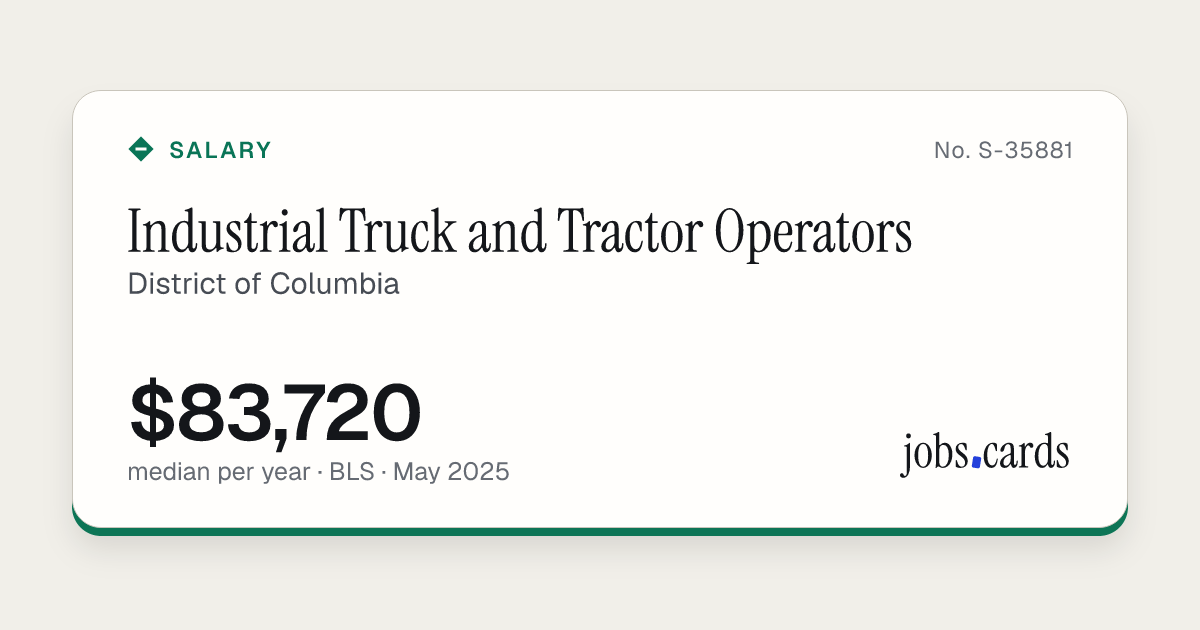
Industrial Truck and Tractor Operators in District of Columbia earn a median of $83,720 a year, according to the U.S. Bureau of Labor Statistics survey for May 2025. Half earn between $70,710 and $83,720. The lowest-paid tenth earn under $57,050 and the highest-paid tenth earn over $83,720. These are government survey figures, not estimates from ads.
Checked Nov 16, 2026Source: U.S. Bureau of Labor Statistics
Reading the Numbers
Worked out from the published figures on this card. Nothing here is an estimate.
The median here is 80% above the national median of $46,420 for the same job.
The middle half of workers earn between $70,710 and $83,720, a band $13,010 wide.
Pay at the 90th percentile ($83,720) is 1.5 times pay at the 10th ($57,050).
The average (mean) is $76,770, 8% below the median, so more of the spread lies on the low side.
Operate industrial trucks or tractors equipped to move materials around a warehouse, storage yard, factory, construction site, or similar location.
Common job titles: Checker Loader, Fork Lift Technician, Fork Truck Driver, Forklift Driver, Forklift Operator, Lift Truck Operator, Shag Truck Driver, Spotter Driver, Tow Motor Operator, Truck Driver.
What the Work Involves
The five tasks that workers and experts surveyed by O*NET rate most important for this job, most important first.
Move levers or controls that operate lifting devices, such as forklifts, lift beams with swivel-hooks, hoists, or elevating platforms, to load, unload, transport, or stack material.
Move controls to drive gasoline- or electric-powered trucks, cars, or tractors and transport materials between loading, processing, and storage areas.
Manually or mechanically load or unload materials from pallets, skids, platforms, cars, lifting devices, or other transport vehicles.
Position lifting devices under, over, or around loaded pallets, skids, or boxes and secure material or products for transport to designated areas.
Inspect product load for accuracy and safely move it around the warehouse or facility to ensure timely and complete delivery.
Preparation This Job Usually Needs
Job Zone 1-2: Very Little to Some Preparation Needed. Usually requires a high school diploma or GED, though some occupations may not. Ranges from a few days to one year of on-the-job training. Some occupations may need little or no previous experience; others require several months to a year of experience. For example, landscaping and groundskeeping workers might require very little training or previous experience, while agricultural equipment operators can benefit from on-the job training.
This page includes information from the O*NET 31.0 Database by the U.S. Department of Labor, Employment and Training Administration (USDOL/ETA). Used under the CC BY 4.0 license. O*NET® is a trademark of USDOL/ETA.