Search job, employer or placeSearch cards/Check an Offer
SalaryNo.S-144104

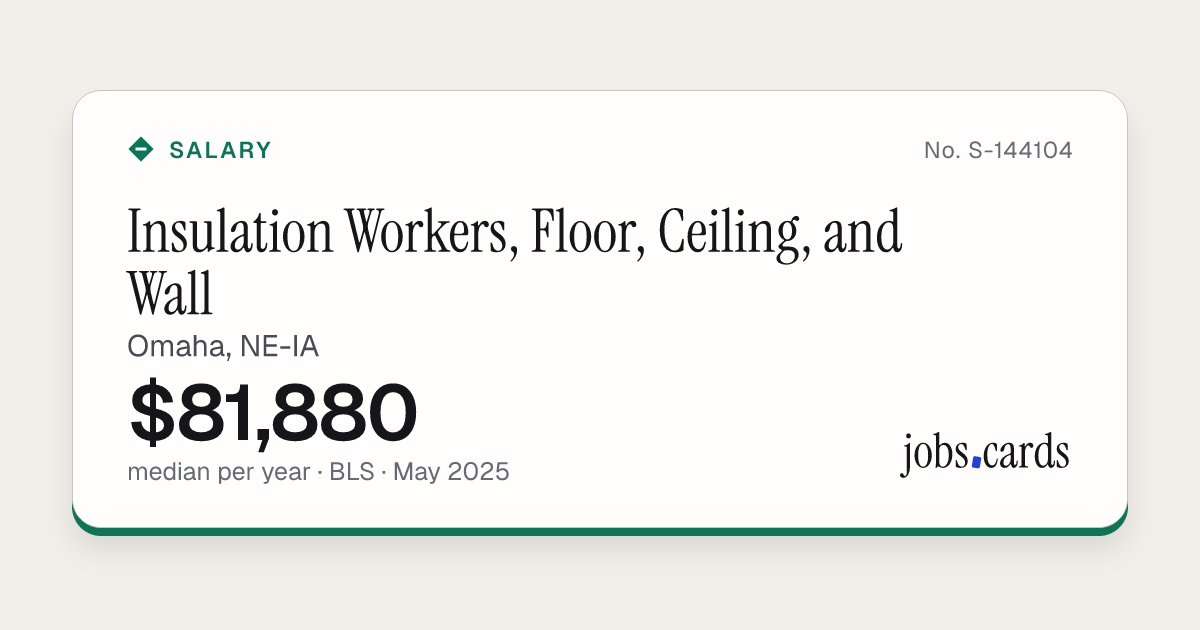
Insulation Workers, Floor, Ceiling, and Wall

Omaha, NE-IAGovernment job code 47-2131

Market pay · all workers · BLS, May 2025

$81,880median pay per year · $39.36 an hour
10th
$44,550
25th
$47,490
Median
$81,880
75th
$82,270
90th
$89,180

Small sample: BLS marks this estimate as less reliable, so treat the figures with care.

Government wage levels · wage year 2026-27

Level I
$46,696
Level II
$57,824
Level III
$68,952
Level IV
$80,080

The four pay levels the Department of Labor sets for this job in Omaha, NE-IA. Yearly figures are the hourly level times 2,080 hours.

Filed pay

Fewer than 10 certified full-time filings for this job here, so there is no filed-pay figure.

Against the U.S. median
+67%
Mean pay per year
$69,050
Source: U.S. Bureau of Labor Statistics, May 2025 data · checked Nov 16, 2026
SourcesNo.S-144104

Where This Card Comes From

We show the government's numbers as published. Yearly pay is the hourly figure times 2,080 hours. Nothing is modelled or guessed. The U.S. comparison uses the national median for the same job code.

This page includes information from the O*NET 31.0 Database by the U.S. Department of Labor, Employment and Training Administration (USDOL/ETA). Used under the CC BY 4.0 license. O*NET® is a trademark of USDOL/ETA.

Content hash 8555ac90 · first dealt Nov 16, 2026 · last changed Nov 16, 2026
Save as Image Compare

jobs.cards/c/S-144104

What Does This Job Pay in Omaha, NE-IA?

Insulation Workers, Floor, Ceiling, and Wall in Omaha, NE-IA earn a median of $81,880 a year, according to the U.S. Bureau of Labor Statistics survey for May 2025. Half earn between $47,490 and $82,270. The lowest-paid tenth earn under $44,550 and the highest-paid tenth earn over $89,180. These are government survey figures, not estimates from ads.

Checked Nov 16, 2026Source: U.S. Bureau of Labor Statistics

Reading the Numbers

Worked out from the published figures on this card. Nothing here is an estimate.

  • The median here is 67% above the national median of $49,120 for the same job.
  • It is 12% above the Nebraska median of $73,140.
  • The middle half of workers earn between $47,490 and $82,270, a band $34,780 wide.
  • Pay at the 90th percentile ($89,180) is 2.0 times pay at the 10th ($44,550).
  • The average (mean) is $69,050, 16% below the median, so more of the spread lies on the low side.
  • By the hour, the published median is $39.36.
  • The market median of $81,880 meets government wage Level IV for this job and area (wage year 2026-27).

What Insulation Workers, Floor, Ceiling, and Wall Do

Line and cover structures with insulating materials. May work with batt, roll, or blown insulation materials.

Common job titles: Attic Blower, Insulation Estimator, Insulation Installer, Insulation Mechanic, Insulation Worker, Insulator, Retrofit Installer, Spray Foam Installer, Warehouse Insulation Worker.

What the Work Involves

The five tasks that workers and experts surveyed by O*NET rate most important for this job, most important first.

  • Measure and cut insulation for covering surfaces, using tape measures, handsaws, power saws, knives, or scissors.
  • Fit, wrap, staple, or glue insulating materials to structures or surfaces, using hand tools or wires.
  • Cover and line structures with blown or rolled forms of materials to insulate against cold, heat, or moisture, using saws, knives, rasps, trowels, blowers, or other tools and implements.
  • Distribute insulating materials evenly into small spaces within floors, ceilings, or walls, using blowers and hose attachments, or cement mortars.
  • Move controls, buttons, or levers to start blowers and regulate flow of materials through nozzles.

Education. 68% of workers surveyed by O*NET said the level required for this job is: High School Diploma or the equivalent.

Preparation This Job Usually Needs

Job Zone 1-2: Very Little to Some Preparation Needed. Usually requires a high school diploma or GED, though some occupations may not. Ranges from a few days to one year of on-the-job training. Some occupations may need little or no previous experience; others require several months to a year of experience. For example, landscaping and groundskeeping workers might require very little training or previous experience, while agricultural equipment operators can benefit from on-the job training.

This page includes information from the O*NET 31.0 Database by the U.S. Department of Labor, Employment and Training Administration (USDOL/ETA). Used under the CC BY 4.0 license. O*NET® is a trademark of USDOL/ETA.

Embed This Card

Paste this where you want the card to appear. It stays up to date.