We show the government's numbers as published. Yearly pay is the hourly figure times 2,080 hours. Nothing is modelled or guessed. The U.S. comparison uses the national median for the same job code.
This page includes information from the O*NET 31.0 Database by the U.S. Department of Labor, Employment and Training Administration (USDOL/ETA). Used under the CC BY 4.0 license. O*NET® is a trademark of USDOL/ETA.
Content hash e25a9cda · first dealt Nov 16, 2026 · last changed Nov 16, 2026
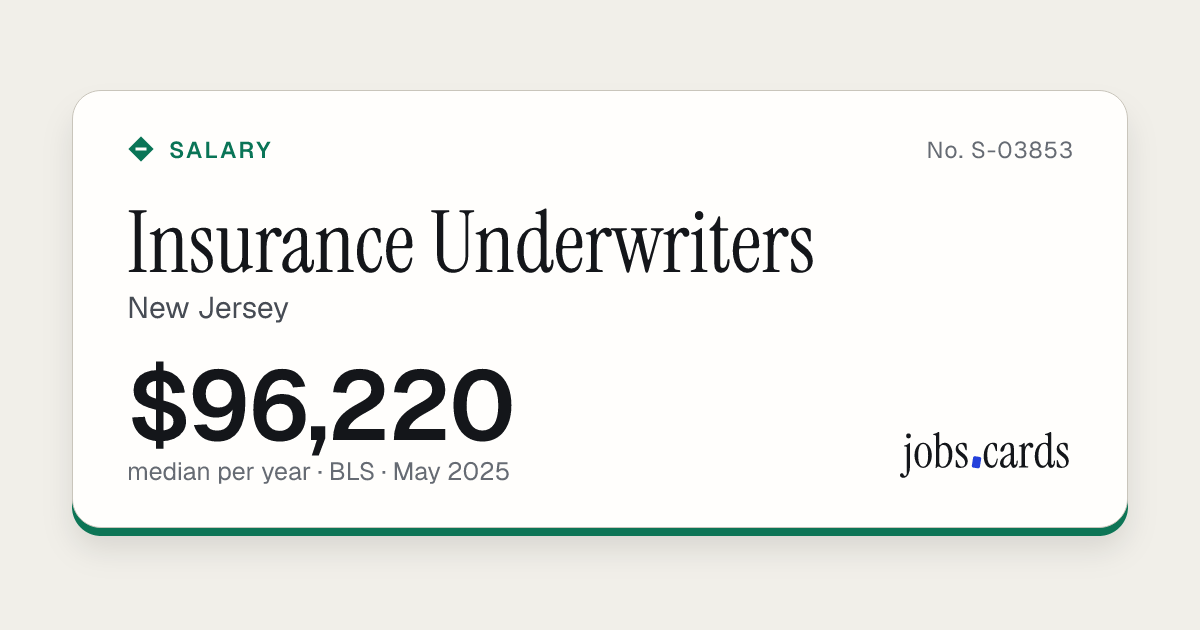
Insurance Underwriters in New Jersey earn a median of $96,220 a year, according to the U.S. Bureau of Labor Statistics survey for May 2025. Half earn between $79,230 and $120,970. The lowest-paid tenth earn under $66,290 and the highest-paid tenth earn over $144,230. These are government survey figures, not estimates from ads.
Checked Nov 16, 2026Source: U.S. Bureau of Labor Statistics
Reading the Numbers
Worked out from the published figures on this card. Nothing here is an estimate.
The median here is 18% above the national median of $81,370 for the same job.
Among the 37 states and territories where the Bureau of Labor Statistics publishes a reliable median for this job, New Jersey ranks 8th by median pay. Massachusetts is highest at $106,640 and Puerto Rico lowest at $46,990.
3,150 people hold this job here, 3.0% of the 105,420 who hold it across the country.
Of every 1,000 jobs here, 0.73 are this job, which makes it 8% more common here than in the U.S. as a whole.
The middle half of workers earn between $79,230 and $120,970, a band $41,740 wide.
Pay at the 90th percentile ($144,230) is 2.2 times pay at the 10th ($66,290).
The average (mean) is $99,990, 4% above the median. An average above the median means a smaller group of high earners pulls it up.
Review individual applications for insurance to evaluate degree of risk involved and determine acceptance of applications.
Common job titles: Account Underwriter, Automobile and Property Underwriter, Commercial Lines Underwriter, Health Underwriter, Life Underwriter, Personal Lines Underwriter, Underwriter, Underwriting Consultant.
What the Work Involves
The five tasks that workers and experts surveyed by O*NET rate most important for this job, most important first.
Examine documents to determine degree of risk from factors such as applicant health, financial standing and value, and condition of property.
Decline excessive risks.
Write to field representatives, medical personnel, or others to obtain further information, quote rates, or explain company underwriting policies.
Evaluate possibility of losses due to catastrophe or excessive insurance.
Review company records to determine amount of insurance in force on single risk or group of closely related risks.
Education. 70% of workers surveyed by O*NET said the level required for this job is: Bachelor's Degree.
Preparation This Job Usually Needs
Job Zone Four: Considerable Preparation Needed. Most of these occupations require a four-year bachelor's degree, but some do not. Employees in these occupations usually need several years of work-related experience, on-the-job training, and/or vocational training. A considerable amount of work-related skill, knowledge, or experience is needed for these occupations. For example, an accountant must complete four years of college and work for several years in accounting to be considered qualified.
This page includes information from the O*NET 31.0 Database by the U.S. Department of Labor, Employment and Training Administration (USDOL/ETA). Used under the CC BY 4.0 license. O*NET® is a trademark of USDOL/ETA.
Employers That Filed Pay for This Job
What these employers told the government they pay for this job in New Jersey.