We show the government's numbers as published. Yearly pay is the hourly figure times 2,080 hours. Nothing is modelled or guessed. The U.S. comparison uses the national median for the same job code.
This page includes information from the O*NET 31.0 Database by the U.S. Department of Labor, Employment and Training Administration (USDOL/ETA). Used under the CC BY 4.0 license. O*NET® is a trademark of USDOL/ETA.
Content hash c2789cc8 · first dealt Nov 16, 2026 · last changed Nov 16, 2026
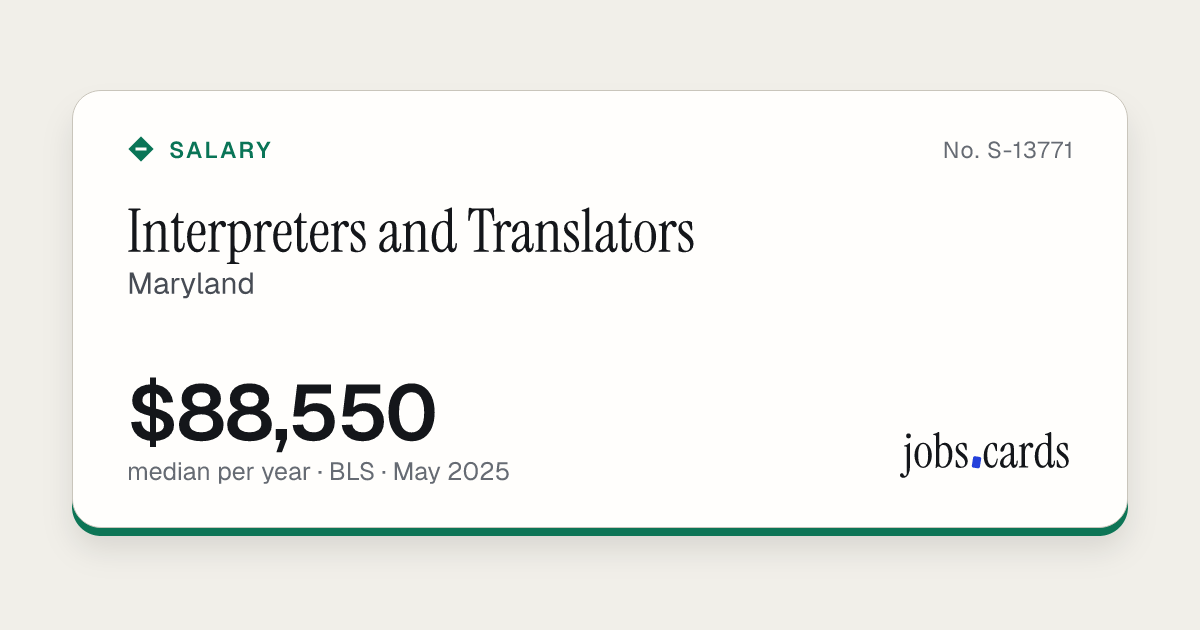
Interpreters and Translators in Maryland earn a median of $88,550 a year, according to the U.S. Bureau of Labor Statistics survey for May 2025. Half earn between $63,270 and $102,750. The lowest-paid tenth earn under $51,660 and the highest-paid tenth earn over $120,900. These are government survey figures, not estimates from ads.
Checked Nov 16, 2026Source: U.S. Bureau of Labor Statistics
Reading the Numbers
Worked out from the published figures on this card. Nothing here is an estimate.
The median here is 47% above the national median of $60,170 for the same job.
Among the 31 states and territories where the Bureau of Labor Statistics publishes a reliable median for this job, Maryland ranks 1st by median pay. Maryland is highest at $88,550 and Alabama lowest at $46,130.
1,150 people hold this job here, 2.2% of the 52,060 who hold it across the country.
Of every 1,000 jobs here, 0.41 are this job, which makes it 24% more common here than in the U.S. as a whole.
The middle half of workers earn between $63,270 and $102,750, a band $39,480 wide.
Pay at the 90th percentile ($120,900) is 2.3 times pay at the 10th ($51,660).
The average (mean) is $87,160, within 3% of the median, so pay is spread fairly evenly around the middle.
Interpret oral or sign language, or translate written text from one language into another.
Common job titles: American Sign Language Interpreter (ASL Interpreter), Court Interpreter, Educational Interpreter, Interpreter, Linguist, Medical Interpreter, Sign Language Interpreter, Spanish Interpreter, Spanish Translator, Translator.
What the Work Involves
The five tasks that workers and experts surveyed by O*NET rate most important for this job, most important first.
Follow ethical codes that protect the confidentiality of information.
Translate messages simultaneously or consecutively into specified languages, orally or by using hand signs, maintaining message content, context, and style as much as possible.
Listen to speakers' statements to determine meanings and to prepare translations, using electronic listening systems as necessary.
Compile terminology and information to be used in translations, including technical terms such as those for legal or medical material.
Adapt translations to students' cognitive and grade levels, collaborating with educational team members as necessary.
Education. 55% of workers surveyed by O*NET said the level required for this job is: Bachelor's Degree.
Preparation This Job Usually Needs
Job Zone Four: Considerable Preparation Needed. Most of these occupations require a four-year bachelor's degree, but some do not. Employees in these occupations usually need several years of work-related experience, on-the-job training, and/or vocational training. A considerable amount of work-related skill, knowledge, or experience is needed for these occupations. For example, an accountant must complete four years of college and work for several years in accounting to be considered qualified.
This page includes information from the O*NET 31.0 Database by the U.S. Department of Labor, Employment and Training Administration (USDOL/ETA). Used under the CC BY 4.0 license. O*NET® is a trademark of USDOL/ETA.