We show the government's numbers as published. Yearly pay is the hourly figure times 2,080 hours. Nothing is modelled or guessed. The U.S. comparison uses the national median for the same job code.
This page includes information from the O*NET 31.0 Database by the U.S. Department of Labor, Employment and Training Administration (USDOL/ETA). Used under the CC BY 4.0 license. O*NET® is a trademark of USDOL/ETA.
Content hash d7415ad1 · first dealt Nov 16, 2026 · last changed Nov 16, 2026
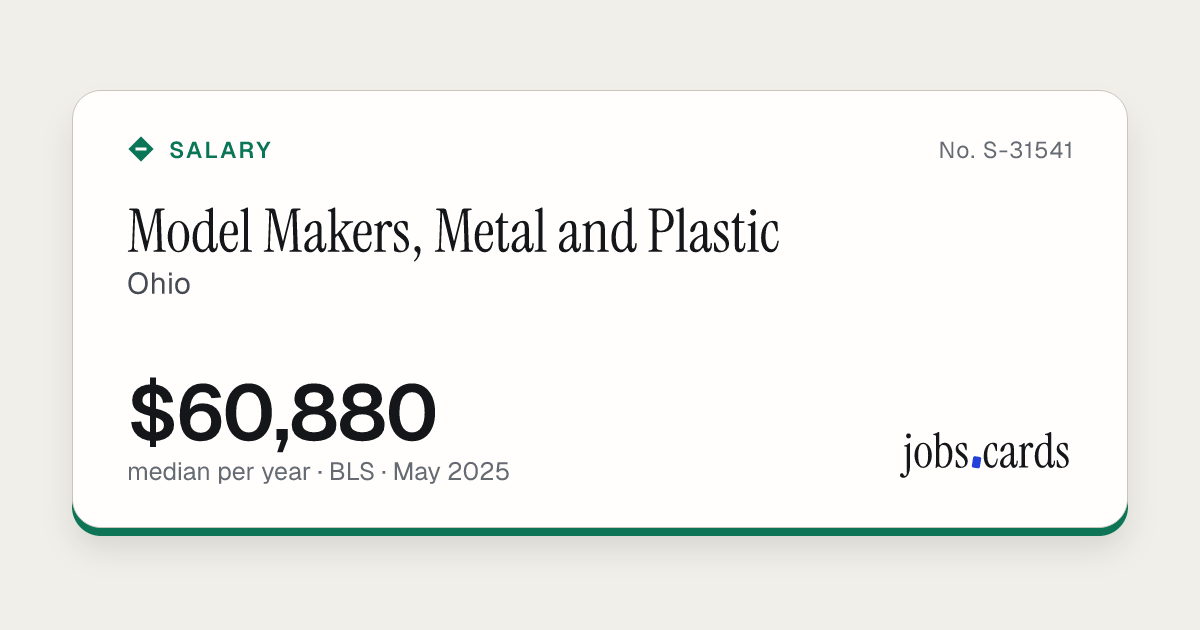
Model Makers, Metal and Plastic in Ohio earn a median of $60,880 a year, according to the U.S. Bureau of Labor Statistics survey for May 2025. Half earn between $51,580 and $61,840. The lowest-paid tenth earn under $46,770 and the highest-paid tenth earn over $76,080. These are government survey figures, not estimates from ads.
Checked Nov 16, 2026Source: U.S. Bureau of Labor Statistics
Reading the Numbers
Worked out from the published figures on this card. Nothing here is an estimate.
The median here is 4% below the national median of $63,340 for the same job.
60 people hold this job here, 2.3% of the 2,610 who hold it across the country.
Of every 1,000 jobs here, 0.011 are this job, which makes it 34% less common here than in the U.S. as a whole.
The middle half of workers earn between $51,580 and $61,840, a band $10,260 wide.
Pay at the 90th percentile ($76,080) is 1.6 times pay at the 10th ($46,770).
The average (mean) is $59,510, within 3% of the median, so pay is spread fairly evenly around the middle.
By the hour, the published median is $29.27.
Ohio has no statewide pay-range law, but Cleveland and Columbus have city rules. What Ohio’s rule says
What Model Makers, Metal and Plastic Do
Set up and operate machines, such as lathes, milling and engraving machines, and jig borers to make working models of metal or plastic objects. Includes template makers.
Common job titles: CNC Machinist (Computer Numerical Control Machinist), CNC Programmer (Computer Numerical Control Programmer), Metal Model Maker, Model Builder, Model Maker, Model Maker Machinist, Model Technician (Model Tech), Molding Technician (Molding Tech), Pattern Finisher, Prototype Special Build.
What the Work Involves
The five tasks that workers and experts surveyed by O*NET rate most important for this job, most important first.
Study blueprints, drawings, and sketches to determine material dimensions, required equipment, and operations sequences.
Set up and operate machines, such as lathes, drill presses, punch presses, or bandsaws, to fabricate prototypes or models.
Program computer numerical control (CNC) machines to fabricate model parts.
Inspect and test products to verify conformance to specifications, using precision measuring instruments or circuit testers.
Cut, shape, and form metal parts, using lathes, power saws, snips, power brakes and shears, files, and mallets.
Preparation This Job Usually Needs
Job Zone Three: Medium Preparation Needed. Most occupations in this zone require training in vocational schools, related on-the-job experience, or an associate's degree. Employees in these occupations usually need one or two years of training involving both on-the-job experience and informal training with experienced workers. A recognized apprenticeship program may be associated with these occupations. Previous work-related skill, knowledge, or experience is required for these occupations. For example, an electrician must have completed three or four years of apprenticeship or several years of vocational training, and often must have passed a licensing exam, in order to perform the job.
This page includes information from the O*NET 31.0 Database by the U.S. Department of Labor, Employment and Training Administration (USDOL/ETA). Used under the CC BY 4.0 license. O*NET® is a trademark of USDOL/ETA.