Search job, employer or placeSearch cards/Check an Offer
SalaryNo.S-16180

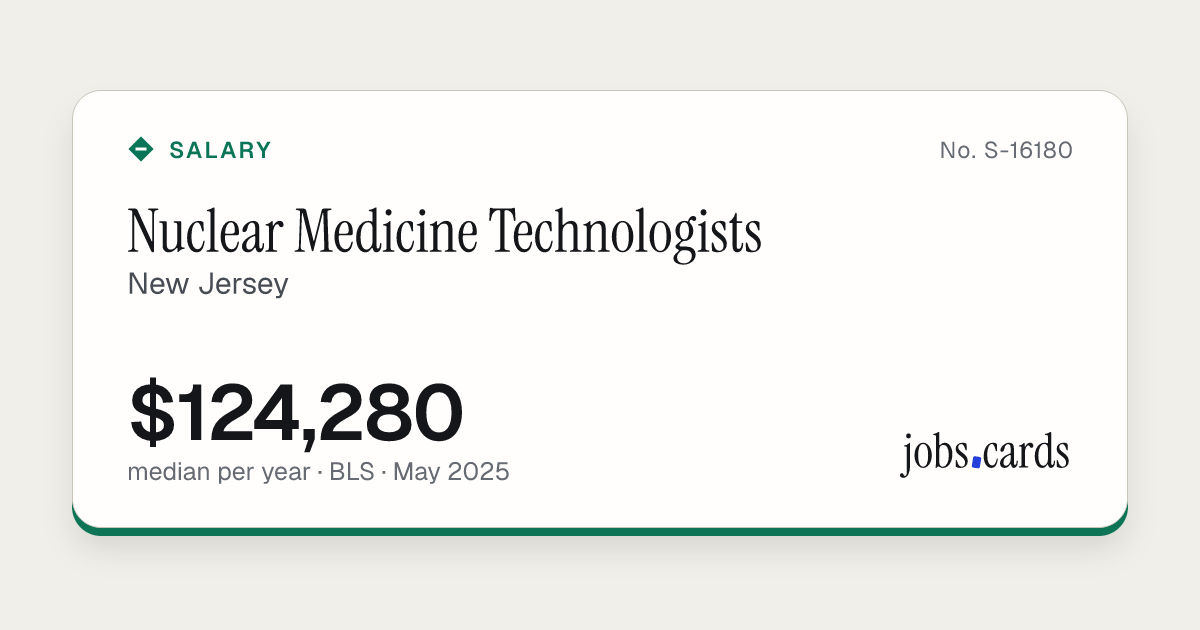
Nuclear Medicine Technologists

New JerseyGovernment job code 29-2033

Market pay · all workers · BLS, May 2025

$124,280median pay per year · $59.75 an hour
10th
$101,830
25th
$108,180
Median
$124,280
75th
$129,170
90th
$140,340

Government wage levels

Wage levels are set for each local area. Open a metro card for this job to see them.

Filed pay

Fewer than 10 certified full-time filings for this job here, so there is no filed-pay figure.

People in this job here
540
Against the U.S. median
+23%
Mean pay per year
$122,290
Source: U.S. Bureau of Labor Statistics, May 2025 data · checked Nov 16, 2026
SourcesNo.S-16180

Where This Card Comes From

We show the government's numbers as published. Yearly pay is the hourly figure times 2,080 hours. Nothing is modelled or guessed. The U.S. comparison uses the national median for the same job code.

This page includes information from the O*NET 31.0 Database by the U.S. Department of Labor, Employment and Training Administration (USDOL/ETA). Used under the CC BY 4.0 license. O*NET® is a trademark of USDOL/ETA.
Content hash b36209cd · first dealt Nov 16, 2026 · last changed Nov 16, 2026

Save as Image Compare

jobs.cards/c/S-16180

What Does This Job Pay in New Jersey?

Nuclear Medicine Technologists in New Jersey earn a median of $124,280 a year, according to the U.S. Bureau of Labor Statistics survey for May 2025. Half earn between $108,180 and $129,170. The lowest-paid tenth earn under $101,830 and the highest-paid tenth earn over $140,340. These are government survey figures, not estimates from ads.

Checked Nov 16, 2026Source: U.S. Bureau of Labor Statistics

Reading the Numbers

Worked out from the published figures on this card. Nothing here is an estimate.

  • The median here is 23% above the national median of $101,370 for the same job.
  • Among the 21 states and territories where the Bureau of Labor Statistics publishes a reliable median for this job, New Jersey ranks 3rd by median pay. California is highest at $162,380 and Kansas lowest at $64,610.
  • 540 people hold this job here, 3.2% of the 17,080 who hold it across the country.
  • Of every 1,000 jobs here, 0.13 are this job, which makes it 15% more common here than in the U.S. as a whole.
  • The middle half of workers earn between $108,180 and $129,170, a band $20,990 wide.
  • Pay at the 90th percentile ($140,340) is 1.4 times pay at the 10th ($101,830).
  • The average (mean) is $122,290, within 3% of the median, so pay is spread fairly evenly around the middle.
  • By the hour, the published median is $59.75.

New Jersey requires pay or a pay range in job ads from covered employers. What New Jersey’s rule says

Where This State Ranks

Its place among 21 states and territories, by median pay for this job.

All States
RankStateMedian PayPeople in the JobAgainst U.S.
1California$162,3801,500+60%
2Washington$126,200320+24%
3New Jersey$124,280540+23%
4New York$118,650890+17%
5Massachusetts$118,250380+17%

What Nuclear Medicine Technologists Do

Prepare, administer, and measure radioactive isotopes in therapeutic, diagnostic, and tracer studies using a variety of radioisotope equipment. Prepare stock solutions of radioactive materials and calculate doses to be administered by radiologists. Subject patients to radiation. Execute blood volume, red cell survival, and fat absorption studies following standard laboratory techniques.

Common job titles: Certified Nuclear Medicine Technologist (CNMT), Nuclear Cardiology Technologist, Nuclear Medicine PET-CT Technologist (Nuclear Medicine Positron Emission Tomography - Computed Tomography Technologist), Nuclear Medicine Technologist (NMT), Radiation Safety Officer, Registered Nuclear Medicine Technologist, Staff Nuclear Medicine Technologist.

What the Work Involves

The five tasks that workers and experts surveyed by O*NET rate most important for this job, most important first.

  • Administer radiopharmaceuticals or radiation intravenously to detect or treat diseases, using radioisotope equipment, under direction of a physician.
  • Detect and map radiopharmaceuticals in patients' bodies, using a camera to produce photographic or computer images.
  • Process cardiac function studies, using computer.
  • Calculate, measure, and record radiation dosage or radiopharmaceuticals received, used, and disposed, using computer and following physician's prescription.
  • Produce a computer-generated or film image for interpretation by a physician.

Education. 63% of workers surveyed by O*NET said the level required for this job is: Associate's Degree or other 2-year degree.

Preparation This Job Usually Needs

Job Zone Three: Medium Preparation Needed. Most occupations in this zone require training in vocational schools, related on-the-job experience, or an associate's degree. Employees in these occupations usually need one or two years of training involving both on-the-job experience and informal training with experienced workers. A recognized apprenticeship program may be associated with these occupations. Previous work-related skill, knowledge, or experience is required for these occupations. For example, an electrician must have completed three or four years of apprenticeship or several years of vocational training, and often must have passed a licensing exam, in order to perform the job.

This page includes information from the O*NET 31.0 Database by the U.S. Department of Labor, Employment and Training Administration (USDOL/ETA). Used under the CC BY 4.0 license. O*NET® is a trademark of USDOL/ETA.

Embed This Card

Paste this where you want the card to appear. It stays up to date.