Search job, employer or placeSearch cards/Check an Offer
SalaryNo.S-15127

Nurse Anesthetists

New JerseyGovernment job code 29-1151

Market pay · all workers · BLS, May 2025

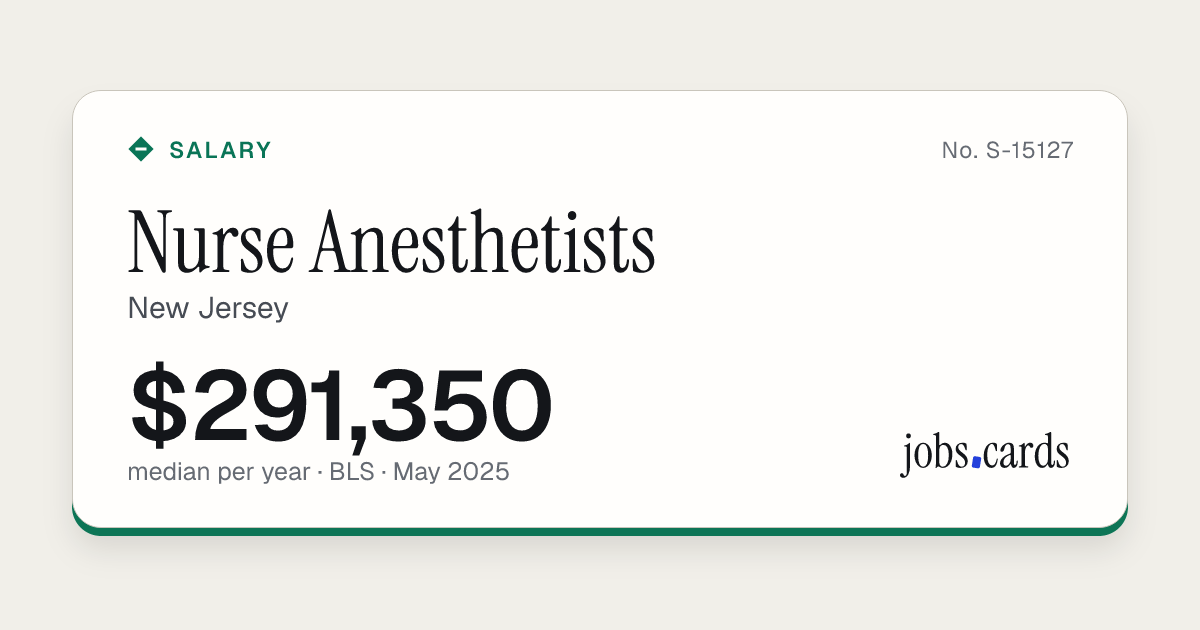
$291,350median pay per year · $140.07 an hour
10th
$229,130
25th
$238,580
Median
$291,350
75th
$311,830
90th
$370,880

Small sample: BLS marks this estimate as less reliable, so treat the figures with care.

Government wage levels

Wage levels are set for each local area. Open a metro card for this job to see them.

Filed pay

Fewer than 10 certified full-time filings for this job here, so there is no filed-pay figure.

Against the U.S. median
+23%
Mean pay per year
$290,920
Source: U.S. Bureau of Labor Statistics, May 2025 data · checked Nov 16, 2026
SourcesNo.S-15127

Where This Card Comes From

We show the government's numbers as published. Yearly pay is the hourly figure times 2,080 hours. Nothing is modelled or guessed. The U.S. comparison uses the national median for the same job code.

This page includes information from the O*NET 31.0 Database by the U.S. Department of Labor, Employment and Training Administration (USDOL/ETA). Used under the CC BY 4.0 license. O*NET® is a trademark of USDOL/ETA.

Content hash f262f040 · first dealt Nov 16, 2026 · last changed Nov 16, 2026
Save as Image Compare

jobs.cards/c/S-15127

What Does This Job Pay in New Jersey?

Nurse Anesthetists in New Jersey earn a median of $291,350 a year, according to the U.S. Bureau of Labor Statistics survey for May 2025. Half earn between $238,580 and $311,830. The lowest-paid tenth earn under $229,130 and the highest-paid tenth earn over $370,880. These are government survey figures, not estimates from ads.

Checked Nov 16, 2026Source: U.S. Bureau of Labor Statistics

Reading the Numbers

Worked out from the published figures on this card. Nothing here is an estimate.

  • The median here is 23% above the national median of $236,590 for the same job.
  • The middle half of workers earn between $238,580 and $311,830, a band $73,250 wide.
  • Pay at the 90th percentile ($370,880) is 1.6 times pay at the 10th ($229,130).
  • The average (mean) is $290,920, within 3% of the median, so pay is spread fairly evenly around the middle.
  • By the hour, the published median is $140.07.

New Jersey requires pay or a pay range in job ads from covered employers. What New Jersey’s rule says

What Nurse Anesthetists Do

Administer anesthesia, monitor patient's vital signs, and oversee patient recovery from anesthesia. May assist anesthesiologists, surgeons, other physicians, or dentists. Must be registered nurses who have specialized graduate education.

Common job titles: Certified Registered Nurse Anesthetist (CRNA), Nurse Anesthetist, Staff Certified Registered Nurse Anesthetist (Staff CRNA), Staff Nurse Anesthetist.

What the Work Involves

The five tasks that workers and experts surveyed by O*NET rate most important for this job, most important first.

  • Manage patients' airway or pulmonary status, using techniques such as endotracheal intubation, mechanical ventilation, pharmacological support, respiratory therapy, and extubation.
  • Respond to emergency situations by providing airway management, administering emergency fluids or drugs, or using basic or advanced cardiac life support techniques.
  • Monitor patients' responses, including skin color, pupil dilation, pulse, heart rate, blood pressure, respiration, ventilation, or urine output, using invasive and noninvasive techniques.
  • Select, order, or administer anesthetics, adjuvant drugs, accessory drugs, fluids or blood products as necessary.
  • Select, prepare, or use equipment, monitors, supplies, or drugs for the administration of anesthetics.

Education. 56% of workers surveyed by O*NET said the level required for this job is: Doctoral Degree.

Preparation This Job Usually Needs

Job Zone Five: Extensive Preparation Needed. Most of these occupations require graduate school. For example, they may require a master's degree, and some require a Ph.D., M.D., or J.D. (law degree). Employees may need some on-the-job training, but most of these occupations assume that the person will already have the required skills, knowledge, work-related experience, and/or training. Extensive skill, knowledge, and experience are needed for these occupations. Many require more than five years of experience. For example, surgeons must complete four years of college and an additional five to seven years of specialized medical training to be able to do their job.

This page includes information from the O*NET 31.0 Database by the U.S. Department of Labor, Employment and Training Administration (USDOL/ETA). Used under the CC BY 4.0 license. O*NET® is a trademark of USDOL/ETA.

The Same Job in Other Places

All Places for This Job

Embed This Card

Paste this where you want the card to appear. It stays up to date.