Search job, employer or placeSearch cards/Check an Offer
SalaryNo.S-88750

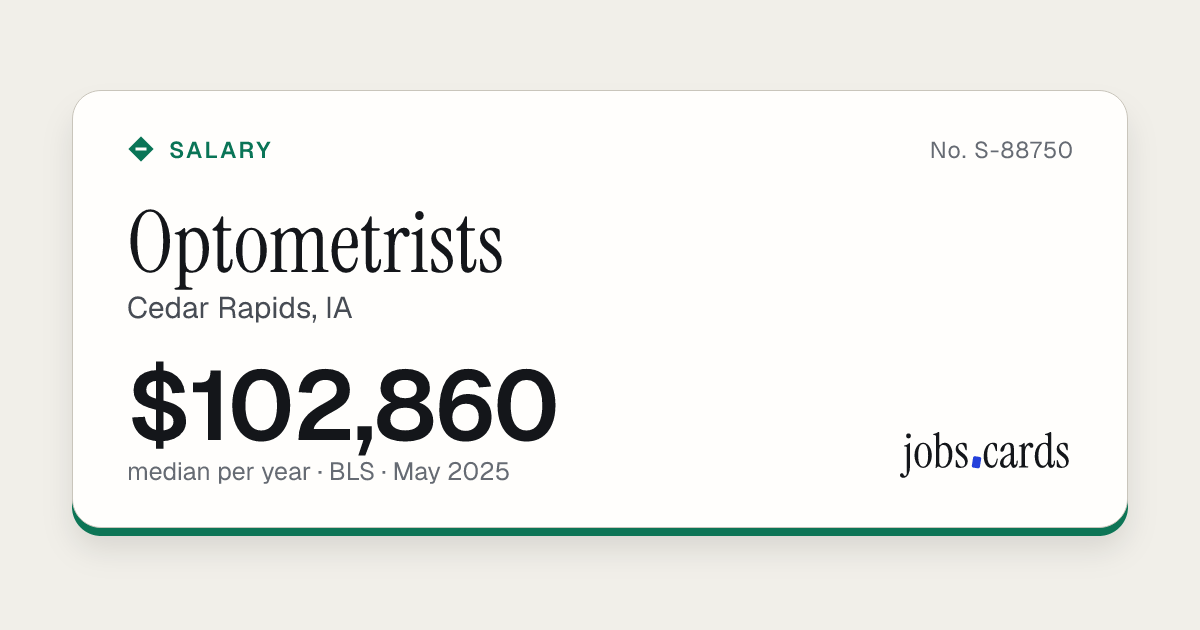
Optometrists

Cedar Rapids, IAGovernment job code 29-1041

Market pay · all workers · BLS, May 2025

$102,860median pay per year · $49.45 an hour
10th
$79,040
25th
$96,730
Median
$102,860
75th
$129,930
90th
$166,570

Small sample: BLS marks this estimate as less reliable, so treat the figures with care.

Government wage levels · wage year 2026-27

Level I
$80,142
Level II
$98,322
Level III
$116,501
Level IV
$134,680

The four pay levels the Department of Labor sets for this job in Cedar Rapids, IA. Yearly figures are the hourly level times 2,080 hours.

Filed pay

Fewer than 10 certified full-time filings for this job here, so there is no filed-pay figure.

People in this job here
50
Against the U.S. median
−25%
Mean pay per year
$116,690
Source: U.S. Bureau of Labor Statistics, May 2025 data · checked Nov 16, 2026
SourcesNo.S-88750

Where This Card Comes From

We show the government's numbers as published. Yearly pay is the hourly figure times 2,080 hours. Nothing is modelled or guessed. The U.S. comparison uses the national median for the same job code.

This page includes information from the O*NET 31.0 Database by the U.S. Department of Labor, Employment and Training Administration (USDOL/ETA). Used under the CC BY 4.0 license. O*NET® is a trademark of USDOL/ETA.

Content hash baef859d · first dealt Nov 16, 2026 · last changed Nov 16, 2026
Save as Image Compare

jobs.cards/c/S-88750

What Does This Job Pay in Cedar Rapids, IA?

Optometrists in Cedar Rapids, IA earn a median of $102,860 a year, according to the U.S. Bureau of Labor Statistics survey for May 2025. Half earn between $96,730 and $129,930. The lowest-paid tenth earn under $79,040 and the highest-paid tenth earn over $166,570. These are government survey figures, not estimates from ads.

Checked Nov 16, 2026Source: U.S. Bureau of Labor Statistics

Reading the Numbers

Worked out from the published figures on this card. Nothing here is an estimate.

  • The median here is 25% below the national median of $136,570 for the same job.
  • It is 18% below the Iowa median of $125,380.
  • 50 people hold this job here, 0.1% of the 42,790 who hold it across the country.
  • Of every 1,000 jobs here, 0.36 are this job, which makes it 30% more common here than in the U.S. as a whole.
  • The middle half of workers earn between $96,730 and $129,930, a band $33,200 wide.
  • Pay at the 90th percentile ($166,570) is 2.1 times pay at the 10th ($79,040).
  • The average (mean) is $116,690, 13% above the median. An average above the median means a smaller group of high earners pulls it up.
  • By the hour, the published median is $49.45.
  • The market median of $102,860 meets government wage Level II for this job and area (wage year 2026-27).

What Optometrists Do

Diagnose, manage, and treat conditions and diseases of the human eye and visual system. Examine eyes and visual system, diagnose problems or impairments, prescribe corrective lenses, and provide treatment. May prescribe therapeutic drugs to treat specific eye conditions.

Common job titles: Optometrist, Optometry Doctor (OD), Therapeutic Optometrist.

What the Work Involves

The five tasks that workers and experts surveyed by O*NET rate most important for this job, most important first.

  • Examine eyes, using observation, instruments, and pharmaceutical agents, to determine visual acuity and perception, focus, and coordination and to diagnose diseases and other abnormalities, such as glaucoma or color blindness.
  • Analyze test results and develop a treatment plan.
  • Prescribe, supply, fit and adjust eyeglasses, contact lenses, and other vision aids.
  • Prescribe medications to treat eye diseases if state laws permit.
  • Educate and counsel patients on contact lens care, visual hygiene, lighting arrangements, and safety factors.

Education. 95% of workers surveyed by O*NET said the level required for this job is: Doctoral Degree.

Preparation This Job Usually Needs

Job Zone Five: Extensive Preparation Needed. Most of these occupations require graduate school. For example, they may require a master's degree, and some require a Ph.D., M.D., or J.D. (law degree). Employees may need some on-the-job training, but most of these occupations assume that the person will already have the required skills, knowledge, work-related experience, and/or training. Extensive skill, knowledge, and experience are needed for these occupations. Many require more than five years of experience. For example, surgeons must complete four years of college and an additional five to seven years of specialized medical training to be able to do their job.

This page includes information from the O*NET 31.0 Database by the U.S. Department of Labor, Employment and Training Administration (USDOL/ETA). Used under the CC BY 4.0 license. O*NET® is a trademark of USDOL/ETA.

Embed This Card

Paste this where you want the card to appear. It stays up to date.