Search job, employer or placeSearch cards/Check an Offer
SalaryNo.S-07222

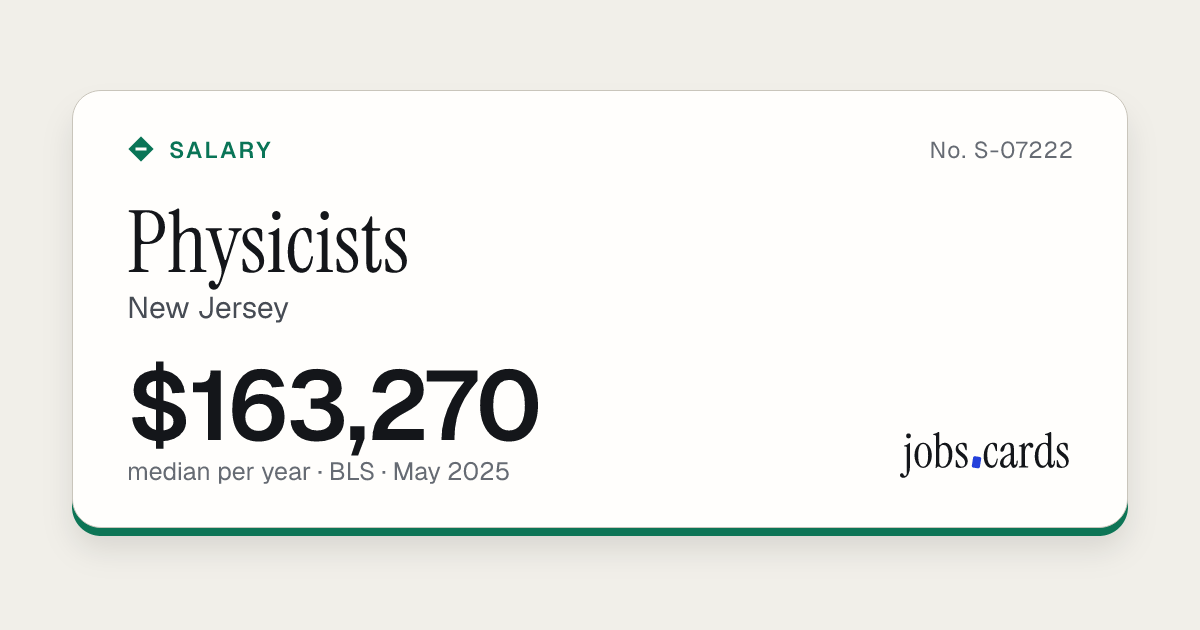
Physicists

New JerseyGovernment job code 19-2012

Market pay · all workers · BLS, May 2025

$163,270median pay per year · $78.49 an hour
10th
$100,490
25th
$120,820
Median
$163,270
75th
$222,140
90th
$289,830

Government wage levels

Wage levels are set for each local area. Open a metro card for this job to see them.

Filed pay · FY2026 · 34 certified filings

10th
$70,905
25th
$77,625
Median
$91,592
75th
$132,571
90th
$196,776

Filings cover positions offered to foreign workers. Base pay only.

People in this job here
470
Against the U.S. median
−5%
Mean pay per year
$175,090
Employers shown with filed pay
5
Source: U.S. Bureau of Labor Statistics, May 2025 data · checked Nov 16, 2026
SourcesNo.S-07222

Where This Card Comes From

We show the government's numbers as published. Yearly pay is the hourly figure times 2,080 hours. Nothing is modelled or guessed. The U.S. comparison uses the national median for the same job code.

This page includes information from the O*NET 31.0 Database by the U.S. Department of Labor, Employment and Training Administration (USDOL/ETA). Used under the CC BY 4.0 license. O*NET® is a trademark of USDOL/ETA.

Content hash b17e555d · first dealt Nov 16, 2026 · last changed Nov 16, 2026
Save as Image Compare

jobs.cards/c/S-07222

What Does This Job Pay in New Jersey?

Physicists in New Jersey earn a median of $163,270 a year, according to the U.S. Bureau of Labor Statistics survey for May 2025. Half earn between $120,820 and $222,140. The lowest-paid tenth earn under $100,490 and the highest-paid tenth earn over $289,830. These are government survey figures, not estimates from ads.

Checked Nov 16, 2026Source: U.S. Bureau of Labor Statistics

Reading the Numbers

Worked out from the published figures on this card. Nothing here is an estimate.

  • The median here is 5% below the national median of $172,250 for the same job.
  • Among the 14 states and territories where the Bureau of Labor Statistics publishes a reliable median for this job, New Jersey ranks 7th by median pay. Florida is highest at $225,390 and Michigan lowest at $94,520.
  • 470 people hold this job here, 2.3% of the 20,430 who hold it across the country.
  • Of every 1,000 jobs here, 0.11 are this job, which makes it 17% less common here than in the U.S. as a whole.
  • The middle half of workers earn between $120,820 and $222,140, a band $101,320 wide.
  • Pay at the 90th percentile ($289,830) is 2.9 times pay at the 10th ($100,490).
  • The average (mean) is $175,090, 7% above the median. An average above the median means a smaller group of high earners pulls it up.
  • By the hour, the published median is $78.49.
  • Employers filed a median of $91,592 on 34 certified filings for this job here, 44% below the market median. Filings cover positions offered to foreign workers, so the two figures describe different groups.

Where This State Ranks

Its place among 14 states and territories, by median pay for this job.

All States
RankStateMedian PayPeople in the JobAgainst U.S.
5Maryland$174,3901,200+1%
6New Mexico$165,340580−4%
7New Jersey$163,270470−5%
8District of Columbia$157,040480−9%
9Virginia$145,040940−16%

What Physicists Do

Conduct research into physical phenomena, develop theories on the basis of observation and experiments, and devise methods to apply physical laws and theories.

Common job titles: Astrophysicist, Biophysics Scientist, Health Physicist, Medical Physicist, Research Physicist, Scientist.

What the Work Involves

The five tasks that workers and experts surveyed by O*NET rate most important for this job, most important first.

  • Analyze data from research conducted to detect and measure physical phenomena.
  • Report experimental results by writing papers for scientific journals or by presenting information at scientific conferences.
  • Perform complex calculations as part of the analysis and evaluation of data, using computers.
  • Describe and express observations and conclusions in mathematical terms.
  • Collaborate with other scientists in the design, development, and testing of experimental, industrial, or medical equipment, instrumentation, and procedures.

Education. 49% of workers surveyed by O*NET said the level required for this job is: Doctoral Degree.

Preparation This Job Usually Needs

Job Zone Five: Extensive Preparation Needed. Most of these occupations require graduate school. For example, they may require a master's degree, and some require a Ph.D., M.D., or J.D. (law degree). Employees may need some on-the-job training, but most of these occupations assume that the person will already have the required skills, knowledge, work-related experience, and/or training. Extensive skill, knowledge, and experience are needed for these occupations. Many require more than five years of experience. For example, surgeons must complete four years of college and an additional five to seven years of specialized medical training to be able to do their job.

This page includes information from the O*NET 31.0 Database by the U.S. Department of Labor, Employment and Training Administration (USDOL/ETA). Used under the CC BY 4.0 license. O*NET® is a trademark of USDOL/ETA.

Employers That Filed Pay for This Job

What these employers told the government they pay for this job in New Jersey.

See the Full Deck

Filings cover positions offered to foreign workers. Base pay only.Not legal or immigration advice

The Same Job in Other Places

All Places for This Job
Salary

Physicists

Trenton-Princeton, NJ

$135,030median / year

Embed This Card

Paste this where you want the card to appear. It stays up to date.