We show the government's numbers as published. Yearly pay is the hourly figure times 2,080 hours. Nothing is modelled or guessed. The U.S. comparison uses the national median for the same job code.
This page includes information from the O*NET 31.0 Database by the U.S. Department of Labor, Employment and Training Administration (USDOL/ETA). Used under the CC BY 4.0 license. O*NET® is a trademark of USDOL/ETA.
Content hash 7c886e61 · first dealt Nov 16, 2026 · last changed Nov 16, 2026
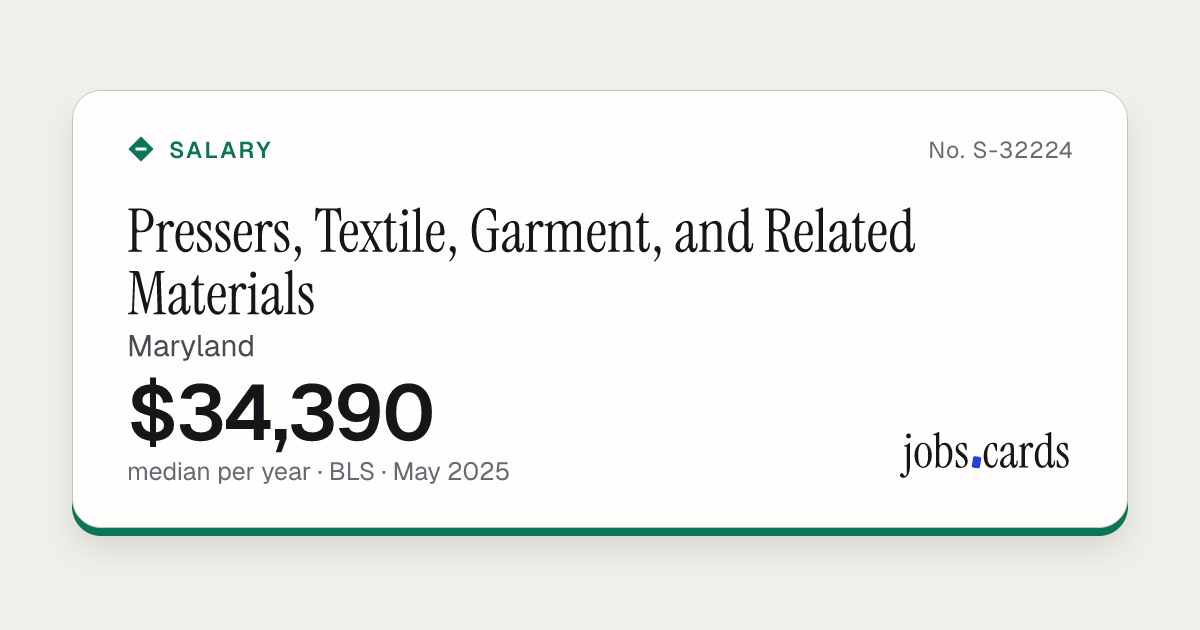
Pressers, Textile, Garment, and Related Materials in Maryland earn a median of $34,390 a year, according to the U.S. Bureau of Labor Statistics survey for May 2025. Half earn between $32,750 and $38,110. The lowest-paid tenth earn under $31,200 and the highest-paid tenth earn over $38,850. These are government survey figures, not estimates from ads.
Checked Nov 16, 2026Source: U.S. Bureau of Labor Statistics
Reading the Numbers
Worked out from the published figures on this card. Nothing here is an estimate.
The median here is 2% below the national median of $35,060 for the same job.
480 people hold this job here, 1.8% of the 26,120 who hold it across the country.
Of every 1,000 jobs here, 0.17 are this job, about as common here as in the U.S. as a whole.
The middle half of workers earn between $32,750 and $38,110, a band $5,360 wide.
Pay at the 90th percentile ($38,850) is 1.2 times pay at the 10th ($31,200).
The average (mean) is $35,340, 3% above the median. An average above the median means a smaller group of high earners pulls it up.
The five tasks that workers and experts surveyed by O*NET rate most important for this job, most important first.
Hang, fold, package, and tag finished articles for delivery to customers.
Operate steam, hydraulic, or other pressing machines to remove wrinkles from garments and flatwork items, or to shape, form, or patch articles.
Straighten, smooth, or shape materials to prepare them for pressing.
Remove finished pieces from pressing machines and hang or stack them for cooling, or forward them for additional processing.
Finish pleated garments, determining sizes of pleats from evidence of old pleats or from work orders, using machine presses or hand irons.
Education. 59% of workers surveyed by O*NET said the level required for this job is: Less than a High School Diploma.
Preparation This Job Usually Needs
Job Zone 1-2: Very Little to Some Preparation Needed. Usually requires a high school diploma or GED, though some occupations may not. Ranges from a few days to one year of on-the-job training. Some occupations may need little or no previous experience; others require several months to a year of experience. For example, landscaping and groundskeeping workers might require very little training or previous experience, while agricultural equipment operators can benefit from on-the job training.
This page includes information from the O*NET 31.0 Database by the U.S. Department of Labor, Employment and Training Administration (USDOL/ETA). Used under the CC BY 4.0 license. O*NET® is a trademark of USDOL/ETA.