Search job, employer or placeSearch cards/Check an Offer
SalaryNo.S-24349

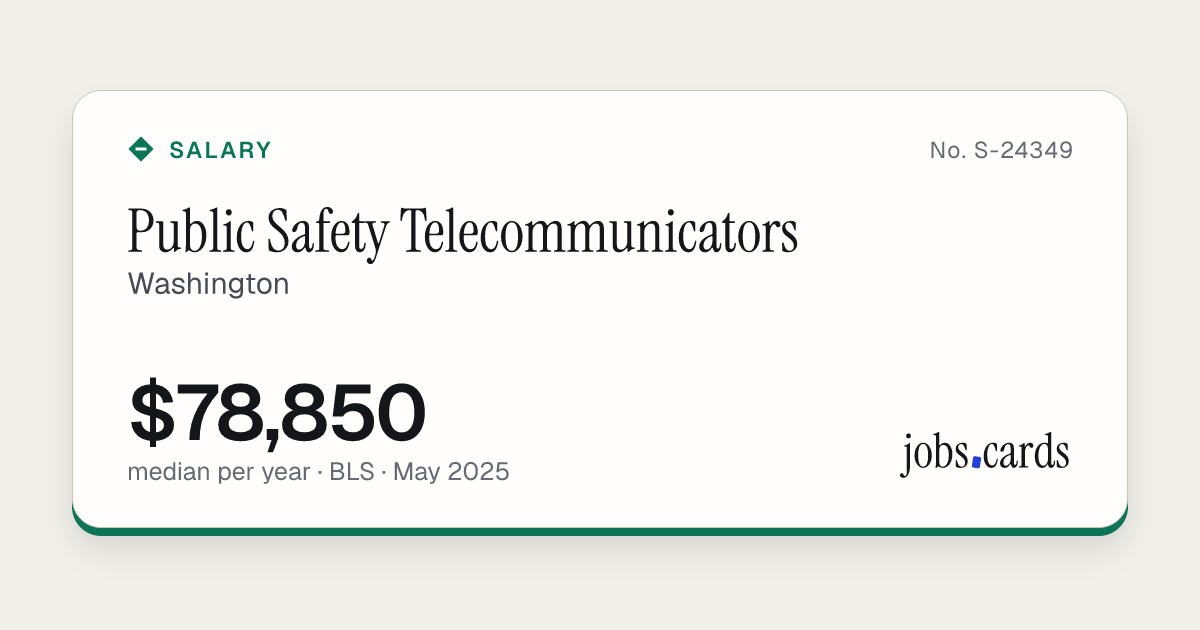
Public Safety Telecommunicators

WashingtonGovernment job code 43-5031

Market pay · all workers · BLS, May 2025

$78,850median pay per year · $37.91 an hour
10th
$56,920
25th
$66,500
Median
$78,850
75th
$84,640
90th
$96,130

Government wage levels

Wage levels are set for each local area. Open a metro card for this job to see them.

Filed pay

Fewer than 10 certified full-time filings for this job here, so there is no filed-pay figure.

People in this job here
1,980
Against the U.S. median
+49%
Mean pay per year
$76,460
Source: U.S. Bureau of Labor Statistics, May 2025 data · checked Nov 16, 2026
SourcesNo.S-24349

Where This Card Comes From

We show the government's numbers as published. Yearly pay is the hourly figure times 2,080 hours. Nothing is modelled or guessed. The U.S. comparison uses the national median for the same job code.

This page includes information from the O*NET 31.0 Database by the U.S. Department of Labor, Employment and Training Administration (USDOL/ETA). Used under the CC BY 4.0 license. O*NET® is a trademark of USDOL/ETA.
Content hash 6a04a599 · first dealt Nov 16, 2026 · last changed Nov 16, 2026

Save as Image Compare

jobs.cards/c/S-24349

What Does This Job Pay in Washington?

Public Safety Telecommunicators in Washington earn a median of $78,850 a year, according to the U.S. Bureau of Labor Statistics survey for May 2025. Half earn between $66,500 and $84,640. The lowest-paid tenth earn under $56,920 and the highest-paid tenth earn over $96,130. These are government survey figures, not estimates from ads.

Checked Nov 16, 2026Source: U.S. Bureau of Labor Statistics

Reading the Numbers

Worked out from the published figures on this card. Nothing here is an estimate.

  • The median here is 49% above the national median of $53,040 for the same job.
  • Among the 46 states and territories where the Bureau of Labor Statistics publishes a reliable median for this job, Washington ranks 2nd by median pay. California is highest at $80,120 and Mississippi lowest at $34,510.
  • 1,980 people hold this job here, 1.9% of the 102,500 who hold it across the country.
  • Of every 1,000 jobs here, 0.56 are this job, which makes it 16% less common here than in the U.S. as a whole.
  • The middle half of workers earn between $66,500 and $84,640, a band $18,140 wide.
  • Pay at the 90th percentile ($96,130) is 1.7 times pay at the 10th ($56,920).
  • The average (mean) is $76,460, 3% below the median, so more of the spread lies on the low side.
  • By the hour, the published median is $37.91.

Washington requires pay or a pay range in job ads from covered employers. What Washington’s rule says

Where This State Ranks

Its place among 46 states and territories, by median pay for this job.

All States
RankStateMedian PayPeople in the JobAgainst U.S.
1California$80,1208,520+51%
2Washington$78,8501,980+49%
3Oregon$71,9801,110+36%
4Alaska$66,660390+26%
5Minnesota$66,5501,460+25%

What Public Safety Telecommunicators Do

Operate telephone, radio, or other communication systems to receive and communicate requests for emergency assistance at 9-1-1 public safety answering points and emergency operations centers. Take information from the public and other sources regarding crimes, threats, disturbances, acts of terrorism, fires, medical emergencies, and other public safety matters. May coordinate and provide information to law enforcement and emergency response personnel. May access sensitive databases and other information sources as needed. May provide additional instructions to callers based on knowledge of and certification in law enforcement, fire, or emergency medical procedures.

Common job titles: 911 Dispatcher, Communications Officer, Communications Operator, Communications Specialist, Emergency Communications Dispatcher, Emergency Communications Operator (ECO), Police Dispatcher, Public Safety Dispatcher, Telecommunicator.

What the Work Involves

The five tasks that workers and experts surveyed by O*NET rate most important for this job, most important first.

  • Provide emergency medical instructions to callers.
  • Question callers to determine their locations and the nature of their problems to determine type of response needed.
  • Determine response requirements and relative priorities of situations, and dispatch units in accordance with established procedures.
  • Receive incoming telephone or alarm system calls regarding emergency and non-emergency police and fire service, emergency ambulance service, information, and after-hours calls for departments within a city.
  • Relay information and messages to and from emergency sites, to law enforcement agencies, and to all other individuals or groups requiring notification.

Education. 63% of workers surveyed by O*NET said the level required for this job is: High School Diploma or the equivalent.

Preparation This Job Usually Needs

Job Zone 1-2: Very Little to Some Preparation Needed. Usually requires a high school diploma or GED, though some occupations may not. Ranges from a few days to one year of on-the-job training. Some occupations may need little or no previous experience; others require several months to a year of experience. For example, landscaping and groundskeeping workers might require very little training or previous experience, while agricultural equipment operators can benefit from on-the job training.

This page includes information from the O*NET 31.0 Database by the U.S. Department of Labor, Employment and Training Administration (USDOL/ETA). Used under the CC BY 4.0 license. O*NET® is a trademark of USDOL/ETA.

The Same Job in Other Places

All Places for This Job

Embed This Card

Paste this where you want the card to appear. It stays up to date.