We show the government's numbers as published. Yearly pay is the hourly figure times 2,080 hours. Nothing is modelled or guessed. The U.S. comparison uses the national median for the same job code.
This page includes information from the O*NET 31.0 Database by the U.S. Department of Labor, Employment and Training Administration (USDOL/ETA). Used under the CC BY 4.0 license. O*NET® is a trademark of USDOL/ETA.
Content hash 0fd25a0e · first dealt Nov 16, 2026 · last changed Nov 16, 2026
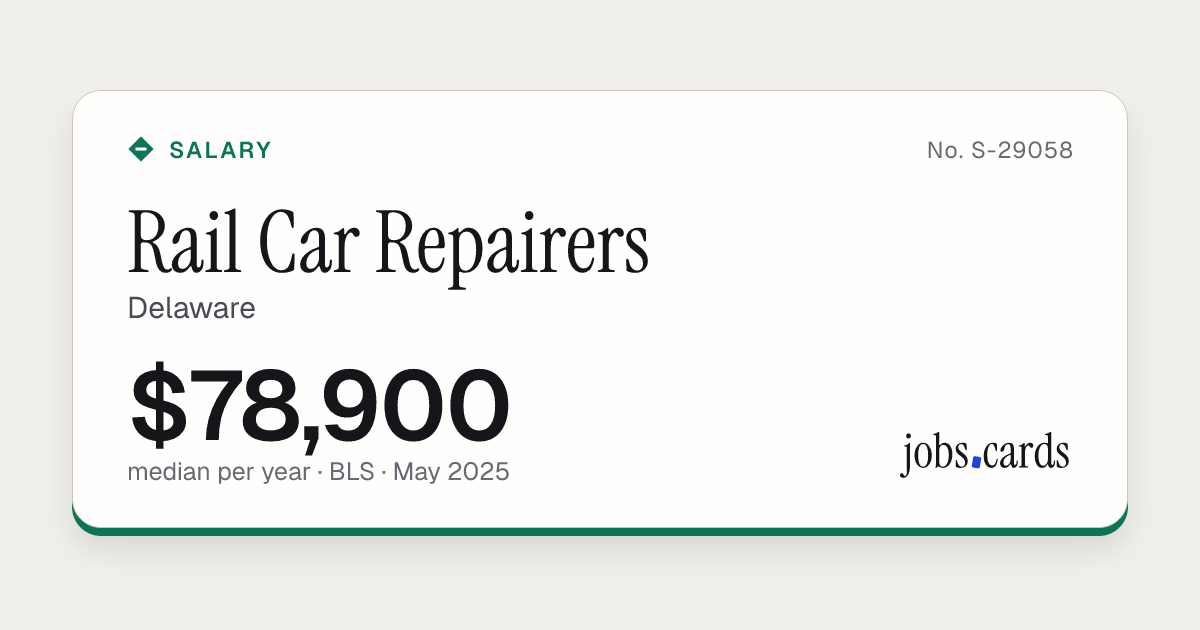
Rail Car Repairers in Delaware earn a median of $78,900 a year, according to the U.S. Bureau of Labor Statistics survey for May 2025. Half earn between $73,590 and $95,100. The lowest-paid tenth earn under $51,830 and the highest-paid tenth earn over $95,100. These are government survey figures, not estimates from ads.
Checked Nov 16, 2026Source: U.S. Bureau of Labor Statistics
Reading the Numbers
Worked out from the published figures on this card. Nothing here is an estimate.
The median here is 17% above the national median of $67,530 for the same job.
130 people hold this job here, 0.6% of the 21,350 who hold it across the country.
Of every 1,000 jobs here, 0.27 are this job, which makes it 99% more common here than in the U.S. as a whole.
The middle half of workers earn between $73,590 and $95,100, a band $21,510 wide.
Pay at the 90th percentile ($95,100) is 1.8 times pay at the 10th ($51,830).
The average (mean) is $80,070, within 3% of the median, so pay is spread fairly evenly around the middle.
By the hour, the published median is $37.93.
Delaware has enacted a law that will require pay in job ads from Sep 26, 2027. What Delaware’s rule says
What Rail Car Repairers Do
Diagnose, adjust, repair, or overhaul railroad rolling stock, mine cars, or mass transit rail cars.
Common job titles: Freight Maintenance Specialist, Locomotive Repairman, Rail Car Maintenance Mechanic, Rail Car Mechanic, Rail Car Repairer, Rail Car Repairman, Rail Car Sandblaster, Rail Car Welder, Railroad Car Repairman, Train Car Repairman.
What the Work Involves
The five tasks that workers and experts surveyed by O*NET rate most important for this job, most important first.
Record conditions of cars, and repair and maintenance work performed or to be performed.
Inspect components such as bearings, seals, gaskets, wheels, and coupler assemblies to determine if repairs are needed.
Repair or replace defective or worn parts such as bearings, pistons, and gears, using hand tools, torque wrenches, power tools, and welding equipment.
Inspect the interior and exterior of rail cars coming into rail yards to identify defects and to determine the extent of wear and damage.
Remove locomotives, car mechanical units, or other components, using pneumatic hoists and jacks, pinch bars, hand tools, and cutting torches.
Education. 61% of workers surveyed by O*NET said the level required for this job is: High School Diploma or the equivalent.
Preparation This Job Usually Needs
Job Zone 1-2: Very Little to Some Preparation Needed. Usually requires a high school diploma or GED, though some occupations may not. Ranges from a few days to one year of on-the-job training. Some occupations may need little or no previous experience; others require several months to a year of experience. For example, landscaping and groundskeeping workers might require very little training or previous experience, while agricultural equipment operators can benefit from on-the job training.
This page includes information from the O*NET 31.0 Database by the U.S. Department of Labor, Employment and Training Administration (USDOL/ETA). Used under the CC BY 4.0 license. O*NET® is a trademark of USDOL/ETA.