We show the government's numbers as published. Yearly pay is the hourly figure times 2,080 hours. Nothing is modelled or guessed. The U.S. comparison uses the national median for the same job code.
This page includes information from the O*NET 31.0 Database by the U.S. Department of Labor, Employment and Training Administration (USDOL/ETA). Used under the CC BY 4.0 license. O*NET® is a trademark of USDOL/ETA.
Content hash 67c40e47 · first dealt Nov 16, 2026 · last changed Nov 16, 2026
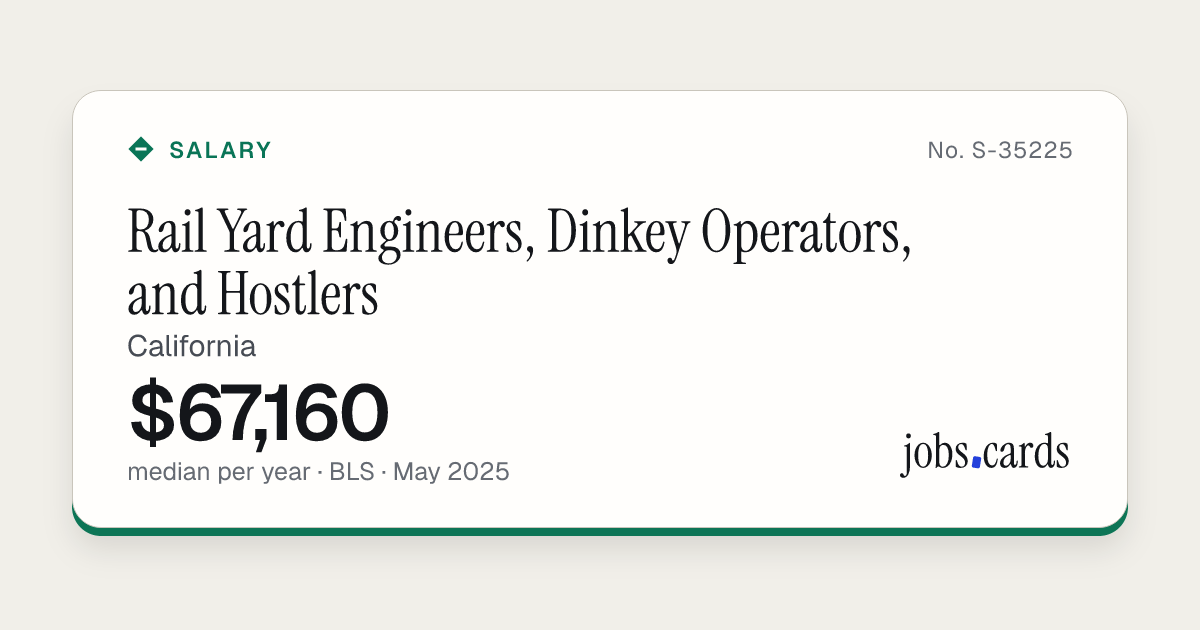
Rail Yard Engineers, Dinkey Operators, and Hostlers in California earn a median of $67,160 a year, according to the U.S. Bureau of Labor Statistics survey for May 2025. Half earn between $67,130 and $67,160. The lowest-paid tenth earn under $66,990 and the highest-paid tenth earn over $67,160. These are government survey figures, not estimates from ads.
Checked Nov 16, 2026Source: U.S. Bureau of Labor Statistics
Reading the Numbers
Worked out from the published figures on this card. Nothing here is an estimate.
The median here is 11% above the national median of $60,600 for the same job.
190 people hold this job here, 4.8% of the 3,920 who hold it across the country.
Of every 1,000 jobs here, 0.01 are this job, which makes it 59% less common here than in the U.S. as a whole.
The middle half of workers earn between $67,130 and $67,160, a band $30 wide.
Pay at the 90th percentile ($67,160) is 1.0 times pay at the 10th ($66,990).
The average (mean) is $66,450, within 3% of the median, so pay is spread fairly evenly around the middle.
The five tasks that workers and experts surveyed by O*NET rate most important for this job, most important first.
Observe and respond to wayside and cab signals, including color light signals, position signals, torpedoes, flags, and hot box detectors.
Inspect engines before and after use to ensure proper operation.
Apply and release hand brakes.
Confer with conductors and other workers via radiotelephones or computers to exchange switching information.
Signal crew members for movement of engines or trains, using lanterns, hand signals, radios, or telephones.
Education. 83% of workers surveyed by O*NET said the level required for this job is: High School Diploma or the equivalent.
Preparation This Job Usually Needs
Job Zone 1-2: Very Little to Some Preparation Needed. Usually requires a high school diploma or GED, though some occupations may not. Ranges from a few days to one year of on-the-job training. Some occupations may need little or no previous experience; others require several months to a year of experience. For example, landscaping and groundskeeping workers might require very little training or previous experience, while agricultural equipment operators can benefit from on-the job training.
This page includes information from the O*NET 31.0 Database by the U.S. Department of Labor, Employment and Training Administration (USDOL/ETA). Used under the CC BY 4.0 license. O*NET® is a trademark of USDOL/ETA.