We show the government's numbers as published. Yearly pay is the hourly figure times 2,080 hours. Nothing is modelled or guessed. The U.S. comparison uses the national median for the same job code.
This page includes information from the O*NET 31.0 Database by the U.S. Department of Labor, Employment and Training Administration (USDOL/ETA). Used under the CC BY 4.0 license. O*NET® is a trademark of USDOL/ETA.
Content hash e4277166 · first dealt Nov 16, 2026 · last changed Nov 16, 2026
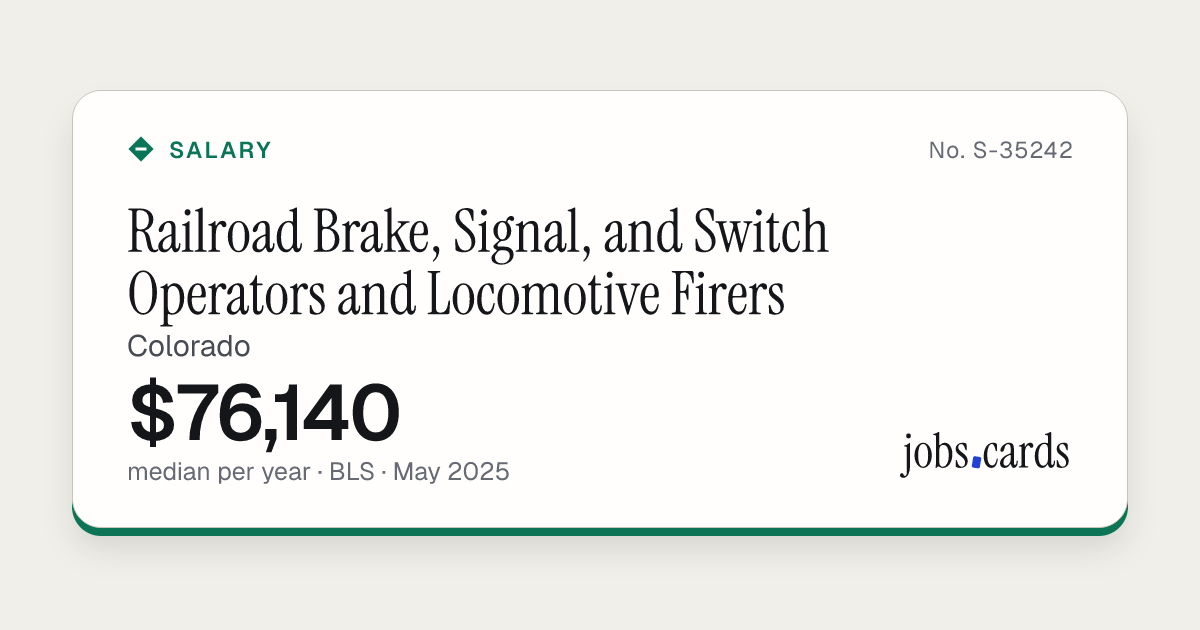
Railroad Brake, Signal, and Switch Operators and Locomotive Firers in Colorado earn a median of $76,140 a year, according to the U.S. Bureau of Labor Statistics survey for May 2025. Half earn between $70,680 and $97,940. The lowest-paid tenth earn under $48,150 and the highest-paid tenth earn over $97,940. These are government survey figures, not estimates from ads.
Checked Nov 16, 2026Source: U.S. Bureau of Labor Statistics
Reading the Numbers
Worked out from the published figures on this card. Nothing here is an estimate.
The median here is 11% above the national median of $68,840 for the same job.
The middle half of workers earn between $70,680 and $97,940, a band $27,260 wide.
Pay at the 90th percentile ($97,940) is 2.0 times pay at the 10th ($48,150).
The average (mean) is $81,040, 6% above the median. An average above the median means a smaller group of high earners pulls it up.
What Railroad Brake, Signal, and Switch Operators and Locomotive Firers Do
Operate or monitor railroad track switches or locomotive instruments. May couple or uncouple rolling stock to make up or break up trains. Watch for and relay traffic signals. May inspect couplings, air hoses, journal boxes, and hand brakes. May watch for dragging equipment or obstacles on rights-of-way.
The five tasks that workers and experts surveyed by O*NET rate most important for this job, most important first.
Signal locomotive engineers to start or stop trains when coupling or uncoupling cars, using hand signals, lanterns, or radio communication.
Inspect locomotives to detect damaged or worn parts.
Observe train signals along routes and verify their meanings for engineers.
Operate and drive locomotives, diesel switch engines, dinkey engines, flatcars, and railcars in train yards and at industrial sites.
Inspect couplings, air hoses, journal boxes, and handbrakes to ensure that they are securely fastened and functioning properly.
Education. 87% of workers surveyed by O*NET said the level required for this job is: High School Diploma or the equivalent.
Preparation This Job Usually Needs
Job Zone 1-2: Very Little to Some Preparation Needed. Usually requires a high school diploma or GED, though some occupations may not. Ranges from a few days to one year of on-the-job training. Some occupations may need little or no previous experience; others require several months to a year of experience. For example, landscaping and groundskeeping workers might require very little training or previous experience, while agricultural equipment operators can benefit from on-the job training.
This page includes information from the O*NET 31.0 Database by the U.S. Department of Labor, Employment and Training Administration (USDOL/ETA). Used under the CC BY 4.0 license. O*NET® is a trademark of USDOL/ETA.