Search job, employer or placeSearch cards/Check an Offer
SalaryNo.S-155547

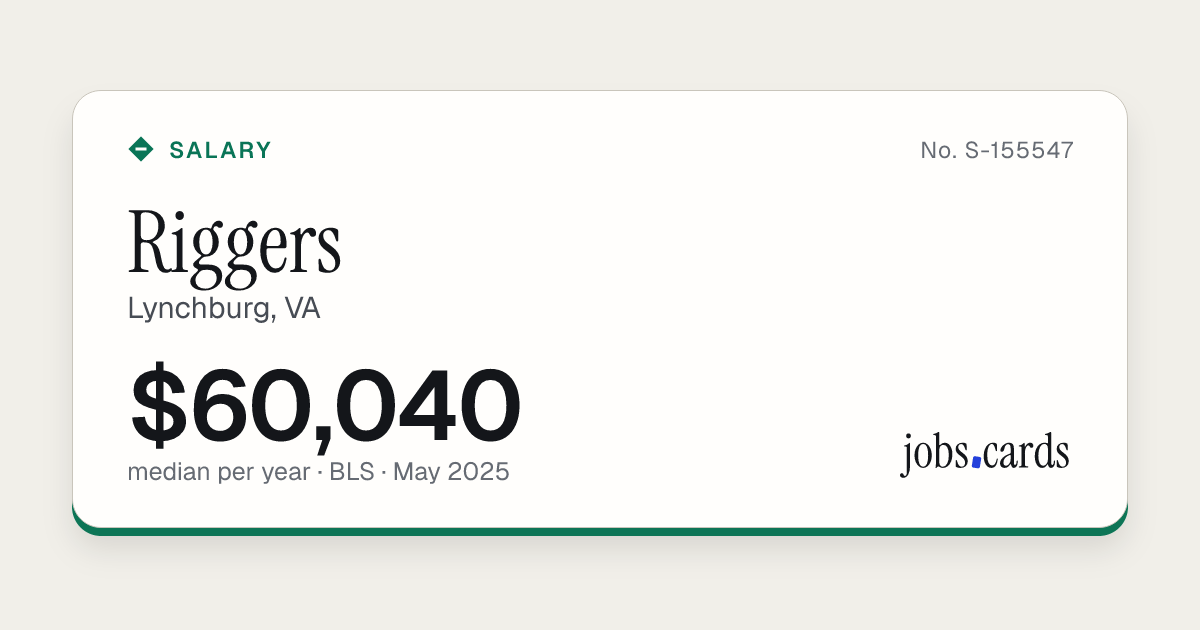
Riggers

Lynchburg, VAGovernment job code 49-9096

Market pay · all workers · BLS, May 2025

$60,040median pay per year · $28.87 an hour
10th
$43,030
25th
$47,750
Median
$60,040
75th
$60,040
90th
$60,040

Small sample: BLS marks this estimate as less reliable, so treat the figures with care.

Government wage levels · wage year 2026-27

Level I
$43,930
Level II
$49,629
Level III
$55,328
Level IV
$61,027

The four pay levels the Department of Labor sets for this job in Lynchburg, VA. Yearly figures are the hourly level times 2,080 hours.

Filed pay

Fewer than 10 certified full-time filings for this job here, so there is no filed-pay figure.

People in this job here
50
Against the U.S. median
−4%
Mean pay per year
$55,380
Source: U.S. Bureau of Labor Statistics, May 2025 data · checked Nov 16, 2026
SourcesNo.S-155547

Where This Card Comes From

We show the government's numbers as published. Yearly pay is the hourly figure times 2,080 hours. Nothing is modelled or guessed. The U.S. comparison uses the national median for the same job code.

This page includes information from the O*NET 31.0 Database by the U.S. Department of Labor, Employment and Training Administration (USDOL/ETA). Used under the CC BY 4.0 license. O*NET® is a trademark of USDOL/ETA.

Content hash 969ef07a · first dealt Nov 16, 2026 · last changed Nov 16, 2026
Save as Image Compare

jobs.cards/c/S-155547

What Does This Job Pay in Lynchburg, VA?

Riggers in Lynchburg, VA earn a median of $60,040 a year, according to the U.S. Bureau of Labor Statistics survey for May 2025. Half earn between $47,750 and $60,040. The lowest-paid tenth earn under $43,030 and the highest-paid tenth earn over $60,040. These are government survey figures, not estimates from ads.

Checked Nov 16, 2026Source: U.S. Bureau of Labor Statistics

Reading the Numbers

Worked out from the published figures on this card. Nothing here is an estimate.

  • The median here is 4% below the national median of $62,640 for the same job.
  • It is 6% below the Virginia median of $63,620.
  • 50 people hold this job here, 0.2% of the 22,530 who hold it across the country.
  • Of every 1,000 jobs here, 0.56 are this job, which makes it 3.9 times as common here as in the U.S. as a whole.
  • The middle half of workers earn between $47,750 and $60,040, a band $12,290 wide.
  • Pay at the 90th percentile ($60,040) is 1.4 times pay at the 10th ($43,030).
  • The average (mean) is $55,380, 8% below the median, so more of the spread lies on the low side.
  • By the hour, the published median is $28.87.
  • The market median of $60,040 meets government wage Level III for this job and area (wage year 2026-27).

What Riggers Do

Set up or repair rigging for construction projects, manufacturing plants, logging yards, ships and shipyards, or for the entertainment industry.

Common job titles: Gantry Rigger, Hand Rigger, Heavy Lift Rigger, Machinery Erector, Machinery Mover, Marine Rigger, Motor Rigger, Rigger, Rigging Fabricator, Ship Rigger.

What the Work Involves

The five tasks that workers and experts surveyed by O*NET rate most important for this job, most important first.

  • Test rigging to ensure safety and reliability.
  • Signal or verbally direct workers engaged in hoisting and moving loads to ensure safety of workers and materials.
  • Control movement of heavy equipment through narrow openings or confined spaces, using chainfalls, gin poles, gallows frames, and other equipment.
  • Select gear, such as cables, pulleys, and winches, according to load weights and sizes, facilities, and work schedules.
  • Tilt, dip, and turn suspended loads to maneuver over, under, or around obstacles, using multi-point suspension techniques.

Education. 63% of workers surveyed by O*NET said the level required for this job is: High School Diploma or the equivalent.

Preparation This Job Usually Needs

Job Zone 1-2: Very Little to Some Preparation Needed. Usually requires a high school diploma or GED, though some occupations may not. Ranges from a few days to one year of on-the-job training. Some occupations may need little or no previous experience; others require several months to a year of experience. For example, landscaping and groundskeeping workers might require very little training or previous experience, while agricultural equipment operators can benefit from on-the job training.

This page includes information from the O*NET 31.0 Database by the U.S. Department of Labor, Employment and Training Administration (USDOL/ETA). Used under the CC BY 4.0 license. O*NET® is a trademark of USDOL/ETA.

Embed This Card

Paste this where you want the card to appear. It stays up to date.