We show the government's numbers as published. Yearly pay is the hourly figure times 2,080 hours. Nothing is modelled or guessed. The U.S. comparison uses the national median for the same job code.
This page includes information from the O*NET 31.0 Database by the U.S. Department of Labor, Employment and Training Administration (USDOL/ETA). Used under the CC BY 4.0 license. O*NET® is a trademark of USDOL/ETA.
Content hash 8b78bd9d · first dealt Nov 16, 2026 · last changed Nov 16, 2026
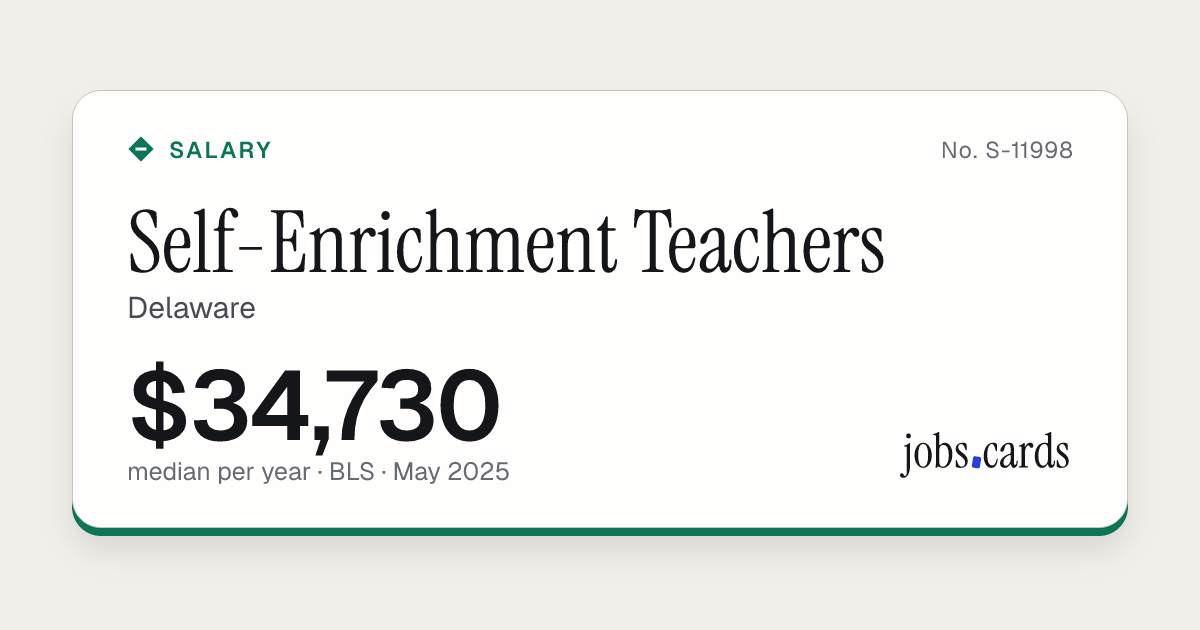
Self-Enrichment Teachers in Delaware earn a median of $34,730 a year, according to the U.S. Bureau of Labor Statistics survey for May 2025. Half earn between $31,380 and $60,060. The lowest-paid tenth earn under $31,200 and the highest-paid tenth earn over $81,300. These are government survey figures, not estimates from ads.
Checked Nov 16, 2026Source: U.S. Bureau of Labor Statistics
Reading the Numbers
Worked out from the published figures on this card. Nothing here is an estimate.
The median here is 26% below the national median of $46,800 for the same job.
260 people hold this job here, less than 0.1% of the 332,110 who hold it across the country.
Of every 1,000 jobs here, 0.54 are this job, which makes it 75% less common here than in the U.S. as a whole.
The middle half of workers earn between $31,380 and $60,060, a band $28,680 wide.
Pay at the 90th percentile ($81,300) is 2.6 times pay at the 10th ($31,200).
The average (mean) is $45,800, 32% above the median. An average above the median means a smaller group of high earners pulls it up.
By the hour, the published median is $16.70.
Delaware has enacted a law that will require pay in job ads from Sep 26, 2027. What Delaware’s rule says
What Self-Enrichment Teachers Do
Teach or instruct individuals or groups for the primary purpose of self-enrichment or recreation, rather than for an occupational objective, educational attainment, competition, or fitness.
Common job titles: Art Teacher, Dance Instructor, Dance Teacher, Driving Instructor, Flight Instructor, Instructor, Martial Arts Instructor, Music Instructor, Piano Teacher, Teacher.
What the Work Involves
The five tasks that workers and experts surveyed by O*NET rate most important for this job, most important first.
Instruct students individually and in groups, using various teaching methods, such as lectures, discussions, and demonstrations.
Adapt teaching methods and instructional materials to meet students' varying needs and interests.
Prepare students for further development by encouraging them to explore learning opportunities and to persevere with challenging tasks.
Observe students to determine qualifications, limitations, abilities, interests, and other individual characteristics.
Maintain accurate and complete student records as required by administrative policy.
Preparation This Job Usually Needs
Job Zone Three: Medium Preparation Needed. Most occupations in this zone require training in vocational schools, related on-the-job experience, or an associate's degree. Employees in these occupations usually need one or two years of training involving both on-the-job experience and informal training with experienced workers. A recognized apprenticeship program may be associated with these occupations. Previous work-related skill, knowledge, or experience is required for these occupations. For example, an electrician must have completed three or four years of apprenticeship or several years of vocational training, and often must have passed a licensing exam, in order to perform the job.
This page includes information from the O*NET 31.0 Database by the U.S. Department of Labor, Employment and Training Administration (USDOL/ETA). Used under the CC BY 4.0 license. O*NET® is a trademark of USDOL/ETA.