Search job, employer or placeSearch cards/Check an Offer
SalaryNo.S-33987

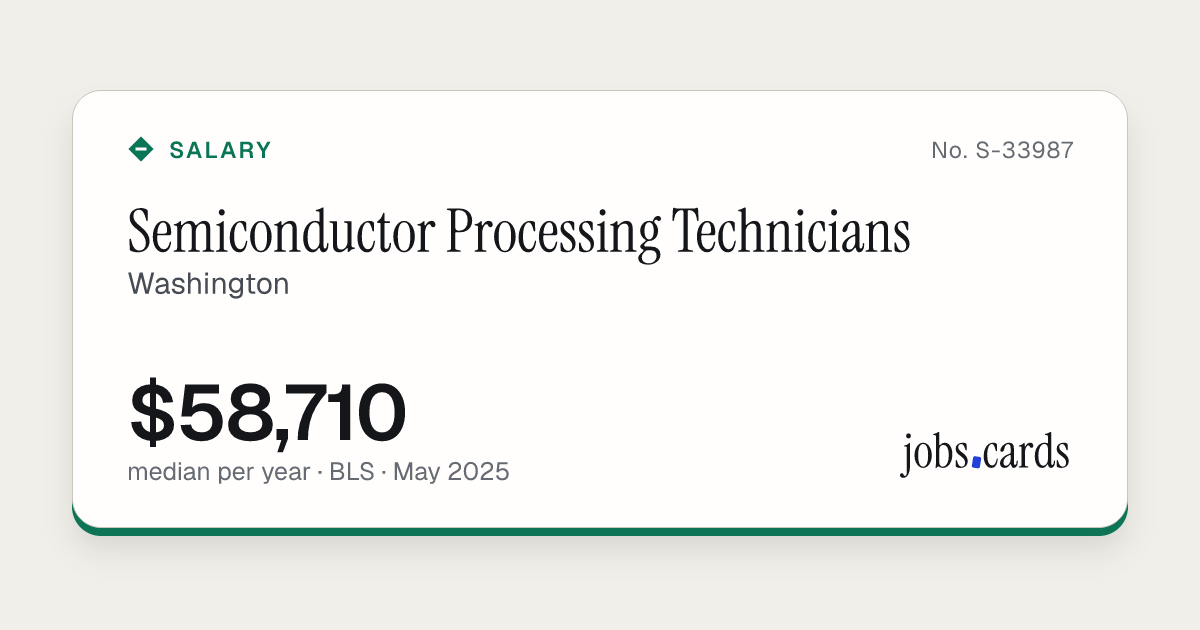
Semiconductor Processing Technicians

WashingtonGovernment job code 51-9141

Market pay · all workers · BLS, May 2025

$58,710median pay per year · $28.22 an hour
10th
$49,490
25th
$51,030
Median
$58,710
75th
$62,810
90th
$74,520

Government wage levels

Wage levels are set for each local area. Open a metro card for this job to see them.

Filed pay

Fewer than 10 certified full-time filings for this job here, so there is no filed-pay figure.

People in this job here
990
Against the U.S. median
+14%
Mean pay per year
$58,690
Source: U.S. Bureau of Labor Statistics, May 2025 data · checked Nov 16, 2026
SourcesNo.S-33987

Where This Card Comes From

We show the government's numbers as published. Yearly pay is the hourly figure times 2,080 hours. Nothing is modelled or guessed. The U.S. comparison uses the national median for the same job code.

This page includes information from the O*NET 31.0 Database by the U.S. Department of Labor, Employment and Training Administration (USDOL/ETA). Used under the CC BY 4.0 license. O*NET® is a trademark of USDOL/ETA.

Content hash de51969f · first dealt Nov 16, 2026 · last changed Nov 16, 2026
Save as Image Compare

jobs.cards/c/S-33987

What Does This Job Pay in Washington?

Semiconductor Processing Technicians in Washington earn a median of $58,710 a year, according to the U.S. Bureau of Labor Statistics survey for May 2025. Half earn between $51,030 and $62,810. The lowest-paid tenth earn under $49,490 and the highest-paid tenth earn over $74,520. These are government survey figures, not estimates from ads.

Checked Nov 16, 2026Source: U.S. Bureau of Labor Statistics

Reading the Numbers

Worked out from the published figures on this card. Nothing here is an estimate.

  • The median here is 14% above the national median of $51,430 for the same job.
  • Among the 9 states and territories where the Bureau of Labor Statistics publishes a reliable median for this job, Washington ranks 3rd by median pay. Arizona is highest at $78,940 and Texas lowest at $38,440.
  • 990 people hold this job here, 3.1% of the 31,460 who hold it across the country.
  • The middle half of workers earn between $51,030 and $62,810, a band $11,780 wide.
  • Pay at the 90th percentile ($74,520) is 1.5 times pay at the 10th ($49,490).
  • The average (mean) is $58,690, within 3% of the median, so pay is spread fairly evenly around the middle.
  • By the hour, the published median is $28.22.

Where This State Ranks

Its place among 9 states and territories, by median pay for this job.

All States
RankStateMedian PayPeople in the JobAgainst U.S.
1Arizona$78,9402,270+53%
2Oregon$63,3306,620+23%
3Washington$58,710990+14%
4Massachusetts$51,4101,1900%
5New York$49,4001,750−4%

What Semiconductor Processing Technicians Do

Perform any or all of the following functions in the manufacture of electronic semiconductors: load semiconductor material into furnace; saw formed ingots into segments; load individual segment into crystal growing chamber and monitor controls; locate crystal axis in ingot using x-ray equipment and saw ingots into wafers; and clean, polish, and load wafers into series of special purpose furnaces, chemical baths, and equipment used to form circuitry and change conductive properties.

Common job titles: Device Processing Engineer, Diffusion Operator, Manufacture Specialist, Manufacturing Technician (Manufacturing Tech), Metalorganic Chemical Vapor Deposition Engineer (MOCVD Engineer), Probe Operator, Process Technician (Process Tech), Semiconductor Laboratory Technician (Semiconductor Lab Tech), Wafer Fabrication Operator, Wafer Technician (Wafer Tech).

Preparation This Job Usually Needs

Job Zone 1-2: Very Little to Some Preparation Needed. Usually requires a high school diploma or GED, though some occupations may not. Ranges from a few days to one year of on-the-job training. Some occupations may need little or no previous experience; others require several months to a year of experience. For example, landscaping and groundskeeping workers might require very little training or previous experience, while agricultural equipment operators can benefit from on-the job training.

This page includes information from the O*NET 31.0 Database by the U.S. Department of Labor, Employment and Training Administration (USDOL/ETA). Used under the CC BY 4.0 license. O*NET® is a trademark of USDOL/ETA.

Embed This Card

Paste this where you want the card to appear. It stays up to date.