Search job, employer or placeSearch cards/Check an Offer
SalaryNo.S-147572

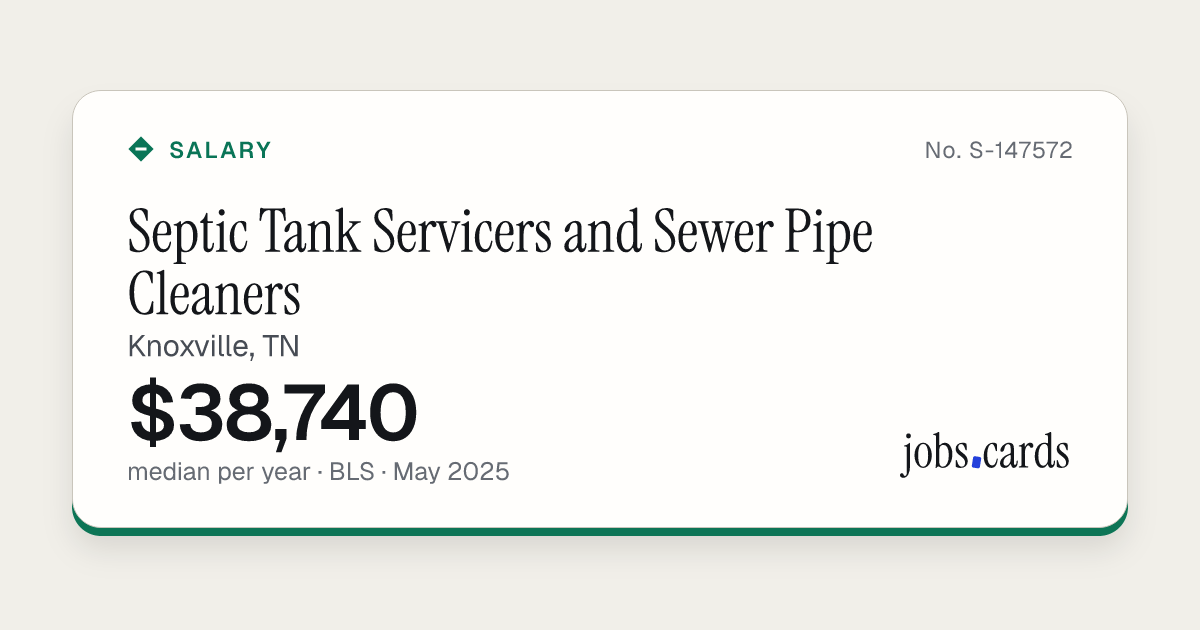
Septic Tank Servicers and Sewer Pipe Cleaners

Knoxville, TNGovernment job code 47-4071

Market pay · all workers · BLS, May 2025

$38,740median pay per year · $18.63 an hour
10th
$29,900
25th
$35,900
Median
$38,740
75th
$60,760
90th
$74,290

Small sample: BLS marks this estimate as less reliable, so treat the figures with care.

Government wage levels · wage year 2026-27

Level I
$32,781
Level II
$39,707
Level III
$46,634
Level IV
$53,560

The four pay levels the Department of Labor sets for this job in Knoxville, TN. Yearly figures are the hourly level times 2,080 hours.

Filed pay

Fewer than 10 certified full-time filings for this job here, so there is no filed-pay figure.

People in this job here
80
Against the U.S. median
−22%
Mean pay per year
$46,700
Source: U.S. Bureau of Labor Statistics, May 2025 data · checked Nov 16, 2026
SourcesNo.S-147572

Where This Card Comes From

We show the government's numbers as published. Yearly pay is the hourly figure times 2,080 hours. Nothing is modelled or guessed. The U.S. comparison uses the national median for the same job code.

This page includes information from the O*NET 31.0 Database by the U.S. Department of Labor, Employment and Training Administration (USDOL/ETA). Used under the CC BY 4.0 license. O*NET® is a trademark of USDOL/ETA.

Content hash dfc733be · first dealt Nov 16, 2026 · last changed Nov 16, 2026
Save as Image Compare

jobs.cards/c/S-147572

What Does This Job Pay in Knoxville, TN?

Septic Tank Servicers and Sewer Pipe Cleaners in Knoxville, TN earn a median of $38,740 a year, according to the U.S. Bureau of Labor Statistics survey for May 2025. Half earn between $35,900 and $60,760. The lowest-paid tenth earn under $29,900 and the highest-paid tenth earn over $74,290. These are government survey figures, not estimates from ads.

Checked Nov 16, 2026Source: U.S. Bureau of Labor Statistics

Reading the Numbers

Worked out from the published figures on this card. Nothing here is an estimate.

  • The median here is 22% below the national median of $49,880 for the same job.
  • It is 2% below the Tennessee median of $39,480.
  • 80 people hold this job here, 0.3% of the 30,650 who hold it across the country.
  • Of every 1,000 jobs here, 0.2 are this job, about as common here as in the U.S. as a whole.
  • The middle half of workers earn between $35,900 and $60,760, a band $24,860 wide.
  • Pay at the 90th percentile ($74,290) is 2.5 times pay at the 10th ($29,900).
  • The average (mean) is $46,700, 21% above the median. An average above the median means a smaller group of high earners pulls it up.
  • By the hour, the published median is $18.63.
  • The market median of $38,740 meets government wage Level I for this job and area (wage year 2026-27).

What Septic Tank Servicers and Sewer Pipe Cleaners Do

Clean and repair septic tanks, sewer lines, or drains. May patch walls and partitions of tank, replace damaged drain tile, or repair breaks in underground piping.

Common job titles: Drain Cleaner, Drain Technician, Public Works Technician, Septic Cleaner, Septic Pump Truck Driver, Septic Tank Service Technician, Service Technician, Sewer Bricklayer.

What the Work Involves

The five tasks that workers and experts surveyed by O*NET rate most important for this job, most important first.

  • Communicate with supervisors and other workers, using equipment such as wireless phones, pagers, or radio telephones.
  • Drive trucks to transport crews, materials, and equipment.
  • Inspect manholes to locate sewer line stoppages.
  • Operate sewer cleaning equipment, including power rodders, high-velocity water jets, sewer flushers, bucket machines, wayne balls, and vac-alls.
  • Prepare and keep records of actions taken, including maintenance and repair work.

Education. 40% of workers surveyed by O*NET said the level required for this job is: High School Diploma or the equivalent.

Preparation This Job Usually Needs

Job Zone 1-2: Very Little to Some Preparation Needed. Usually requires a high school diploma or GED, though some occupations may not. Ranges from a few days to one year of on-the-job training. Some occupations may need little or no previous experience; others require several months to a year of experience. For example, landscaping and groundskeeping workers might require very little training or previous experience, while agricultural equipment operators can benefit from on-the job training.

This page includes information from the O*NET 31.0 Database by the U.S. Department of Labor, Employment and Training Administration (USDOL/ETA). Used under the CC BY 4.0 license. O*NET® is a trademark of USDOL/ETA.

Embed This Card

Paste this where you want the card to appear. It stays up to date.