We show the government's numbers as published. Yearly pay is the hourly figure times 2,080 hours. Nothing is modelled or guessed. The U.S. comparison uses the national median for the same job code.
This page includes information from the O*NET 31.0 Database by the U.S. Department of Labor, Employment and Training Administration (USDOL/ETA). Used under the CC BY 4.0 license. O*NET® is a trademark of USDOL/ETA.
Content hash 545946ae · first dealt Nov 16, 2026 · last changed Nov 16, 2026
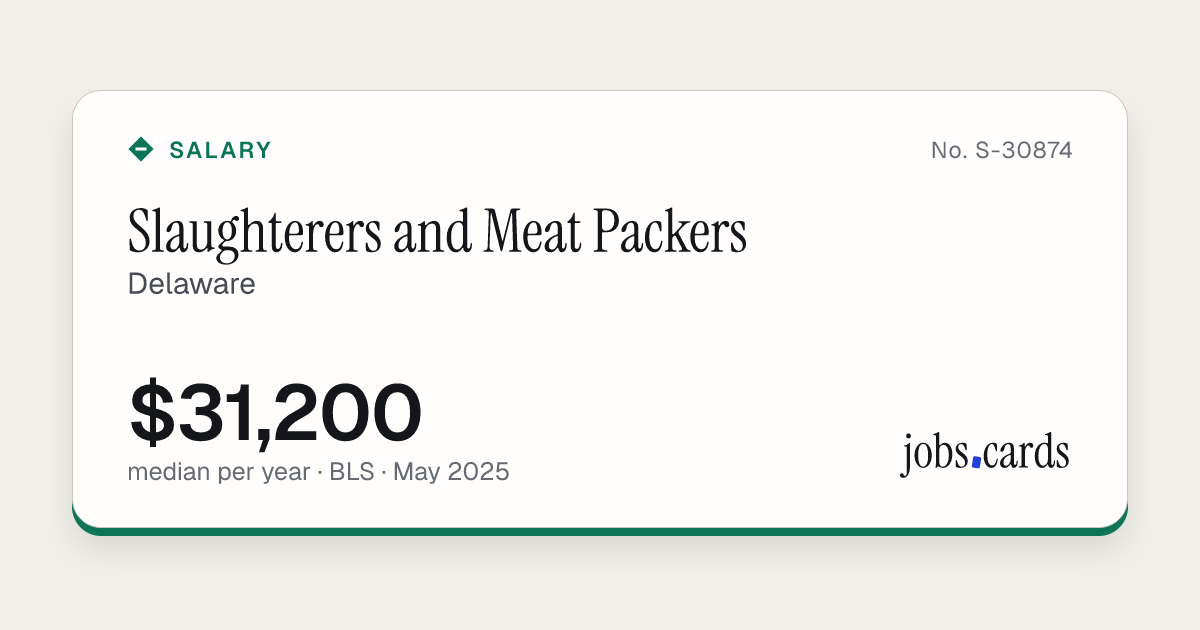
Slaughterers and Meat Packers in Delaware earn a median of $31,200 a year, according to the U.S. Bureau of Labor Statistics survey for May 2025. Half earn between $31,200 and $31,200. The lowest-paid tenth earn under $31,200 and the highest-paid tenth earn over $31,910. These are government survey figures, not estimates from ads.
Checked Nov 16, 2026Source: U.S. Bureau of Labor Statistics
Reading the Numbers
Worked out from the published figures on this card. Nothing here is an estimate.
The median here is 22% below the national median of $40,130 for the same job.
50 people hold this job here, less than 0.1% of the 69,950 who hold it across the country.
Of every 1,000 jobs here, 0.11 are this job, which makes it 75% less common here than in the U.S. as a whole.
The middle half of workers earn between $31,200 and $31,200, a band $0 wide.
Pay at the 90th percentile ($31,910) is 1.0 times pay at the 10th ($31,200).
The average (mean) is $31,620, within 3% of the median, so pay is spread fairly evenly around the middle.
By the hour, the published median is $15.00.
Delaware has enacted a law that will require pay in job ads from Sep 26, 2027. What Delaware’s rule says
What Slaughterers and Meat Packers Do
Perform nonroutine or precision functions involving the preparation of large portions of meat. Work may include specialized slaughtering tasks, cutting standard or premium cuts of meat for marketing, making sausage, or wrapping meats. Work typically occurs in slaughtering, meat packing, or wholesale establishments.
Common job titles: Boning Room Worker, Meat Packager, Meat Packer, Meat Processor, Meat Wrapper, Saw Man, Side Puller, Wrapper.
What the Work Involves
The five tasks that workers and experts surveyed by O*NET rate most important for this job, most important first.
Remove bones, and cut meat into standard cuts in preparation for marketing.
Sever jugular veins to drain blood and facilitate slaughtering.
Tend assembly lines, performing a few of the many cuts needed to process a carcass.
Shackle hind legs of animals to raise them for slaughtering or skinning.
Slit open, eviscerate, and trim carcasses of slaughtered animals.
Education. 61% of workers surveyed by O*NET said the level required for this job is: High School Diploma or the equivalent.
Preparation This Job Usually Needs
Job Zone 1-2: Very Little to Some Preparation Needed. Usually requires a high school diploma or GED, though some occupations may not. Ranges from a few days to one year of on-the-job training. Some occupations may need little or no previous experience; others require several months to a year of experience. For example, landscaping and groundskeeping workers might require very little training or previous experience, while agricultural equipment operators can benefit from on-the job training.
This page includes information from the O*NET 31.0 Database by the U.S. Department of Labor, Employment and Training Administration (USDOL/ETA). Used under the CC BY 4.0 license. O*NET® is a trademark of USDOL/ETA.