We show the government's numbers as published. Yearly pay is the hourly figure times 2,080 hours. Nothing is modelled or guessed. The U.S. comparison uses the national median for the same job code.
This page includes information from the O*NET 31.0 Database by the U.S. Department of Labor, Employment and Training Administration (USDOL/ETA). Used under the CC BY 4.0 license. O*NET® is a trademark of USDOL/ETA.
Content hash d9399f29 · first dealt Nov 16, 2026 · last changed Nov 16, 2026
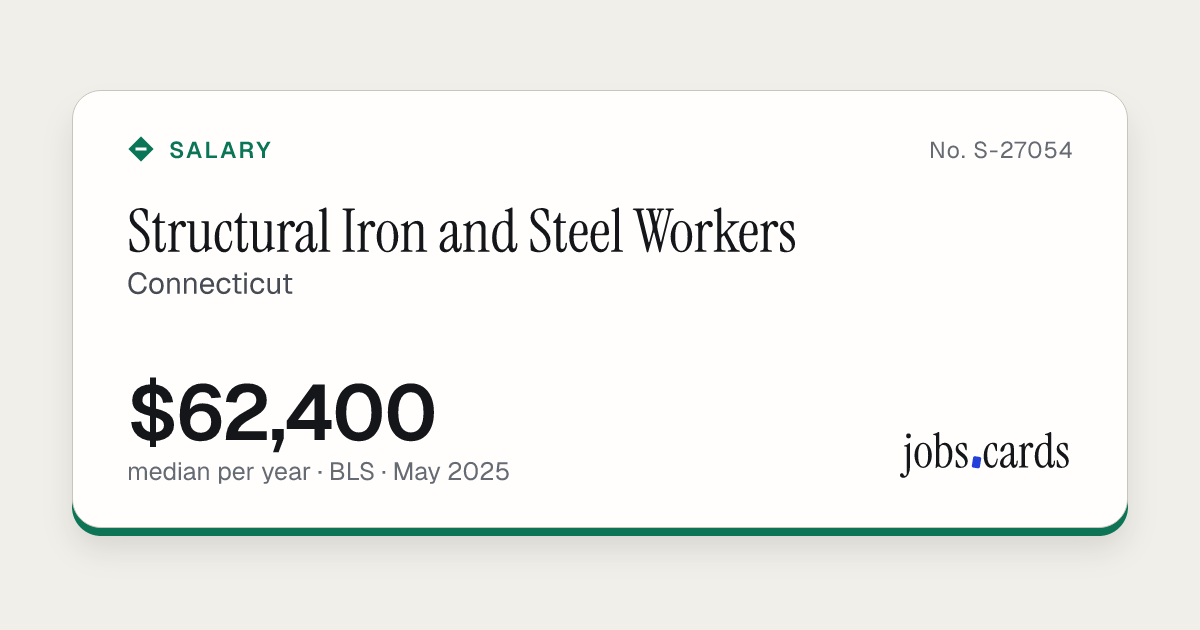
Structural Iron and Steel Workers in Connecticut earn a median of $62,400 a year, according to the U.S. Bureau of Labor Statistics survey for May 2025. Half earn between $50,210 and $87,960. The lowest-paid tenth earn under $47,810 and the highest-paid tenth earn over $97,760. These are government survey figures, not estimates from ads.
Checked Nov 16, 2026Source: U.S. Bureau of Labor Statistics
Reading the Numbers
Worked out from the published figures on this card. Nothing here is an estimate.
The median here is 1% below the national median of $62,780 for the same job.
Among the 32 states and territories where the Bureau of Labor Statistics publishes a reliable median for this job, Connecticut ranks 18th by median pay. New Jersey is highest at $113,220 and Arkansas lowest at $45,510.
330 people hold this job here, 0.5% of the 68,380 who hold it across the country.
Of every 1,000 jobs here, 0.2 are this job, which makes it 56% less common here than in the U.S. as a whole.
The middle half of workers earn between $50,210 and $87,960, a band $37,750 wide.
Pay at the 90th percentile ($97,760) is 2.0 times pay at the 10th ($47,810).
The average (mean) is $68,500, 10% above the median. An average above the median means a smaller group of high earners pulls it up.
Raise, place, and unite iron or steel girders, columns, and other structural members to form completed structures or structural frameworks. May erect metal storage tanks and assemble prefabricated metal buildings.
Common job titles: Field Iron Worker, Iron Worker, Ironworker, Steel Erector, Steel Fabricator, Steel Worker, Structural Erector, Structural Steel Erector, Tower Hand, Union Ironworker.
What the Work Involves
The five tasks that workers and experts surveyed by O*NET rate most important for this job, most important first.
Read specifications or blueprints to determine the locations, quantities, or sizes of materials required.
Verify vertical and horizontal alignment of structural steel members, using plumb bobs, laser equipment, transits, or levels.
Erect metal or precast concrete components for structures, such as buildings, bridges, dams, towers, storage tanks, fences, or highway guard rails.
Bolt aligned structural steel members in position for permanent riveting, bolting, or welding into place.
Assemble or inspect hoisting equipment or rigging, such as cables, pulleys, or hooks, to move heavy equipment or materials.
Preparation This Job Usually Needs
Job Zone 1-2: Very Little to Some Preparation Needed. Usually requires a high school diploma or GED, though some occupations may not. Ranges from a few days to one year of on-the-job training. Some occupations may need little or no previous experience; others require several months to a year of experience. For example, landscaping and groundskeeping workers might require very little training or previous experience, while agricultural equipment operators can benefit from on-the job training.
This page includes information from the O*NET 31.0 Database by the U.S. Department of Labor, Employment and Training Administration (USDOL/ETA). Used under the CC BY 4.0 license. O*NET® is a trademark of USDOL/ETA.