Search job, employer or placeSearch cards/Check an Offer
SalaryNo.S-35305

Subway and Streetcar Operators

New JerseyGovernment job code 53-4041

Market pay · all workers · BLS, May 2025

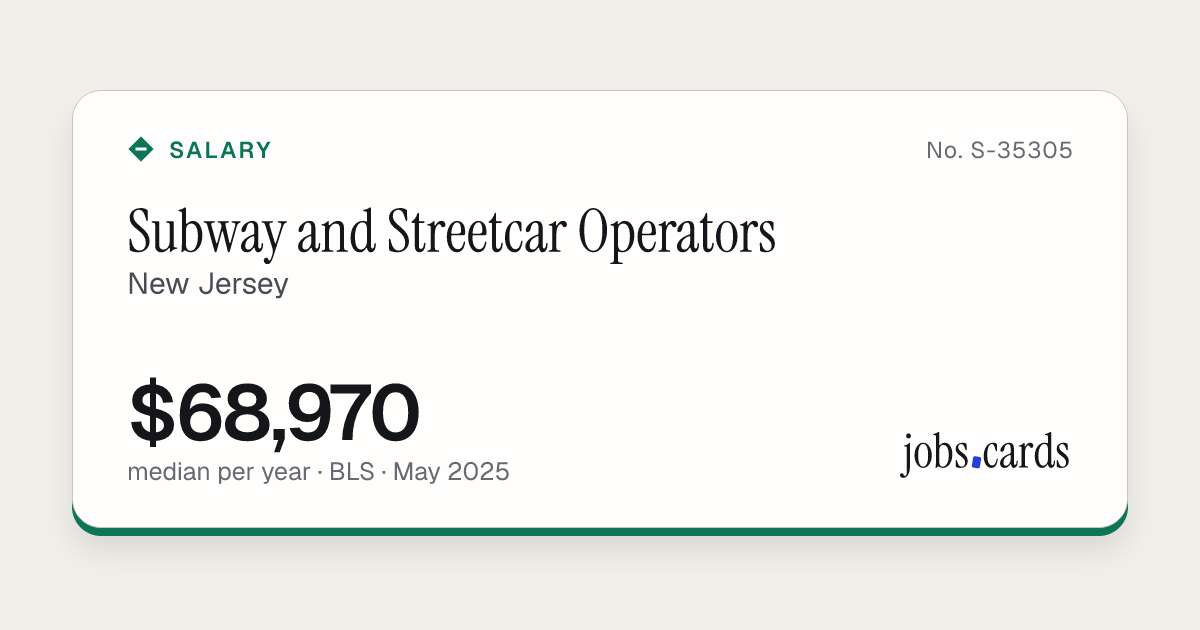
$68,970median pay per year · $33.16 an hour
10th
$65,600
25th
$65,630
Median
$68,970
75th
$73,550
90th
$74,640

Small sample: BLS marks this estimate as less reliable, so treat the figures with care.

Government wage levels

Wage levels are set for each local area. Open a metro card for this job to see them.

Filed pay

Fewer than 10 certified full-time filings for this job here, so there is no filed-pay figure.

People in this job here
140
Against the U.S. median
−20%
Mean pay per year
$70,650
Source: U.S. Bureau of Labor Statistics, May 2025 data · checked Nov 16, 2026
SourcesNo.S-35305

Where This Card Comes From

We show the government's numbers as published. Yearly pay is the hourly figure times 2,080 hours. Nothing is modelled or guessed. The U.S. comparison uses the national median for the same job code.

This page includes information from the O*NET 31.0 Database by the U.S. Department of Labor, Employment and Training Administration (USDOL/ETA). Used under the CC BY 4.0 license. O*NET® is a trademark of USDOL/ETA.

Content hash 5210f4a6 · first dealt Nov 16, 2026 · last changed Nov 16, 2026
Save as Image Compare

jobs.cards/c/S-35305

What Does This Job Pay in New Jersey?

Subway and Streetcar Operators in New Jersey earn a median of $68,970 a year, according to the U.S. Bureau of Labor Statistics survey for May 2025. Half earn between $65,630 and $73,550. The lowest-paid tenth earn under $65,600 and the highest-paid tenth earn over $74,640. These are government survey figures, not estimates from ads.

Checked Nov 16, 2026Source: U.S. Bureau of Labor Statistics

Reading the Numbers

Worked out from the published figures on this card. Nothing here is an estimate.

  • The median here is 20% below the national median of $86,380 for the same job.
  • 140 people hold this job here, 1.4% of the 10,200 who hold it across the country.
  • Of every 1,000 jobs here, 0.033 are this job, which makes it 50% less common here than in the U.S. as a whole.
  • The middle half of workers earn between $65,630 and $73,550, a band $7,920 wide.
  • Pay at the 90th percentile ($74,640) is 1.1 times pay at the 10th ($65,600).
  • The average (mean) is $70,650, within 3% of the median, so pay is spread fairly evenly around the middle.
  • By the hour, the published median is $33.16.

New Jersey requires pay or a pay range in job ads from covered employers. What New Jersey’s rule says

What Subway and Streetcar Operators Do

Operate subway or elevated suburban trains with no separate locomotive, or electric-powered streetcar, to transport passengers. May handle fares.

Common job titles: Combined Rail Operator, Light Rail Operator, Light Rail Train Operator, Light Rail Vehicle Operator (LRV Operator), Rail Operator, Rapid Transit Operator (RTO), Streetcar Operator, Train Operator, Transit Operator, Trolley Operator.

What the Work Involves

The five tasks that workers and experts surveyed by O*NET rate most important for this job, most important first.

  • Monitor lights indicating obstructions or other trains ahead and watch for car and truck traffic at crossings to stay alert to potential hazards.
  • Operate controls to open and close transit vehicle doors.
  • Drive and control rail-guided public transportation, such as subways, elevated trains, and electric-powered streetcars, trams, or trolleys, to transport passengers.
  • Report delays, mechanical problems, and emergencies to supervisors or dispatchers, using radios.
  • Regulate vehicle speed and the time spent at each stop to maintain schedules.

Education. 87% of workers surveyed by O*NET said the level required for this job is: High School Diploma or the equivalent.

Preparation This Job Usually Needs

Job Zone 1-2: Very Little to Some Preparation Needed. Usually requires a high school diploma or GED, though some occupations may not. Ranges from a few days to one year of on-the-job training. Some occupations may need little or no previous experience; others require several months to a year of experience. For example, landscaping and groundskeeping workers might require very little training or previous experience, while agricultural equipment operators can benefit from on-the job training.

This page includes information from the O*NET 31.0 Database by the U.S. Department of Labor, Employment and Training Administration (USDOL/ETA). Used under the CC BY 4.0 license. O*NET® is a trademark of USDOL/ETA.

Embed This Card

Paste this where you want the card to appear. It stays up to date.