We show the government's numbers as published. Yearly pay is the hourly figure times 2,080 hours. Nothing is modelled or guessed. The U.S. comparison uses the national median for the same job code.
This page includes information from the O*NET 31.0 Database by the U.S. Department of Labor, Employment and Training Administration (USDOL/ETA). Used under the CC BY 4.0 license. O*NET® is a trademark of USDOL/ETA.
Content hash 438089a6 · first dealt Nov 16, 2026 · last changed Nov 16, 2026
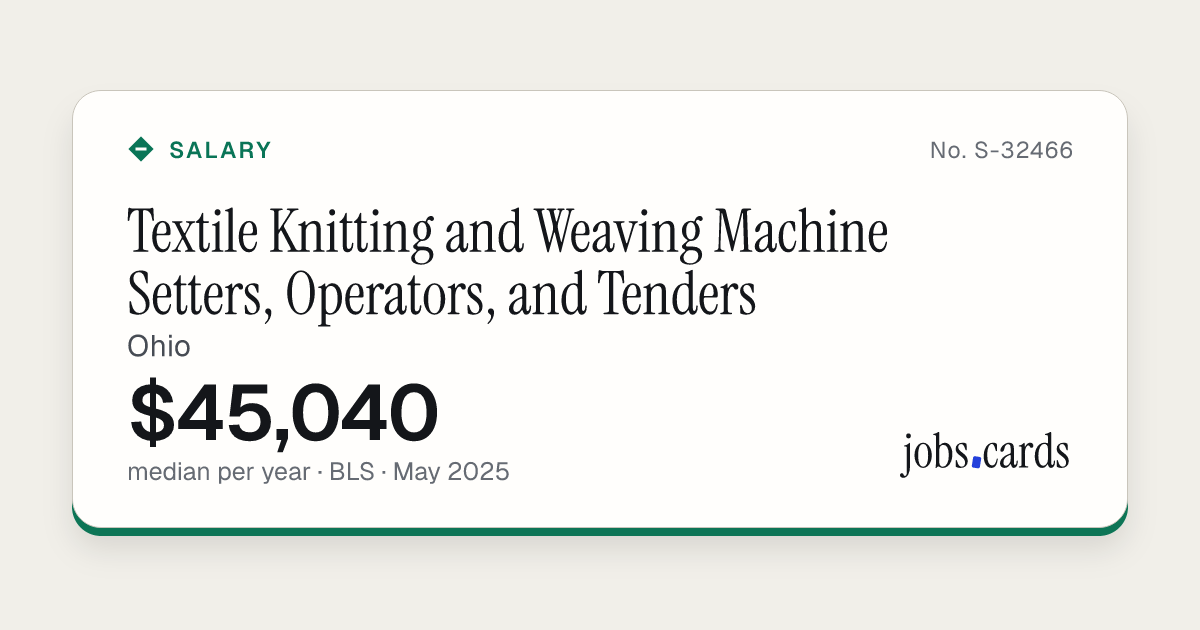
Textile Knitting and Weaving Machine Setters, Operators, and Tenders in Ohio earn a median of $45,040 a year, according to the U.S. Bureau of Labor Statistics survey for May 2025. Half earn between $38,290 and $60,510. The lowest-paid tenth earn under $37,600 and the highest-paid tenth earn over $62,750. These are government survey figures, not estimates from ads.
Checked Nov 16, 2026Source: U.S. Bureau of Labor Statistics
Reading the Numbers
Worked out from the published figures on this card. Nothing here is an estimate.
The median here is 14% above the national median of $39,530 for the same job.
60 people hold this job here, 0.5% of the 13,030 who hold it across the country.
Of every 1,000 jobs here, 0.011 are this job, which makes it 87% less common here than in the U.S. as a whole.
The middle half of workers earn between $38,290 and $60,510, a band $22,220 wide.
Pay at the 90th percentile ($62,750) is 1.7 times pay at the 10th ($37,600).
The average (mean) is $49,800, 11% above the median. An average above the median means a smaller group of high earners pulls it up.
By the hour, the published median is $21.65.
Ohio has no statewide pay-range law, but Cleveland and Columbus have city rules. What Ohio’s rule says
What Textile Knitting and Weaving Machine Setters, Operators, and Tenders Do
Set up, operate, or tend machines that knit, loop, weave, or draw in textiles.
The five tasks that workers and experts surveyed by O*NET rate most important for this job, most important first.
Observe woven cloth to detect weaving defects.
Thread yarn, thread, and fabric through guides, needles, and rollers of machines for weaving, knitting, or other processing.
Remove defects in cloth by cutting and pulling out filling.
Examine looms to determine causes of loom stoppage, such as warp filling, harness breaks, or mechanical defects.
Inspect products to ensure that specifications are met and to determine if machines need adjustment.
Education. 95% of workers surveyed by O*NET said the level required for this job is: High School Diploma or the equivalent.
Preparation This Job Usually Needs
Job Zone 1-2: Very Little to Some Preparation Needed. Usually requires a high school diploma or GED, though some occupations may not. Ranges from a few days to one year of on-the-job training. Some occupations may need little or no previous experience; others require several months to a year of experience. For example, landscaping and groundskeeping workers might require very little training or previous experience, while agricultural equipment operators can benefit from on-the job training.
This page includes information from the O*NET 31.0 Database by the U.S. Department of Labor, Employment and Training Administration (USDOL/ETA). Used under the CC BY 4.0 license. O*NET® is a trademark of USDOL/ETA.