Search job, employer or placeSearch cards/Check an Offer
SalaryNo.S-103631

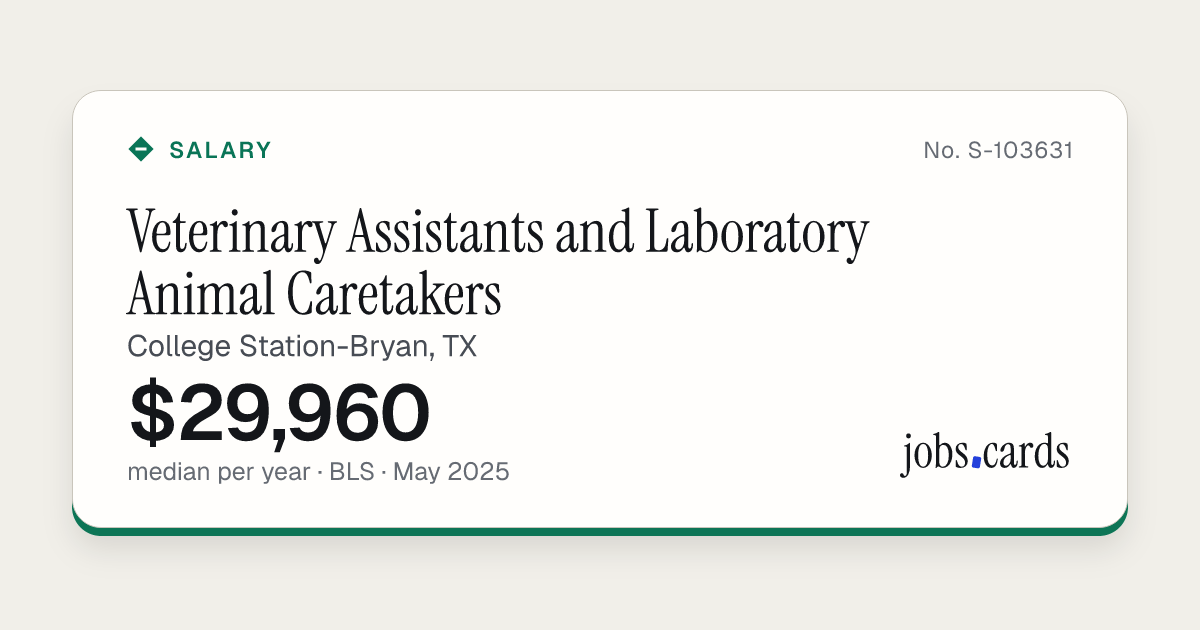
Veterinary Assistants and Laboratory Animal Caretakers

College Station-Bryan, TXGovernment job code 31-9096

Market pay · all workers · BLS, May 2025

$29,960median pay per year · $14.40 an hour
10th
$23,880
25th
$23,880
Median
$29,960
75th
$30,660
90th
$38,550

Government wage levels · wage year 2026-27

Level I
$22,922
Level II
$25,792
Level III
$28,662
Level IV
$31,533

The four pay levels the Department of Labor sets for this job in College Station-Bryan, TX. Yearly figures are the hourly level times 2,080 hours.

Filed pay

Fewer than 10 certified full-time filings for this job here, so there is no filed-pay figure.

People in this job here
410
Against the U.S. median
−21%
Mean pay per year
$28,690
Source: U.S. Bureau of Labor Statistics, May 2025 data · checked Nov 16, 2026
SourcesNo.S-103631

Where This Card Comes From

We show the government's numbers as published. Yearly pay is the hourly figure times 2,080 hours. Nothing is modelled or guessed. The U.S. comparison uses the national median for the same job code.

This page includes information from the O*NET 31.0 Database by the U.S. Department of Labor, Employment and Training Administration (USDOL/ETA). Used under the CC BY 4.0 license. O*NET® is a trademark of USDOL/ETA.

Content hash f7d47f42 · first dealt Nov 16, 2026 · last changed Nov 16, 2026
Save as Image Compare

jobs.cards/c/S-103631

What Does This Job Pay in College Station-Bryan, TX?

Veterinary Assistants and Laboratory Animal Caretakers in College Station-Bryan, TX earn a median of $29,960 a year, according to the U.S. Bureau of Labor Statistics survey for May 2025. Half earn between $23,880 and $30,660. The lowest-paid tenth earn under $23,880 and the highest-paid tenth earn over $38,550. These are government survey figures, not estimates from ads.

Checked Nov 16, 2026Source: U.S. Bureau of Labor Statistics

Reading the Numbers

Worked out from the published figures on this card. Nothing here is an estimate.

  • The median here is 21% below the national median of $38,150 for the same job.
  • It is 14% below the Texas median of $34,850.
  • 410 people hold this job here, 0.3% of the 126,580 who hold it across the country.
  • Of every 1,000 jobs here, 3.07 are this job, which makes it 3.8 times as common here as in the U.S. as a whole.
  • The middle half of workers earn between $23,880 and $30,660, a band $6,780 wide.
  • Pay at the 90th percentile ($38,550) is 1.6 times pay at the 10th ($23,880).
  • The average (mean) is $28,690, 4% below the median, so more of the spread lies on the low side.
  • By the hour, the published median is $14.40.
  • The market median of $29,960 meets government wage Level III for this job and area (wage year 2026-27).

What Veterinary Assistants and Laboratory Animal Caretakers Do

Feed, water, and examine pets and other nonfarm animals for signs of illness, disease, or injury in laboratories and animal hospitals and clinics. Clean and disinfect cages and work areas, and sterilize laboratory and surgical equipment. May provide routine postoperative care, administer medication orally or topically, or prepare samples for laboratory examination under the supervision of veterinary or laboratory animal technologists or technicians, veterinarians, or scientists.

Common job titles: Animal Care Provider, Animal Caregiver, Avian Keeper, Certified Veterinary Assistant, Emergency Veterinary Assistant, Inpatient Technician Assistant, Kennel Vet Assistant (Kennel Veterinary Assistant), Research Animal Attendant, Small Animal Caretaker, Veterinarian Assistant (Vet Assistant).

What the Work Involves

The five tasks that workers and experts surveyed by O*NET rate most important for this job, most important first.

  • Hold or restrain animals during veterinary procedures.
  • Monitor animals recovering from surgery and notify veterinarians of any unusual changes or symptoms.
  • Administer anesthetics during surgery and monitor the effects on animals.
  • Fill medication prescriptions.
  • Clean and maintain kennels, animal holding areas, examination or operating rooms, or animal loading or unloading facilities to control the spread of disease.

Education. 78% of workers surveyed by O*NET said the level required for this job is: High School Diploma or the equivalent.

Preparation This Job Usually Needs

Job Zone 1-2: Very Little to Some Preparation Needed. Usually requires a high school diploma or GED, though some occupations may not. Ranges from a few days to one year of on-the-job training. Some occupations may need little or no previous experience; others require several months to a year of experience. For example, landscaping and groundskeeping workers might require very little training or previous experience, while agricultural equipment operators can benefit from on-the job training.

This page includes information from the O*NET 31.0 Database by the U.S. Department of Labor, Employment and Training Administration (USDOL/ETA). Used under the CC BY 4.0 license. O*NET® is a trademark of USDOL/ETA.

Embed This Card

Paste this where you want the card to appear. It stays up to date.