We show the government's numbers as published. Yearly pay is the hourly figure times 2,080 hours. Nothing is modelled or guessed. The U.S. comparison uses the national median for the same job code.
This page includes information from the O*NET 31.0 Database by the U.S. Department of Labor, Employment and Training Administration (USDOL/ETA). Used under the CC BY 4.0 license. O*NET® is a trademark of USDOL/ETA.
Content hash adf3a256 · first dealt Nov 16, 2026 · last changed Nov 16, 2026
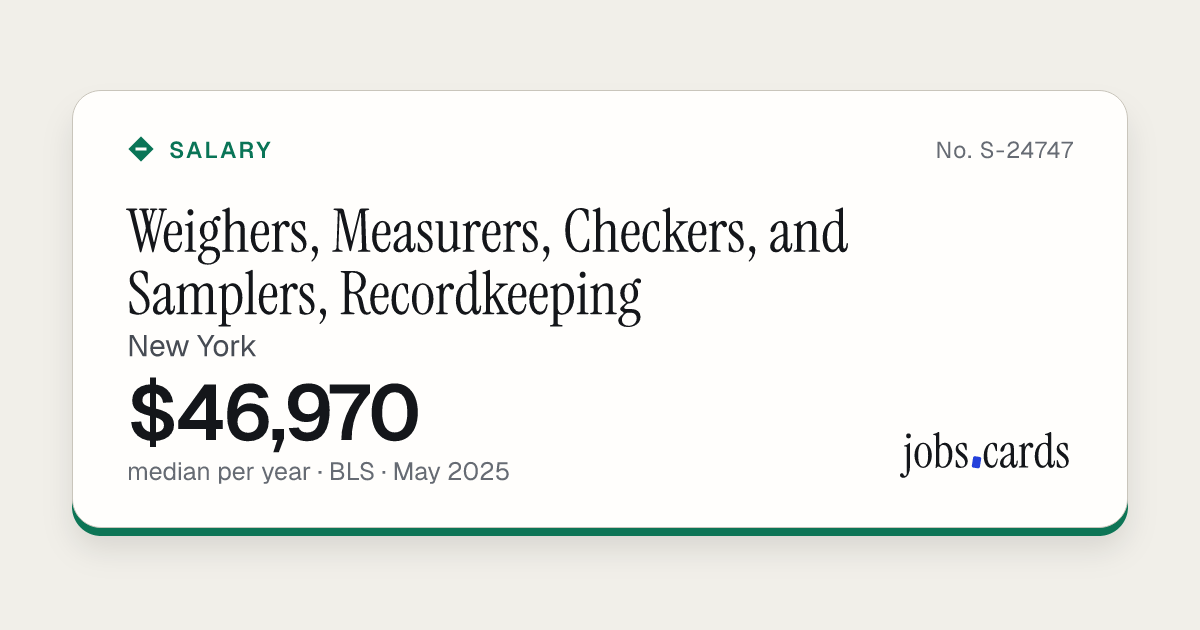
Weighers, Measurers, Checkers, and Samplers, Recordkeeping in New York earn a median of $46,970 a year, according to the U.S. Bureau of Labor Statistics survey for May 2025. Half earn between $39,530 and $56,700. The lowest-paid tenth earn under $34,880 and the highest-paid tenth earn over $67,960. These are government survey figures, not estimates from ads.
Checked Nov 16, 2026Source: U.S. Bureau of Labor Statistics
Reading the Numbers
Worked out from the published figures on this card. Nothing here is an estimate.
The median here is 1% above the national median of $46,380 for the same job.
Among the 37 states and territories where the Bureau of Labor Statistics publishes a reliable median for this job, New York ranks 14th by median pay. Indiana is highest at $57,210 and West Virginia lowest at $31,210.
2,240 people hold this job here, 4.2% of the 53,300 who hold it across the country.
Of every 1,000 jobs here, 0.23 are this job, which makes it 32% less common here than in the U.S. as a whole.
The middle half of workers earn between $39,530 and $56,700, a band $17,170 wide.
Pay at the 90th percentile ($67,960) is 1.9 times pay at the 10th ($34,880).
The average (mean) is $49,220, 5% above the median. An average above the median means a smaller group of high earners pulls it up.
What Weighers, Measurers, Checkers, and Samplers, Recordkeeping Do
Weigh, measure, and check materials, supplies, and equipment for the purpose of keeping relevant records. Duties are primarily clerical by nature. Includes workers who collect and keep record of samples of products or materials.
Common job titles: Cycle Counter, Fluid Operator, Inventory Specialist, Quality Assurance Inspector (QA Inspector), Scale Operator, Supply Clerk, Temperature Taker.
What the Work Involves
The five tasks that workers and experts surveyed by O*NET rate most important for this job, most important first.
Compare product labels, tags, or tickets, shipping manifests, purchase orders, and bills of lading to verify accuracy of shipment contents, quality specifications, or weights.
Document quantity, quality, type, weight, test result data, and value of materials or products to maintain shipping, receiving, and production records and files.
Weigh or measure materials, equipment, or products to maintain relevant records, using volume meters, scales, rules, or calipers.
Collect or prepare measurement, weight, or identification labels and attach them to products.
Remove from stock products or loads not meeting quality standards, and notify supervisors or appropriate departments of discrepancies or shortages.
Education. 50% of workers surveyed by O*NET said the level required for this job is: High School Diploma or the equivalent.
Preparation This Job Usually Needs
Job Zone 1-2: Very Little to Some Preparation Needed. Usually requires a high school diploma or GED, though some occupations may not. Ranges from a few days to one year of on-the-job training. Some occupations may need little or no previous experience; others require several months to a year of experience. For example, landscaping and groundskeeping workers might require very little training or previous experience, while agricultural equipment operators can benefit from on-the job training.
This page includes information from the O*NET 31.0 Database by the U.S. Department of Labor, Employment and Training Administration (USDOL/ETA). Used under the CC BY 4.0 license. O*NET® is a trademark of USDOL/ETA.