We show the government's numbers as published. Yearly pay is the hourly figure times 2,080 hours. Nothing is modelled or guessed. The U.S. comparison uses the national median for the same job code.
This page includes information from the O*NET 31.0 Database by the U.S. Department of Labor, Employment and Training Administration (USDOL/ETA). Used under the CC BY 4.0 license. O*NET® is a trademark of USDOL/ETA.
Content hash 1fb09c58 · first dealt Nov 16, 2026 · last changed Nov 16, 2026
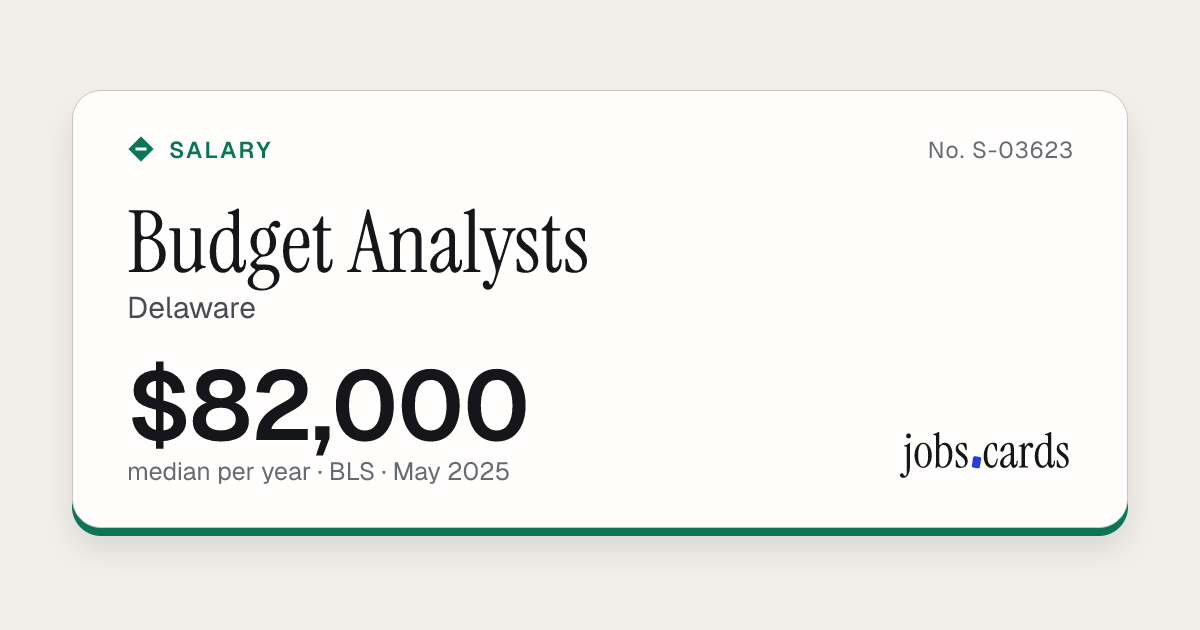
Budget Analysts in Delaware earn a median of $82,000 a year, according to the U.S. Bureau of Labor Statistics survey for May 2025. Half earn between $77,570 and $102,520. The lowest-paid tenth earn under $65,980 and the highest-paid tenth earn over $122,260. These are government survey figures, not estimates from ads.
Checked Nov 16, 2026Source: U.S. Bureau of Labor Statistics
Reading the Numbers
Worked out from the published figures on this card. Nothing here is an estimate.
The median here is 11% below the national median of $91,640 for the same job.
260 people hold this job here, 0.6% of the 47,160 who hold it across the country.
Of every 1,000 jobs here, 0.55 are this job, which makes it 80% more common here than in the U.S. as a whole.
The middle half of workers earn between $77,570 and $102,520, a band $24,950 wide.
Pay at the 90th percentile ($122,260) is 1.9 times pay at the 10th ($65,980).
The average (mean) is $89,320, 9% above the median. An average above the median means a smaller group of high earners pulls it up.
By the hour, the published median is $39.42.
Delaware has enacted a law that will require pay in job ads from Sep 26, 2027. What Delaware’s rule says
What Budget Analysts Do
Examine budget estimates for completeness, accuracy, and conformance with procedures and regulations. Analyze budgeting and accounting reports.
The five tasks that workers and experts surveyed by O*NET rate most important for this job, most important first.
Analyze monthly department budgeting and accounting reports to maintain expenditure controls.
Provide advice and technical assistance with cost analysis, fiscal allocation, and budget preparation.
Review operating budgets to analyze trends affecting budget needs.
Compile and analyze accounting records and other data to determine the financial resources required to implement a program.
Examine budget estimates for completeness, accuracy, and conformance with procedures and regulations.
Education. 77% of workers surveyed by O*NET said the level required for this job is: Bachelor's Degree.
Preparation This Job Usually Needs
Job Zone Four: Considerable Preparation Needed. Most of these occupations require a four-year bachelor's degree, but some do not. Employees in these occupations usually need several years of work-related experience, on-the-job training, and/or vocational training. A considerable amount of work-related skill, knowledge, or experience is needed for these occupations. For example, an accountant must complete four years of college and work for several years in accounting to be considered qualified.
This page includes information from the O*NET 31.0 Database by the U.S. Department of Labor, Employment and Training Administration (USDOL/ETA). Used under the CC BY 4.0 license. O*NET® is a trademark of USDOL/ETA.