We show the government's numbers as published. Yearly pay is the hourly figure times 2,080 hours. Nothing is modelled or guessed. The U.S. comparison uses the national median for the same job code.
This page includes information from the O*NET 31.0 Database by the U.S. Department of Labor, Employment and Training Administration (USDOL/ETA). Used under the CC BY 4.0 license. O*NET® is a trademark of USDOL/ETA.
Content hash 1a34b9ec · first dealt Nov 16, 2026 · last changed Nov 16, 2026
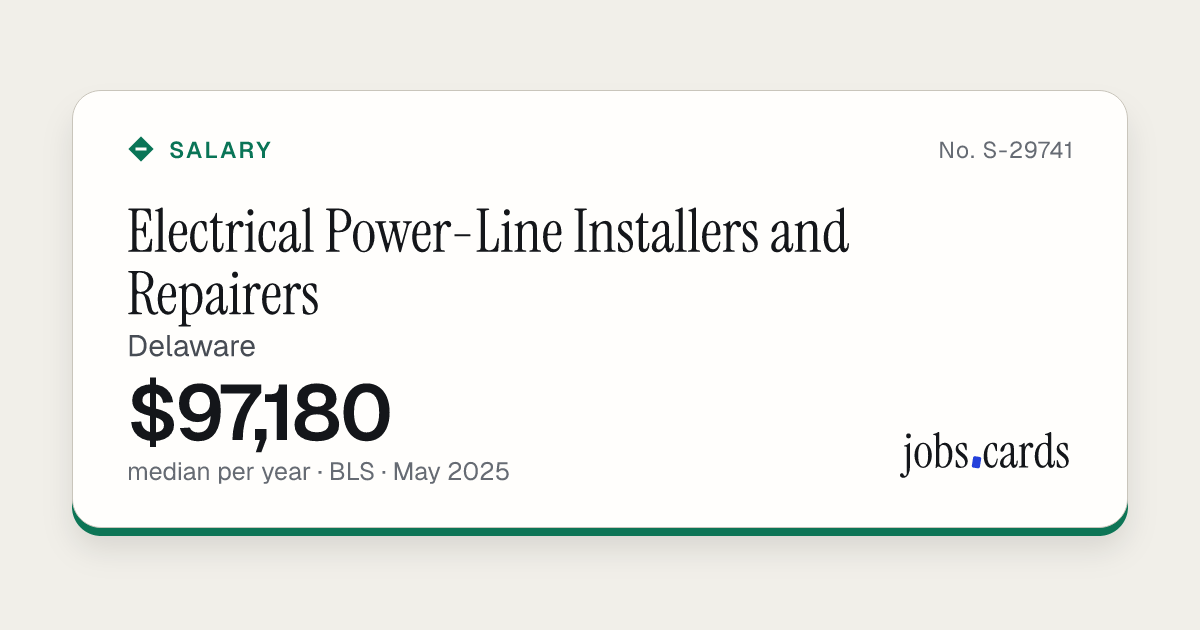
Electrical Power-Line Installers and Repairers in Delaware earn a median of $97,180 a year, according to the U.S. Bureau of Labor Statistics survey for May 2025. Half earn between $76,000 and $106,590. The lowest-paid tenth earn under $48,570 and the highest-paid tenth earn over $119,790. These are government survey figures, not estimates from ads.
Checked Nov 16, 2026Source: U.S. Bureau of Labor Statistics
Reading the Numbers
Worked out from the published figures on this card. Nothing here is an estimate.
The median here is 2% above the national median of $95,320 for the same job.
Among the 49 states and territories where the Bureau of Labor Statistics publishes a reliable median for this job, Delaware ranks 25th by median pay. Hawaii is highest at $134,340 and Arizona lowest at $75,420.
330 people hold this job here, 0.3% of the 131,070 who hold it across the country.
Of every 1,000 jobs here, 0.69 are this job, which makes it 18% less common here than in the U.S. as a whole.
The middle half of workers earn between $76,000 and $106,590, a band $30,590 wide.
Pay at the 90th percentile ($119,790) is 2.5 times pay at the 10th ($48,570).
The average (mean) is $91,660, 6% below the median, so more of the spread lies on the low side.
By the hour, the published median is $46.72.
Delaware has enacted a law that will require pay in job ads from Sep 26, 2027. What Delaware’s rule says
Where This State Ranks
Its place among 49 states and territories, by median pay for this job.
What Electrical Power-Line Installers and Repairers Do
Install or repair cables or wires used in electrical power or distribution systems. May erect poles and light or heavy duty transmission towers.
Common job titles: Class Gloving Electrical Lineman, Class Rubber Gloving Lineman, Electrical Lineman, Electrical Lineworker, Lineworker, Power Lineman, Power Lineman Technician, Service Man, Third Step Lineman, Troubleman.
What the Work Involves
The five tasks that workers and experts surveyed by O*NET rate most important for this job, most important first.
Adhere to safety practices and procedures, such as checking equipment regularly and erecting barriers around work areas.
Drive vehicles equipped with tools and materials to job sites.
Open switches or attach grounding devices to remove electrical hazards from disturbed or fallen lines or to facilitate repairs.
Climb poles or use truck-mounted buckets to access equipment.
Install, maintain, and repair electrical distribution and transmission systems, including conduits, cables, wires, and related equipment, such as transformers, circuit breakers, and switches.
Education. 50% of workers surveyed by O*NET said the level required for this job is: High School Diploma or the equivalent.
Preparation This Job Usually Needs
Job Zone 1-2: Very Little to Some Preparation Needed. Usually requires a high school diploma or GED, though some occupations may not. Ranges from a few days to one year of on-the-job training. Some occupations may need little or no previous experience; others require several months to a year of experience. For example, landscaping and groundskeeping workers might require very little training or previous experience, while agricultural equipment operators can benefit from on-the job training.
This page includes information from the O*NET 31.0 Database by the U.S. Department of Labor, Employment and Training Administration (USDOL/ETA). Used under the CC BY 4.0 license. O*NET® is a trademark of USDOL/ETA.